11 October, 2009

Vintage Sunday: The Cracker Barrel Cook Book

No, not that Cracker Barrel.

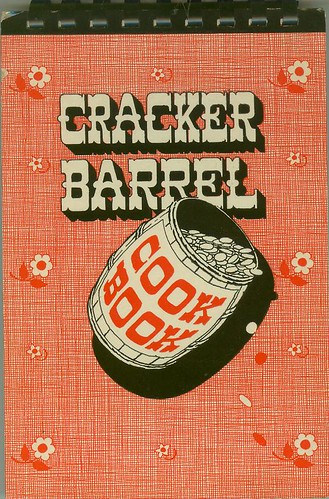
This Cracker Barrel Cook Book has nothing to do with the ubiquitous chain restaurant. It was written as a fund raiser by the Ladies' Aid of the First Congregational Church of Newbury, VT in 1957. It's one of my favorite old cookbooks - a fascinating, sometimes quaint, sometimes bizarre collection of 1950's "heavy cooking," traditional New England fare, folk medicine, and household advice.

Here's a fairly typical traditional recipe from the book. To modern eyes this may seem to be a pretty strange recipe, but you should remember that "salt pork" on a New England family farm wasn't like the thick fatty stuff we have in the supermarket today. "A chunk of fat salt pork" would likely be a relatively lean cut taken from an area between the shoulder and the belly, with a generous amount of fat included:

Salt Pork and Milk Gravy

Take a chunk of fat salt pork and slice it ¼ inch thick. Cover with cold water and bring to boil to remove excess salt. Drain the pork and dry it. Then roll it in flour and fry slowly in hot pork drippings in an iron spider, if you have one. After it has been well browned on both sides, which takes about 20 minutes, remove pork to a warm place. Empty part of the drippings, leaving enough to make gravy. Add flour and stir, cooking until paste is brown, then add hot milk and stir smooth. Use ¼ cup pork drippings, ¼ cup flour, and ½ teaspoon salt to 1 pint of milk for a family of four.

"Spider" is a New England term for a cast-iron frying pan. Once upon a time, when lots of cooking was done over the embers in the kitchen fireplace, cast-iron skillets often were made with long legs that would hold the pan above the embers. I guess they bore enough of a resemblance to a spider that the nickname stuck. You can still buy leggy spiders today for outdoor and campfire cooking. The example on the right is available to order from Curt's Blacksmith Shop in Middlebury, Indiana.

.

10 October, 2009

Tasting The Famous Canned Cheeseburger

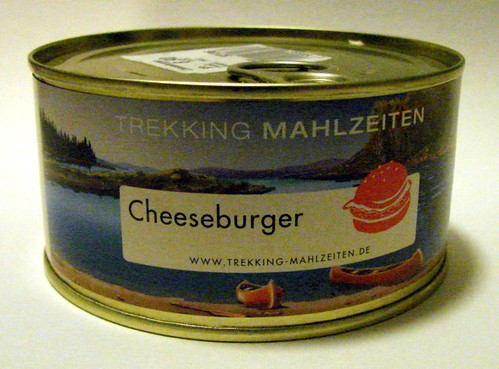
I first read about the Trek'n Eat Cheeseburger in a Can in 2004, and was instantly fascinated. Unfortunately, it's not sold in the United States, and the German company that produces them does not ship outside Europe.

Recently, however, my sister-in-law visited friends in Switzerland and came home with a special treat for me: a canned cheeseburger!!

Americans love their cheeseburgers. It is no wonder that this canned version - impossible for the ordinary burger aficionado to obtain - has achieved some sort of mythic status among American bloggers. Besides, if it were possible to equip your Zombie Apocalypse Shelter with non-perishable burgers, wouldn't you prefer them to MREs, sardines, and powdered milk? You bet you would. Let me tell you, though: the fact that Trek'n Eat doesn't distribute these things in the US is a gift to America. Canned cheeseburgers are foul. Think of the worst "convenience meal" you've ever had - even the Banquet Cheesy Smothered Meat Patty Meal - and the canned cheeseburger completely surpasses it for nastiness.

Opening the can revealed that the top bun, studded with sesame seeds, completely filled the diameter of the can. We gave it a sniff, but there wan't much aroma. Lynnafred poked at the bun a bit and found it to be surprisingly fresh and rather spongy, and not kind of dried and "day-oldish" as we thought it might have been.

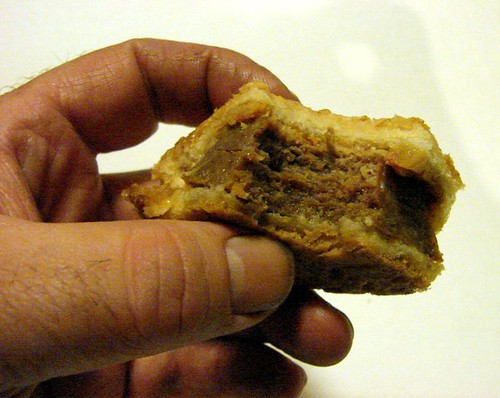
Once out of the can, though, the burger was much more like you would have expected a canned cheeseburger to be: small, kind of flat, almost sullen-looking (if a burger could be said to look sullen.) The meat and cheese and whatever else might have been between the buns were invisible, because the bun was large enough to have encased the entire structure all around. We found that intriguing, and I tried to peel back the buns to reveal some of the burgery secrets that might have been contained within. Alas, the bread and cheese had more or less fused together during processing and it was difficult to lift the top bun without having it delaminate into crumbs. I settled for cross-sectioning it with a kitchen knife instead.

I cut the burger first in half to examine the components, then into smaller wedges so that my wife Maryanne, daughtger Lynnafred, and friend Michael could all have a piece. I could not have had a less appetizing-looking item in my hand if I were gripping a cat turd.

The meat patties - yes, there were two of them, stacked atop one another though sligltly offset - were greyish brown, coarse and gritty, with visible bits of...something...studded in there. The cheese had kind of seeped into the pores of the bun like a strange sort of dairy-based plastic sealant. I took a bite, and chewed...

...and spit it out. The meat was disgusting - it was like slices of horribly malseasoned, overcooked, adulterated sausage, at once pasty and grainy and rubbery. It tasted nothing like any type of beef (or even beef substitute) I'd ever had. It is beyond belief that whoever developed this horrid simulacrum of a burger has ever tasted a real cheeseburger. I can't imagine that they've even seen a real cheeseburger, though the possibility that they might have glimpsed a grainy, low-resolution thumbnail of one, from a distance, is plausible.

I took another bite, determined to get at least one taste down the ol' hatch. When all was said and done, the four of us had reluctantly managed to eat a little less than half of the cheeseburger between us. It must be said, though, that Zim thoroughly enjoyed the leftovers.

So. I have eaten a canned cheeseburger. An experience which no one will ever be able to take from me - as well as one I wish never to repeat again. I owe my sister-in-law bigtime favors for this one.

How about a closeup? I promise it was even worse in person.

Link:

Trek'n Eat Cheeseburger in a can website - The actual product website (English Language.) Be grateful there is no ordering link for the United States.


One last pair of pictures:

On the left, the product depicted in Trek'n Eat's catalog photo. On the right, what the actual burger looked like when it came out of the can. Not even calling that a "serving suggestion" forgives that level of bullshit.


09 October, 2009

Doritos Late Night Last Call Jalapeno Popper

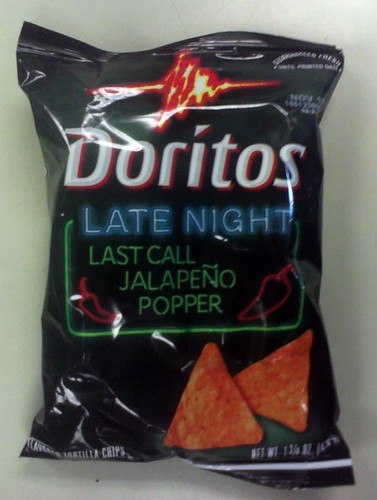
I really love spicy Doritos, and these "Jalapeno Poppers" deliver. They start out with a cheesy tang and then the heat builds in - sharp and hot and noticeable.

The spice flavor isn't quite "grassy" enough for a proper jalapeno taste, but the fire is just right so I'll forgive Frito-Lay that technical detail.

Win.

08 October, 2009

The KFC Double Down Sandwich

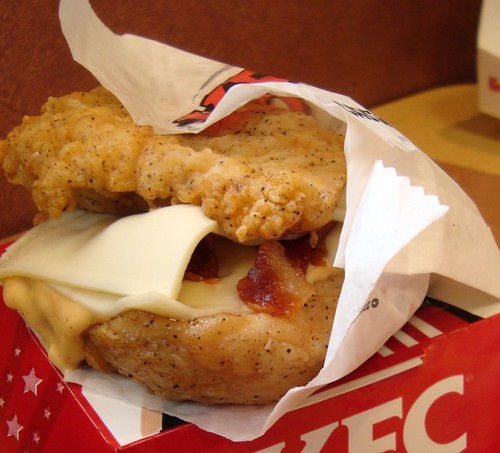
Kentucky Fried Chicken's Double Down Sandwich has been on my Grail List since the day I first read about it. It's completely unlike anything else the Colonel has ever offered: two pieces of bacon, sandwiched between two slices of cheese, dressed with sauce and served between two spicy fried chicken breast filets. Yeah, the fried chicken is the bun. How awesome is that?

KFC is offering this sandwich in two test markets right now: Omaha Nebraska and Providence Rhode Island. Providence is but a short road trip from my pleasant little town in the Connecticut River Valley, so it was an easy decision to take a drive to Rhode Island in search of a Double Down Lunch.

Lynnafred, Michael Loo and I set out in the general direction of Providence staying primarily on scenic US6. As we crossed into Rhode Island, I punched "KFC" into the Garmin and let it guide us to the first one it found in the Providence area - a combo KFC/Taco Bell at a shopping plaza in Greenville (just north of Providence.) We pulled into the parking lot and Lynnafred noticed the sign in the window: "They've got 'em - check it out."

Inside, we found that most of the diners were eating from the Taco Bell side of the menu. I scanned the menu boards, but the only mention of the Double Down was on a stand-up sign by the register. We ignored the taco chompers and ordered our Double Downs.

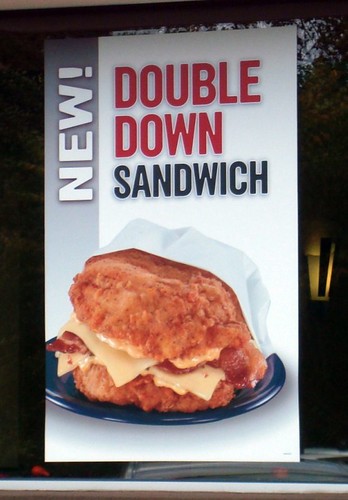
First of all, allow me to give props to KFC, for creating a sandwhich that actually looks in real life like it does on the signs. Chicken, cheese, bacon, sauce, bingo. When we took our sandwiches out of their serving boxes, they weren't substantially different from the photo illustrations. That is pretty much a first since I started writing about fast food.

Okay. So, how about those Double Downs, huh? I can't even begin to tell you how awesome they are. The chicken was perfectly done - juicy and tender, and not a bit overcooked. The coating was spicy - loaded with lots of visible black pepper - but not overwhelmingly so.

The cheese used here was two slices of standard American cheese, not the Pepper Jack and Swiss that are mentioned on some signs. But the bacon was authentic, and the Colonel's Sauce was inoffensive.

At a little under five bucks for the sandwich alone, the Double Down seems a little pricey at first glance. But this is no small snack. There is at least half a pound of chicken here (actually, it felt like a little more than that) and the chicken, bacon, and cheese flavors combine so well that none of us were dissapointed (or hungry when we left.)

I've heard that Double Downs are flying out the door at some of the test locations. I hope that KFC decides to roll these babies out nationally. They're probably the best chicken-and-bacon sandwiches I've ever had, and I'd love to get another one without having to drive all the way out to Rhode Island to get one.
.


07 October, 2009

Fishy Delights 25: Roland Canned Sprats

Roland Sprats are lightly smoked little fishies packed in soybean oil, so similar to sardines that the difference hardly matters. As canned fish go, they're very good - the smoke flavor is subtle but distinct and the fish are scaleless, tender, and quite delicious.

These probably would have been better if they were packed in olive oil, but they would have been a lot more expensive as well. (These were $1.60 at Ocean State Job Lot.)

06 October, 2009

Goodbye, Gourmet

Conde-Nast has announced the closure of Gourmet magazine, a victim of falling advertising revenue in hard economic times as well as print media's struggle to remain relevant in an increasingly digital environment.

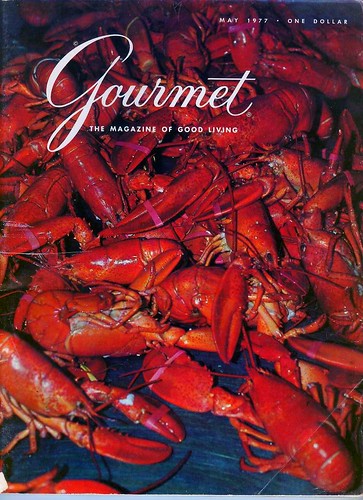
When I was a teenager learning how to cook in the early 1970's, my first influences were the Better Homes and Gardens Cookbook (the 1967 edition, still my favorite and most-recommended general-purpose cookbook,) Julia Child, and - believe it or not - Graham Kerr in his "Galloping Gourmet" days on PBS. Ha! I bet you thought I was going to say Gourmet, right? Nope. I didn't discover Gourmet until I was in my twenties, stacking magazines at the town recycling center, when I found a huge bundle of them from the 60's and 70's. I took them home just because I was fascinated by the cover photography and figured there would probably be some good stuff inside.

I was right. Gourmet was a treasure trove - travelogues, menus, recipes, cookware, essays and articles - even the ads fascinated me. It was kitchen and escapism all rolled into one, and it was written in such an easy approachable style that I sometimes wondered what was so damn special about "gourmet" cooking anyway?

Even though I thought the magazine had kind of slipped a little in recent years, I'm going to miss it. The recipes will remain accessible, online at epicurious.com, but it would be really great if Conde-Nast would digitize back issues by the decade and market the files.

.

Pickled Lamb's Tongues

NOTE: THIS BLOG POST CONTAINS A RECIPE AND TUTORIAL TO HELP YOU MAKE YOUR OWN PICKLED LAMB'S TONGUES. IT IS NOT AN OFFER TO SELL OR SHIP PICKLED LAMB'S TONGUES TO YOU. NO, I DON'T SELL PICKLED LAMB'S TONGUES. NO, I WON'T SEND YOU ANY. READ THE POST AND MAKE YOUR OWN.      

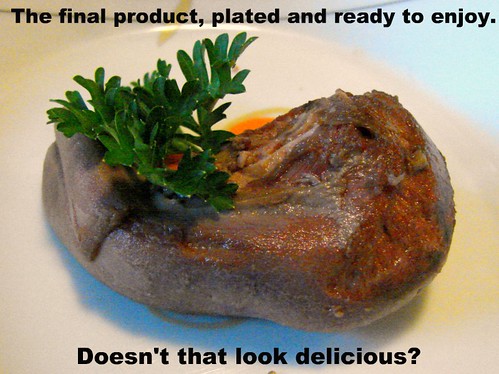
Some time ago, I used to buy jars of pickled lamb's tongues. Made by Rogers, a company that put up all sorts of pickled "tavern food" like pigs feet, ham hocks, pickled eggs, and sausages, they were tender, ready-to-eat, fully-cooked lamb's tongues, packed in a mild vinegar brine and sold in one of the local supermarkets from the chilly area right above the self-service meat case. They were delicious, but when the supermarket closed, I was no longer able to find pickled lamb tongues. I never stopped looking for them, but eventually I found that Rogers Company went out of business a few years back, a victim of changing tastes and the general decline in demand for "tavern food." Dave Fazer of Long Lake Foods believes that Rogers was the last commercial maker of pickled tongue, and my own searching leads me to agree. Apparently, the number of people who ask at their local stores and who email Mr. Fazer looking for lamb tongues just aren't enough to make commercial production viable.

It's possible, however, to make your own.

I have years of experience in canning, meat processing, and charcuterie. I make my own bacon, sausages, corned beef, patés, and more. But I had never put up any pickled meats, so I started by searching for some kind of recipe or written technique that I could study and use - or at least use as a starting point for my own recipe. I pored through my collection of vintage cookbooks and books on charcuterie and meat preservation, to no avail. And when I turned to the internet, the search was almost as frustrating - most Google hits for "pickled tongue" lead to message board postings by people trying to find the commercially prepared product.

Finally, a search on the Chowhound message board found this thread, in which Chowhound user Porker shares his recipe for pickled pork tongue. Lamb's tongue is smaller, more tender, and cooks more quickly than pork tongue, so I made a few tweaks to the recipe - including scaling it to handle the ten-pound wholesaale box of lamb's tongues my neighborhood butcher obtained for me. But without Porker's help and the groundwork he did in developing his recipe, this recipe wouldn't have been such a success.


So, follow along with this step-by-step photo tutorial.

Step One: Curing

Because the tongues are going to be canned for storage, they need to be cured to help prevent botulism (the combination of curing, the acidic vinegar pickle, and refrigeration keeps the pickled tongue safe to eat.) Normally, curing with Instacure #1 (formerly known as Prague Powder #1 or "pink salt") requires about 1 ounce for every 30 pounds of meat, but because we'll be using a simple overnight liquid brine, we need a stronger concentration.

Make as much brine as needed to completely cover the tongues using this baseline:

12 cups of water
1 cup of pickling or kosher salt
6 tablespoons Instacure #1

For the ten-pound batch of tongues I prepared, I needed 3 batches of this brine (2½ gallons.)

Mix the ingredients for the brine in a stainless steel (non-reactive) pot. Wash the tongues under cool running water. Place them in the pot, bring just to a boil on high heat, then remove from heat, allow to cool to room temperature, and store overnight in the liquid.

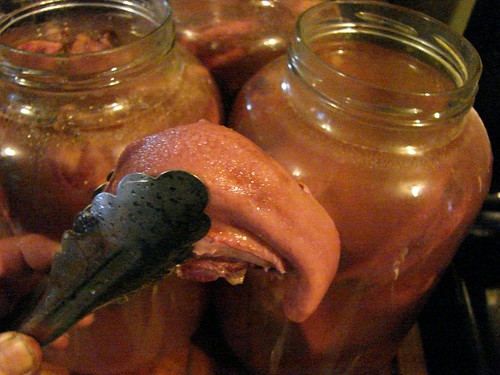
Because I was processing ten pounds of meat I had to do this step in a 21-quart stockpot which would not fit in my fridge. So, when the tongues had cooled down enough to handle, I divided them between three one-gallon glass jars and filled the jars to the top with the still-warm curing brine. Then, off they went into the fridge for their overnight soak.


Step Two: Cooking


The next day, drain off the curing brine and discard it, and rinse the tongues.

Make up a batch of cooking brine using this baseline:

3 cups of water
1 cup of vinegar
1 tablespoon of salt
1 tablespoon of pickling spice

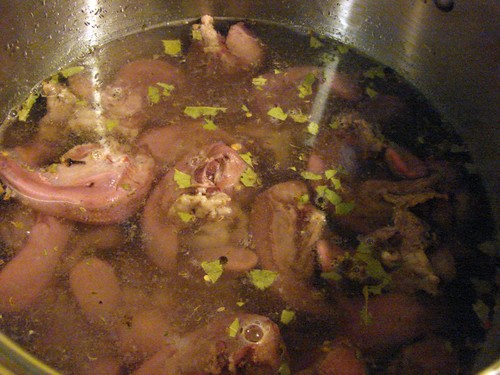
As before, make up as many batches as you will need to cover the tongues in the pot. Bring up to a boil, then turn down the heat and simmer the tongues gently for two hours, until they are fork-tender. Drain the cooked tongues and shock them under cold running water. You'll notice that the tongues are covered in a loose yet tough membrane "shell" - this is the skin of the tongue and it has to be removed. Peel off the skins, and use a sharp knife to remove any roots, veins, and fatty tissues under the tongue.

The skinning process is very easy and although a little tedious will go quickly. When the skin cooks, it becomes hard and plastic-like, and most of the time will peel easily from the tongue. Once it's off, you can use the knife blade to scrape away any fatty bits under the tongue and especially under the thickest part, where you'll find fatty clumps and veins that you'll want to take out if only for appearances' sake.

With the tongues cooked tender, skinned, and ready for the final processing, you're ready to can them.

Step Three: Canning

NOTE: The USDA recommends that meats be canned using a pressure-canning process. I believe that the hot water bath process used here is safe because of the nitrite in the Instacure #1 and the acidity of both the cooking and the canning brines. However, I DO NOT KEEP THESE CANNED TONGUES ON THE SHELF AT ROOM TEMPERATURE, I KEEP THEM IN THE REFRIGERATOR AND I RECOMMEND THAT YOU DO THE SAME. I assume no responsibility for your actions in your kitchen; this is simply a chronicle of my own actions in my kitchen.

Wash your canning jars and prepare the canning brine: You won't need as much of the canning brine as you do cooking brine - only about eight cups or so. For this canning brine, you'll need:

4 cups of water
4 cups of vinegar
2 tbsp salt
2 tbsp of pickling spices if desired (I skipped this because I just wanted a nice clear brine.)

Pack the tongues in your canning jars, leaving at least 1½ inches headspace (two inches is even better - the tongues swell during processing and if you don't leave lots of headspace the brine won't completely cover the meat.) Add brine to cover the tongues completely and within ½-inch of the top of the jar. Cap the jars and process them in a boiling water bath for 15 to 20 minutes. Cool to room temperature and refrigerate 3 to 4 days before eating.

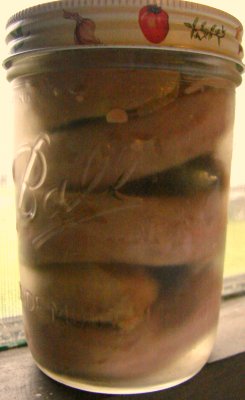
The ten pounds of tongues I process yielded eight 1½-pint widemouth jars of pickled snacks.


Special thanks for the info and encouragement from Porker at Chowhound, and to Anthony Caronna, my neighborhood butcher at Caronna's Market in Thompsonville CT, who was happy to get the lamb's tongues for me on special order. Caronna's, located on Pearl Street right next door to the yellow-brick art deco Thompsonville Fire Department, has been in operation since 1918.

PLEASE NOTE:  I know that many of you reading this blog post have been brought here by Google and Bing as you search for the commercially-produced lamb's tongues you or your family members once purchased at grocery stores.  Unfortunately, when the Rogers Company went out of business, pickled lamb's tongues became unavailable - they were the only company in the United States making them, and no one else has stepped forward to continue the tradition.


Because I enjoy pickled tongues and wanted to enjoy them again, I developed  and published this recipe to help those who are interested in the product make their own, in their own home kitchen, the way I did.  I am not a commercial supplier, just a hobbyist who likes to fiddle around in the kitchen.


If you decide to try making your own pickled tongues and have questions or want more information, please feel free to send me an email and I will do what I can for you to help make your job easier.  Canning anything is a little intimidating - canning and preserving meat products can seem overwhelming to someone who's never done it before.


Please do not write asking to buy pickled lamb's tongues from me. I don't sell them and I won't send you any. I wrote this post to help you make your own, and the only way you're going to get any pickled lamb's tongue is if you get off your ass and get to work.  

.

05 October, 2009

Porkie Pork Skins

These pork rinds have the BEST LOGO EVAR. Check out Porkie there. Friendly little guy, looks almost like a dog eh? And he's wearing a chef's hat, joining a long parade of cartoon piggies who cheerfully cavort in company logos, oblivious of their ultimate fate at the sharp end of a fork.

Great stuff, made by Evans Food Group of Chicago, a company that makes a huge variety of pork rinds and cracklins, both for their own brands and for distribution by others.

04 October, 2009

Wilson's Certified Campsite Bacon Bar


Pictured above: a genuine Wilson's Certified Campsite Bacon Bar. Compact food for the cutting-edge camper in the 60's and 70's, the Bacon Bar is 100% pre-fried bacon, compressed into a block measuring about 2 x 3 x 1 inches. This is an actual product, and the example shown above really does contain a block of bacon, still vacuum-sealed in its heavy foil-like pouch (I've thought about opening it up and perhaps giving it a taste - who wouldn't want to try 35-year-old bacon after all?) but decided that since I only have one, I'd keep it intact.

Amazingly, this small 3-ounce bar started off as a full pound of bacon and was considered innovative enough to be mentioned in a Sports Illustrated article in 1963, soon after it had been introduced.

According to this advertisement in the April 1976 issue of Backpacker magazine, the Bacon Bar retailed for $2.45.

.

03 October, 2009

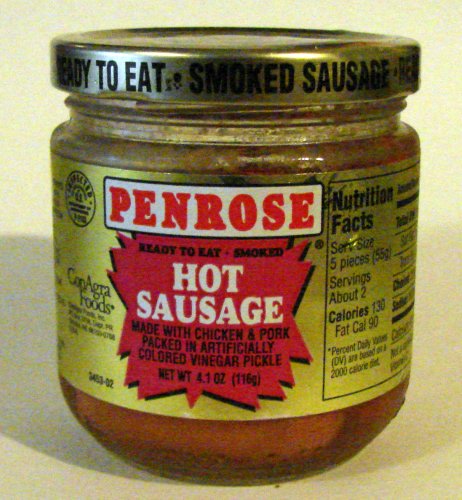
Penrose Hot Sausage

I'm not really sure what posessed me to try these Penrose Hot Sausages. Madness and an appreciation for the bizarre, I guess. They're kind of hard to describe: sort of like the bastard love child of Vienna sausage and Slim Jims, thown into a vat of "artificially colored vinegar pickle."

The small sausages are tough on the outside, soft on the inside; the meat is a little fibrous and studded with little chunks of white fat that leaves a vaguely umpleasant film on the roof of my mouth. There's some gently spicy heat, on the mild side, and of course the sharp vinegar flavor from the pickle.

Anyway, they're made by ConAgra and there are many better brands of pickled sausages out there, so don't be fooled by the cheap price. Spend a little more money and get something good.

.