Showing posts with label beef. Show all posts

13 June, 2012

Comfort Creek Canned Gravy & Roast Beef

If there is one thing I've learned from buying oddball food products in dollar stores and ethnic markets, it is this: Canned beef is generally pretty nasty. It's often tricked out with fillers and glutamates, and the associated "gravy" is usually tastes artificial and tinny.

And so, my expectations were pretty low (as usual) when I bought a can of Comfort Creek Foods Gravy and Roast Beef at Dollar Tree. For one thing, I knew there'd be more gravy in the can than beef - not only was it right there on the label, but the can sloshed a little when I gently shook it.

Lynnafred mocked me when I brought it home. "It's in a dog food can," she said, "You and your damned food shenanigans."

I opened the can carefully so it wouldn't slosh, and found what looked like a can of nothing but gravy (since the level of the liquid was far above that of the meat.) And I have to admit, the first sniff was not promising: it smelled rather cheap and pet-foody.

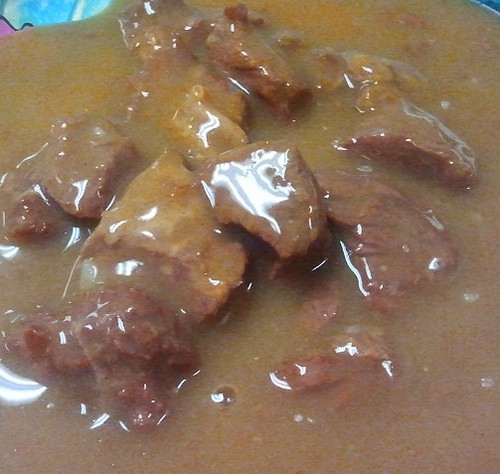
But I dumped it out on a plate anyway and found chunks of real beef which did not seem to have been stretched with TVP or other weirdness. I heated it up in the microwave and gave it a taste, and...

...found that it was actually pretty good.

The beef was tender and tasted just like homemade pot roast, although a little more dry and a bit crumbly. And the gravy was flavorful - beefy, well-seasoned, and not too salty.

I heated up some leftover mashed potatoes, made a well in the center of them, poured in the gravy and beef and had a really good lunch. 

08 May, 2012

Let's Make Some Pastrami

Geez, have you priced pastrami at the deli lately? Nine bucks a pound! Also, I happen to like my pastrami with some fat on it like they used to make when I was a kid, and that stuff is getting harder to find these days.

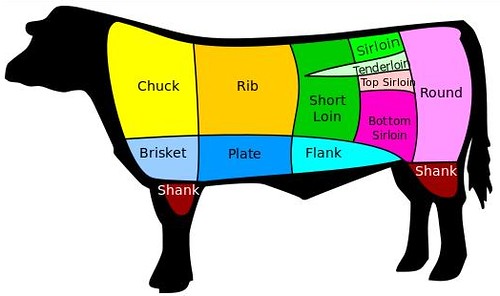
Here's a quick primer about pastrami. Take a look at the beef cuts chart below. The parts we want to pay particular attention to are the plate, the brisket, and the round:

Illustration courtesy Wikipedia Commons / Ysangkok
In my youth, Plate Pastrami was common. As you can probably figure out, it's made from beef plate, the fatty "belly" area of the beefer which is also the source of short ribs. Plate pastrami gets a lot of it's textural character and richness from the fat which is integral to the cut. It closely resembles bacon, which shouldn't be surprising. Bacon is cured and smoked pig belly, and plate pastrami is cured and smoked beef belly. Plate pastrami is hard to find these days; most supermarkets and delis don't carry it, and if you want to make your own the plate cut often has to be special ordered from a trusted butcher. This rarity is market-driven - while once upon a time, consumers wanted flavorful fatty meat, they are now demanding leaner cuts, and there is no way anyone can describe the plate as "lean."

This is why so much pastrami sold nowadays is Round Pastrami. It's made from the round of the beef, which is very lean. It's very popular and has all but replaced plate pastrami in supermarkets and most delis, but I don't find it at all desireable - pastrami should have some fat on it!

And so, without ready access to beef plate and without any interest at all in curing a round, I direct your attention to the brisket, the cut just in front of the plate. Brisket Pastrami doesn't have quite as much fat as a proper plate pastrami, but it's not bad. It's actually a pretty good compromise between the very fatty plate and the very lean round. And because briskets are pretty easy to come by, you can make pastrami just about any time you want.

Making the Pastrami

Pastrami starts out as a brine-cured cut of meat - a corned beef, actually. There are many perfectly acceptable commercial corned beefs out there, so when I make pastrami at home, I start with a commercial corned  beef rather than a fresh brisket. That allows me to skip the curing process and get right to the seasoning and smoking.

So: Start with a commercial corned beef. You can use a flat cut or a point cut as you prefer. (I happened to get a great deal on a whole brisket and decided to turn the entire thing into enough pastrami for family and friends.)

Remove the corned beef from the wrapping, drain off any juices, and rinse it off. You can also use this opportunity to trim some of the fat and membranes off. I remove the membranes, but only minimally trim the fat.

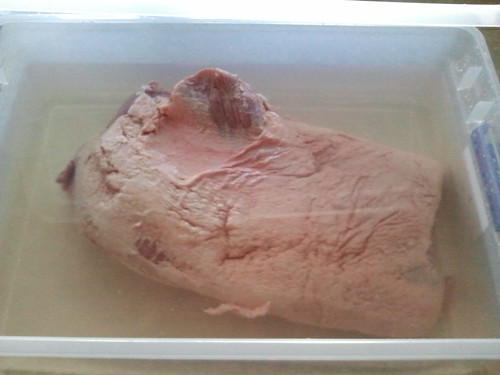
Notice that this is pretty much an untrimmed brisket. Remember, fat is flavor.
Place the corned beef into a container and add enough water to cover the pastrami. Let it sit and soak for about twenty-four hours or so. You don't have to change the water - just make sure the meat is covered by the water.  The idea is to soak out a lot of the salt that's in the corned beef. As the beef cooks over the smoke and turns into pastrami, it can lose up to 20% of its weight, which will concentrate any salt remaining in the meat. Without this soaking step, your finished pastrami will be almost unbearably salty.

The next day, make up a batch of Pastrami Rub. The most basic of pastrami rubs contain black pepper and coriander with a touch of paprika. Over time, I've developed a rub that gives me exactly the flavor I'm looking for, and that's the recipe I'm sharing here. I encourage you to do some experimenting, too, so you can find your own perfect blend.

Pastrami Rub
Makes enough to transform 1 average point cut or flat cut corned beef into pastrami. If you're using a whole brisket, double the recipe.

1/4 cup black peppercorns
1/4 cup coriander seed
1 tablespoon white pepper
2 tablespoons yellow mustard seed
2 tablespoons good paprika
1/4 cup kosher salt

Grind the peppercorns, coriander, and mustard seed coarsely in a spice grinder or use a mortar and pestle. Add the paprika (use a good quality Hungarian paprika if you can, not that nasty red dust they sell in dollar stores in plastic tubes) and salt, stir well to thoroughly combine.

Take the brisket out of it's soaking water and pat it dry as best you can. Rub the spices liberally onto every square inch of the brisket's surface, pressing the mixture into the surface as you go so there is a decent coating of spices.

With the beef well-coated, put it into the smoker and hold it over the smoke at 250 F for three or four hours, or until the internal temperature of the brisket reaches 165 F on a meat thermometer inserted into the thickest part of the meat. I like to use a mild wood for the smoke - apple is good, and so is citrus wood and maple.

Take the brisket out of the smoker, wrap it up well in aluminum foil, and chill it thoroughly. Cold meat slices better than hot.


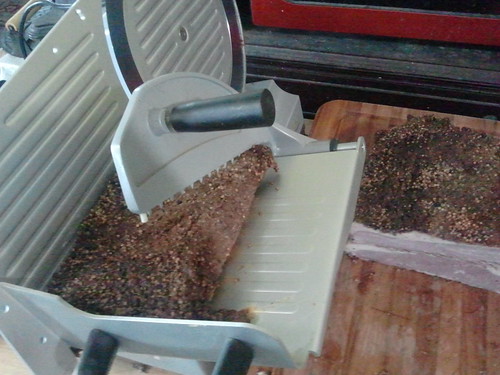
When the meat is cold, slice it as thinly as possible. I have a meat slicer, but if you don't, that's okay - use a good sharp slicing knife and make thin, uniform slices against the grain.

Check that out - isn't it just gorgeous?

You can eat it just the way it is if you like - remember, it is fully cooked - but you can also sizzle it a bit in a frying pan or, if you've trimmed a lot of the fat off it first, steam it. Get yourself some good rye bread, some sharp mustard, and some strong horseradish if you so desire, and have yourself a feast.


16 April, 2012

The Kobe Beef Lie

In a recent article in Forbes, Larry Olmstead reveals the true nature of beef sold in the United States as "Kobe beef."  It's quite a read, and I recommend it.

Read the article here:

Food's Biggest Scam: The Great Kobe Beef Lie by Larry Olmstead.

30 December, 2010

"French Leftover Beef"

I've got nothing but leftovers in the fridge, the family is hungry, and I'm just not feeling all that creative.  WAT DO??

Turn for help from the internet, of course.

It really is amazing what Google will turn up in a simple search for "leftover beef recipe."  Mostly it's amazing because it seems like there are an awful lot of people out there who think "hash" when they think of leftover beef, and I've done that to death.

And then I ran into "French Leftover Beef" - A blog post which was published in 2005 on a blog called Mantia's Musings. As blog author Alyce tells it, the recipe is derived from boeuf miroton, a French dish which is specifically about using up leftover beef, and was originally published in "a women's magazine years ago."  Alyce's description of the dish sounded delicious and I knew right away I had found what I was going to make for supper. 

Such a recipe is enormously flexible, and so I made a few tweaks of my own to the ingredients.  I think it turned out great, and so did the rest of the family.  Except the dogs.  They never got to try it.  The gravy is heavy on the onions, and onions are not at all healthy for dogs.

French Leftover Beef
Serves 4 to 6

2 tablespoons olive oil
3 smallish onions, thinly sliced
2 tablespoons flour
1/2 cup chardonnay
1/2 cup beef stock, plus more as needed
2 tablespoons tomato paste
1 teaspoon sweet paprika
1 tablespoon Gravy Master
Salt and pepper to taste
3 cups leftover cooked beef, cut into cubes

Heat the oil in a Dutch oven and add the sliced onions. Sautee until the onions are soft and beginning to caramelize. Stir in the flour and continue to cook until the flour is lightly browned, then stir in the chardonnay, beef stock, tomato paste and paprika.  Continue to stir over the heat until the mixture thickens, darkening the color of the mix as you wish with the Gravy Master.  

Cover the gravy and simmer it over very low heat for 10 minutes, adding more beef stock as necessary to prevent the gravy from getting too thick and scorching the dutch oven.

Stir in the meat and simmer, covered, for an additional 20 minutes (adding broth when needed as before.)  Serve with a tossed green salad and cheese toasts.

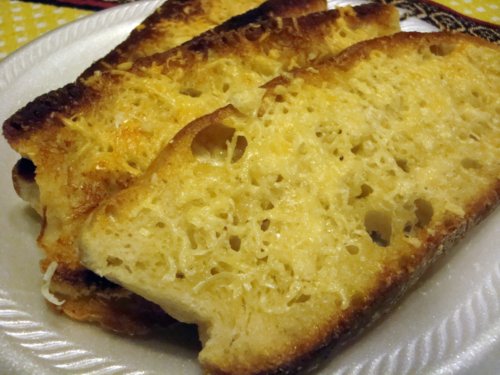
Alyce suggests serving Cheese Toast with French Leftover Beef, and I agree.  It's easy to make: just butter some slices of ciabatta or French bread, sprinkle it with grated Parmesan cheese, and run it under the broiler for a few minutes to toast the cheese and make the bread crispy.

07 October, 2010

A Tale of Two Beef Tongues - Corned, and Smoked

Tongue.  It's not a very popular cut of meat nowadays; this is perhaps because it is the one common cut of meat that most resembles a chunk of dead animal.  There aren't that many things that can be done to a whole tongue to make it look untonguely.

And it's expensive, too!  I was checking out prepared tongue at ShopRite last week.  Ready-to-eat corned tongue was going for $10.95 a pound, making even the smallest one in the meat case almost $24.  Damn.  Luckily though, Tony Impoco at Impoco Poultry Market in Springfield came to the rescue - he had fresh beef tongue in and selling for a delightful $2.00 a pound.  I bought two of them.

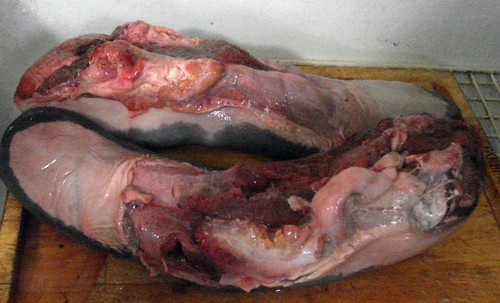
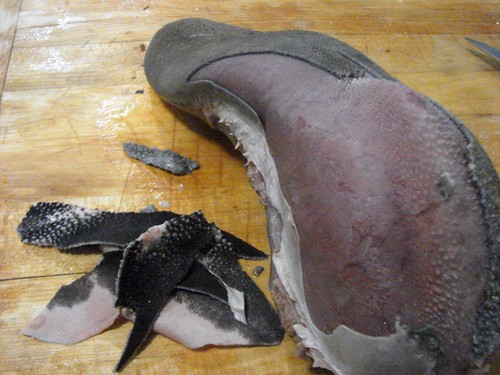
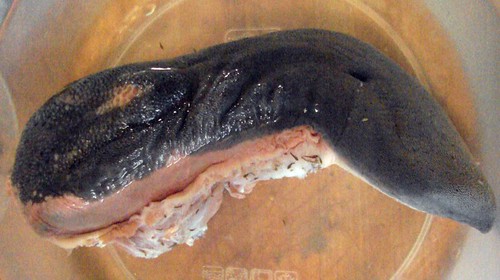
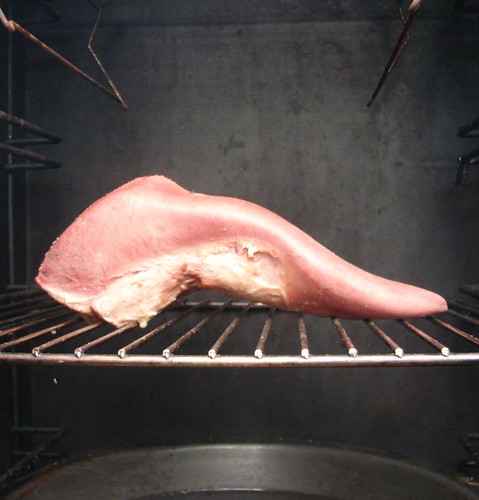
Fresh tongue is not a pretty sight, and takes some work to prepare properly.  It's covered with a  thick, rough skin and there are fatty sections and glands underneath near the base of the tongue before it can be used.  At left is a picture of the tongues as Ithey looked when I  got them home. 

The plan is to put both tongues into a curing brine for the better part of a week.  One of them will be slow-cooked for several hours as Corned Tongue, while the other one will be taken from the brine and with the application of smoke and time be turned into tasty Smoked Tongue.

Onto a cutting board and into the sink they went for cleaning and trimming.  I gave them a good scrubbing and trimmed off the unpleasant bits with a sharp boning knife.

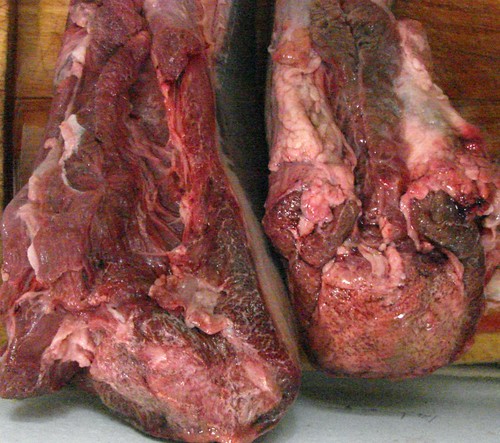
The picture at right shows the difference between a "pared" tongue (on the left) with an "unpared" tongue (on the left.)  I usually remove the fatty sections on the right and left of the tongue's base along with any remaining bits of glands that might be there.  I also pare off the root of the tongue (about 1/2 inch in or so) to remove any dubious or bloody bits.  (If you'd like to see a larger version of that pic, just click on it)

With the tongue trimmed and rinsed, it was time to make the brine.

Corned Beef Brine
For Corned Beef or Tongue
Makes 1 Gallon

1 gallon water
1 cup Kosher salt
1/2 cup sugar
1 teaspoon InstaCure #1, aka "pink salt" (this is optional, but using it will keep the meat an attractive pink color. Without it, the tongues will turn grey during the curing process.)
6 garlic cloves, crushed
3 teaspoons whole peppercorns
1 teaspoon whole allspice berries
1 teaspoon juniper berries
1 tablespoon dried thyme
6 bay leaves
2 teaspoons whole mustard seed

Bring the water to a boil and stir in the remaining ingredients.  Simmer the brine until the salt and sugar is dissolved, then allow the brine to cool completely before using.

Corning the Tongues:

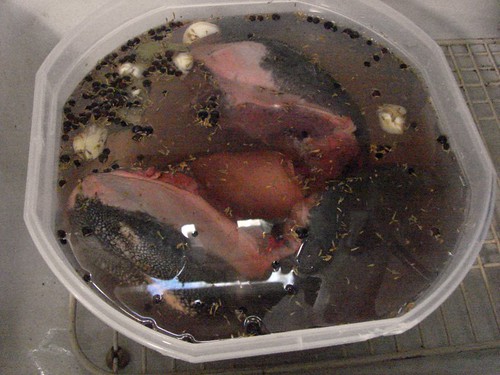
Pour the brine into a tightly-sealable container - a large Tupperware or Stearlite food storage tub is ideal - and add the tongues, submerging them as much as possible.  Most of the techniques I've read say that you should hold the meat under the surface of the brine using a heavy plate, but if you have something that closes with a leakproof seal, you can omit the plate since you can flip the container over periodically to make sure it brines evenly (which is what I did.)

Seal the container and put it into the fridge for about five days.  Twice a day, flip the container over - or open it up and turn the tongues over.

At the end of five days, the tongue is cured and ready to cook.

Cooking Corned Tongue:

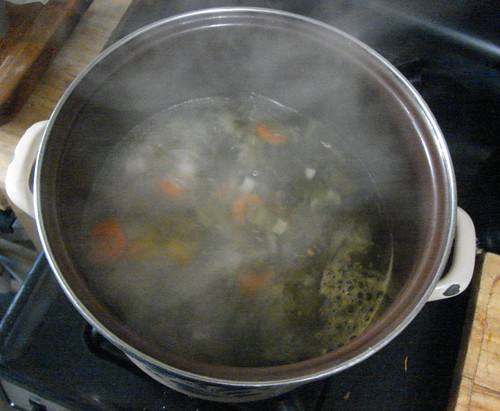
Prepare a flavorful vegetable stock by bringing about 6 quarts of water to a boil in a stock pot.  Add some sliced carrots, sliced parsnips, a couple of cut up fresh tomatoes, a few ribs of celery, a few onions,  some parsley, a couple of bay leaves, and a chopped up bell pepper.  Simmer the stock for about an hour, and then add the tongue to the pot.  Simmer the tongue for about four hours, until it's nice and tender.  When it's done, remove it from the pot to a cutting board and let it stand a few minutes to cool down a little - just enough for you to be able to handle it.

 The cooking time will have made the skin covering the tongue hard and plastic-like, as well as loosening it from the meat.  Use a sharp knife to carefully slit the skin at the base of the tongue and you will find it pretty easy to peel off the skin - it won't slip off all in one piece, but it won't offer much resistance as you peel it off in strips.

The skin is not widely considered to be edible - it's tough and not very pleasant to eat for people - but if you have dogs, you can give it to them as a treat.  Zim and Iris both loved the bits of tongue-skin that I gave them as Good Dog Cookies.

.Slice the tongue after peeling - warm and served with veggies if you want to serve it as an old-timey dinner, or chill it overnight and slice it thin for sandwiches.

Making Smoked Tongue:

The process for Smoked Tongue is similar, but there are some differences.  When you remove the tongue from the brine, rinse it off well and soak it in fresh water for an hour or so to draw out some of the excess salt.  This is necessary, because the tongue doesn't cook in liquid as long as boiled corned tongue. After the soaking period, simmer the tongue in vegetable broth just like for corned tongue - except don't fully cook it until tender.  Simmer it only for about an hour and a half to two hours - just long enough to loosen the skin - then peel it and place it into the smoker.

I put the par-cooked tongue on a rack in the center of my smoker, which was preheated to about 175 F.  There is some fat in the meat - mostly toward the base - but for the most part, you'll need to keep the heat on the low side to prevent it from drying out (some instructions on the web say your should cover the tongue with strips of bacon to keep it basting in the smoker, but I was going for a more traditional, all-beef approach.

A boldly flavored smoke is best for tongue.  I used some awesome old citrus chips that have an exceptional flavor.  Keeping the heat below 200 F, I held the tongue over the smoke for about 2½ hours.

(Note:  You can put the tongue directly into the smoker from the freshwater soak if you want - skipping the initial simmering and peeling steps - but this makes the tongue a little harder to peel in the long run, and the skin really is nasty.  Also, if you don't simmer the tongue, increase the time in the smoker dramatically, by two or even three hours.)

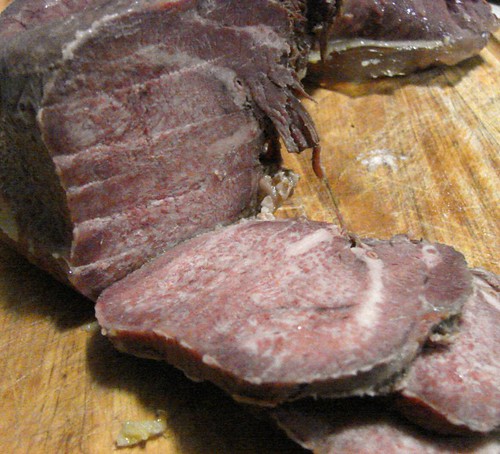
The tongue is done cooking when it can be easily pierced by a fork.  The outside will be a rich, dark brown from the smoke.  While it's still hot (but after taking a couple slices off for immediate OM NOM NOMming, of course) wrap the tongue tightly in aluminum foil and stash it in the fridge until it's chilled.  This will firm up the meat and make it much easier to get lovely wafer-thin slices later.

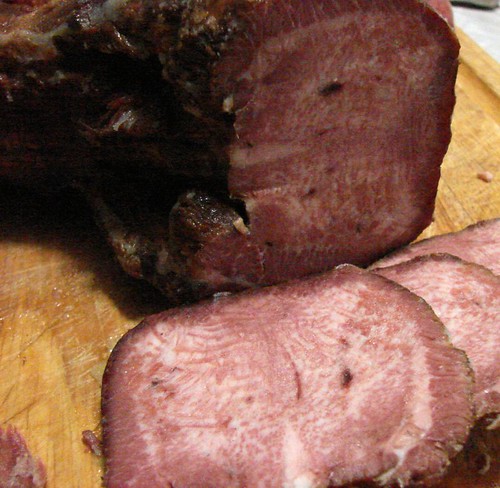
Notice in the photo how much darker the smoked version is than the simple corned version - the meat is less red and more of a mahogany brown.  The smoke adds another dimension of flavor as well.  Serve it on sandwiches, or slice thinly as part of a charcuterie plate with other delights like salami and capicola and various sharp cheeses.



07 July, 2010

Backyard BBQ in Enfield CT

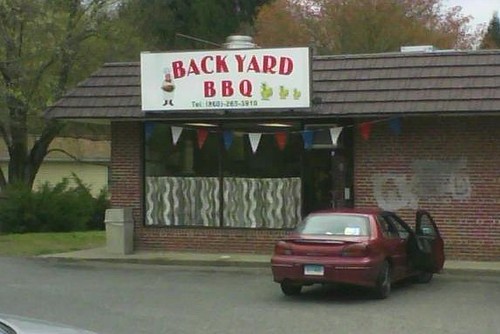
Back in April, I wrote about getting an awesome pulled-pork sandwich as Backyard BBQ in Enfield CT.  I've been there a few times since then - most recently last night - and I think it's about time I offered a more extensive review of their offerings.

Grilled Chicken:  Because Backyard BBQ uses real, hardwood charcoal to cook their chicken (and all their other entrees, for that matter) it shouldn't come as any surprise that their grilled chicken is second to none.  Slow cooked over an actual fire, this was the first restaurant grilled chicken that I can say tasted as good as my own.

Beef Brisket - Meltingly tender, Backyard BBQ's brisket is excellent.  I especially like the mild-yet-sharp tang of the homemade house sauce it's served with.

Pictured with the brisket is a side of BBQ Beans.  For most of my life, I have pretty much hated barbecue beans.  This is probably because the only ones I've ever had have been cheapo baked beans swimming in low-grade barbecue sauce.  These are the beans which changed my mind.  Loaded with chunks of pulled pork, dressed with sauce, and kicked up with a medium boost of spicy heat, these beans are almost a meal in themselves.  I like them so much that I order at least one side of them every time I go in.  Seriously, even if you hate baked beans, you should give them a try to see if their extreme awesomeness can win you over, too.
I'm happy to say that the Pulled Pork is every bit as excellent now as it was in April.  This time, I got it as a dinner entree rather than a sandwich. It's still the best pulled pork you'll find outside the Carolinas.

Backyard BBQ's Garlic Mashed Potatoes deserve special mention as well.  Thin-skinned new potatoes, roughly mashed with the skins on and spiked with roasted garlic and a touch of sour cream, they complimented the brisket and the pulled pork extremely well.  Like the beans, the potatoes are good enough to buy all by themselves for the sake of eating potatoey goodness.
Corn Bread - Quite a unique recipe (and I mean that in a good way) - a nearly perfect balance between the sweet, moist Northern style and the dryer, not-very-sweet Southern style.  Plus there are chewy little kernels of roasted corn distributed throughout.

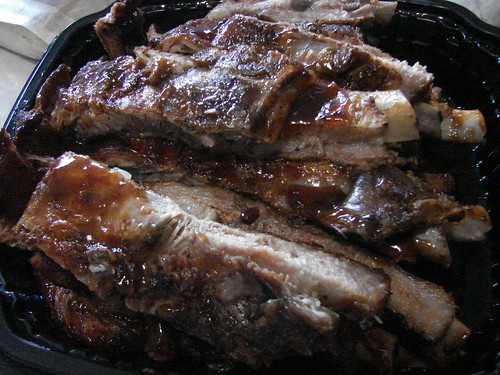
Last, but certainly not least, are the St. Louis Style Spare Ribs.  We bought a full rack and were glad we did.  Backyard BBQ does 'em right:  nice and slow over hardwood coals, using whole untrimmed sides that yield big and meaty ribs.  They're tender and perfectly done - right to the point where the meat pulls off the bone but not quite to the overdone "fall off the bone" stage.  The meat is dressed with homemade rib sauce for the last few turns over the fire, and then are cut into serving sizes ready to go.  I can't recommend them highly enough.

I'm really glad that Backyard BBQ opened up in town.  They're following through with their initial promise to bring an authentic and reasonably priced barbecue takeout to Enfield, and I'm looking forward to many more meals there.
.

18 March, 2010

Bresaola is Ready!

I went up to the attic last night to check on the meats - with the temps climbing toward the 60's during the day, I don't want to let the attic room get too warm - and found that the bresaola was ready to open.  Actually, I think it might have hung a few days too long because it seemed a little stiff to me.  So I brought it down to the kitchen for a tasting and photoshoot.


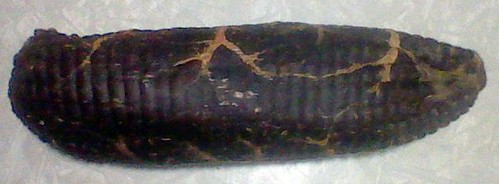
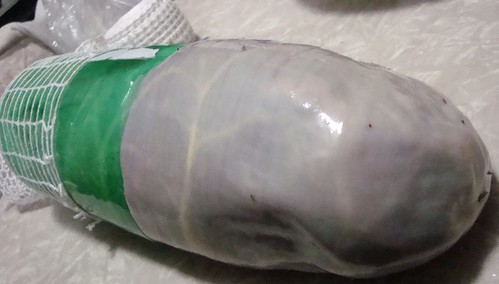
There it is, dried to a lovely nut-brown, wrapped in its casing.   The casing is a little drier and stiffer than I would have liked.  I suspect the curing room's humidity might be little low.  We'll see when we cut into it.

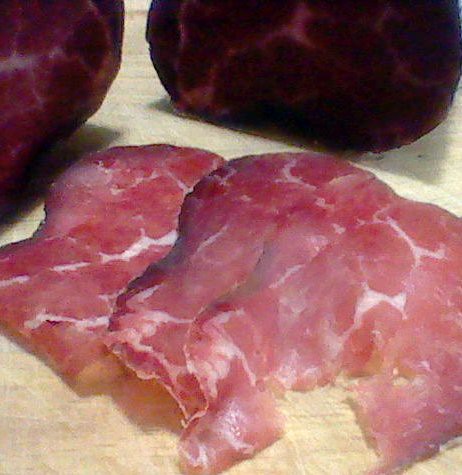
I cut a few lovely paper-thin slices.  They are absolutely delicious.  The beef has a rich and meaty flavor with a distinctive flavor of rosemary and hints of juniper.  I still think it could have hung three or four days less - especially considereing the temperature lately - but it was moist and yielding and the interior fat veins were creamy and not at all unpleasant (the way beef fat can so often be, coating one's mouth and so on.  That didn't happen here at all.)

However, it's obvious that I am going to have to start better regulating the humidity in the curing room.  The outer edges of the slices are very well-dried and dark, making sort of an edible "rind" on the meat which I prefer not to have.  I suspect I am going to find the same thing on the capicola when I take it down and this does not please me.  I haven't had this problem in the past but I think that the unusually cold winter we had this year affected the humidity levels in my attic and it will make this batch of cappy less glorious than my past efforts.

At any rate, despite the extra drying around the edges - which I will remedy next time - the bresaola came out quite acceptable (though not perfect.)  Slices of it will definitely be on the charcuterie plates this year.

.

04 March, 2010

Capicola and Bresaola - The Meat Hanging in my Attic

Time once again to check in on the delicious meats which are aging in my attic closet.  In the background are two hot capicola - rubbed with a mixture of black pepper, smoked paprika, and powdered chipotle pepper.  In the foreground on the left is the bresaloa - a cured beef eye of round.  On the right is a sweet capicola.

The capicolas have several more weeks left to cure.  They're still soft and pliant.  I think they're curing a little faster this year because they're not strapped with wooden slats, but they still have a long way to go.

The bresaola, though, will be ready much sooner.  It's already fairly firm because the beef loses moisture faster than the pork even though they are both cased.  I'm checking it every few days now to make sure it doesn't become overdried.

Meanwhile, the weather is getting a bit milder, though the temps are still in the high thirties during the day, so I'm monitoring the temperature in the attic a little closer too,  If we get a warm spell I'll have to move the meats to the spare refrigerator until the weather cools down again.


23 February, 2010

Flatburgers

There is nothing like a big, juicy burger. I never buy pre-made ground beef patties; I always get freshly-made burger from Caronna's Market (my local butcher shop) which is ground right there in the store - often while I wait. A big hand-formed patty of that beef, grilled under a broiler or, better yet, over hot coals, is truly awesome.

But sometimes, I don't want a big juicy burger. I want a thinner, 1930's-style fried patty. I call 'em flatburgers.

 I start out by using a cheap teflon-coated egg ring as a burger form.  It's completely useless as an egg ring because it's been made with a deep seam where the egg sticks.  But it makes a nearly perfect 1/3-pound ground beef patty just the right size to fit on a standard hamburger bun.  I press the meat into the ring on a disposable foam plate and carefully remove the ring.

To make this patty into a flatburger, I press the patty gently with my fingertips, forming it into a thinner quarter-inch-thick patty with a wider diameter.  Then I fry it under a cast-iron bacon press to keep it from shrinking as it cooks, and serve it up with ketchup and mustard and a slice of cheese on an oversized sesame-seed sandwich bun. Voilà!  A flatburger - remarkably similar to the burgers my great-grandfather used to get at small diners in the late 30s. Despite the thinness of the patty, it's still a 1/3-pound burger, so it's  remarkably satisfying

Flatburger or no, it can still be decked out with all the trimmings you desire.  Add cheese, onions, lettuce, tomatoes, and bacon - especially bacon - and the Flatburger suddenly doesn't seem so flat.

Take a trip back in time and try a flatburger sometime.


11 February, 2010

Bresaola Update

I had been keeping watch on the beef eye round in the fridge as it cured, checking it every so often to see how the cure was working.  It felt ready to come out on Sunday - the meat had firmed up quite a bit as the curing process pulled moisture out of the roast - but I just didn't have a chance to get to it until yesterday.  (That's the good thing about doing this - a day or two longer doesn't make too much of a difference in the long run as long as your raw materials are fresh and decent to begin with.)

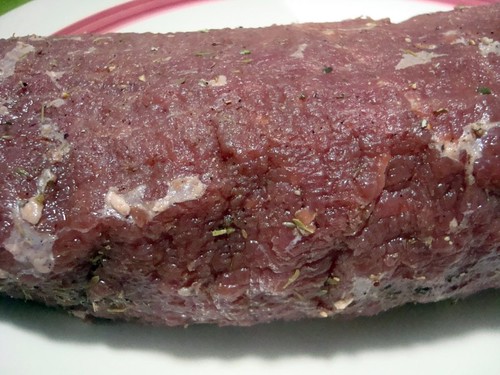
Even though I had pulled the curing roast out last week and drained it, the fresh cure had found plenty of moisture left to draw out, and the wrinkles in the cryovac were filled with red brine.  I cut the bag and drained the brine, then rinsed all of the herbs from the meat under cool running water.  Some of them still clung a little, so I finished rinsing the meat with white wine, the same way I had done weeks earlier with the capicola before hanging it.

It looked pretty good - nice and red and ready to age.  Some little bits of herbs and especially black pepper clung to the meat even after rinsing and patting it dry.  I considered rinsing the roast off again, but in the end decided to leave the remaining flavorings where they were.

Meanwhile, the casing (a beef bung cap, the same as I use for capicola) soaked in warm water with a good squeeze of lemon juice added.  After soaking for a half hour or so, I rinsed the casing well inside and out and stuffed it with the roast.

Surprisingly enough, I found that stuffing the casings with the beef went a little easier than with the pork.  The somewhat oblong shape of the pork loins lamost require stuffing to be a two-man job, with one guy holding onto the loin and the other working the casing up from the bottom, until finally the casing is on far enough for the loin to "drop in" to the bottom.  The beef eye round was more regular and circular in cross-section, and wasn't that hard to do by myself.


So, here's a ridiculous-looking photo of the bresaola getting the elastic netting applied.  The beef eye is a lot longer than the pork half-loins for capicola, so it stuck out of my homemade pop-bottle sleeve tool.  It was a little tighter fit, too, because the diameter was a bit larger.  But the plastic bottle still made it into a relatively simple job, and the elastic netting was fit to the meat in no time.  I pricked some holes in the casing to squeeze out any trapped air, and then it was off to the attic for curing time.

And there it is, my proto-bresaola, hanging in the curing closet up in the attic alongside the cappies.

Foreground left: Bresaoia
Foreground right: Sweet capicola
Background:  Hot capicolas  (That'w why there's a color difference.)

As long as we're up here anyway, here's an observation about the capicolas:  This is the first year I've tried using elastic netting instead of wooden slats tightly clamped to the meat.  I notice that there isn't an awful lot of shrinkage in diameter as the meat ages and dries, but there seems to be quite a bit of shrinkage in length.  The cappies are getting firmer, though, and are only a little damp to the touch, so I'm reasonably sure that they're drying okay.  I'm hoping that the texture will be as good as normal when we unwrap them.  (If not, no problem, we just go back to slats next year.)

.


31 January, 2010

Quick Bresaola Update

I took the round roast out of the first cure stage today. The cryovac it was in was filled with meat juices and brine and the meat was starting to get firm, so the cure is doing its job. The meat was a vivid pink and smelled gorgeous with the thyme, rosemary, and juniper in the mix.

I rinsed it off with wine, patted it dry, and reapplied a fresh coating of cure, then resealed it in cryovac. It needs to stay for another five days or so, then I'll put it in a beef bung cap casing and hang it in the curing room in the attic with the capicola.

Pictures next week, when it comes out of the cure for the last time.

.

25 January, 2010

Making Bresaola

On Saturday, I headed over to the local wholesale/retail meat market to buy a whole pork belly. I want to make some pancetta, and I still have plenty of room to hang stuff in my curing room in the attic. Unfortunately, there were no bellies available that day; I'll have to check back later in the week.

But they did have whole beef eye round for the very reasonable price of $2.29 a pound (untrimmed) and so I decided to make bresaola instead. In much the same way that my capicola is a cured and aged whole boneless pork loin, bresaola is a cured and aged whole eye round.

The process is somewhat longer, though. For one thing, the curing process is longer - my capicolas are only left in their salt cure for 2 days. The beef stays in its cure for 10 to 14 days. Following Ruhlman & Polcyn's method, I'll be draining off the first accumulation of brine after 5 to 7 days, then reapplying fresh brine to finish the aging for another week. After that, I'll be casing the beef in a natural beef bung cap casing, just like my cappy, and hanging it to age for a month or two...or longer, depending on how it goes. This is a learning process for me, and it's the first time I've ever tried making bresaola. So, welcome to the first steps and I hope you stop back every so often as I update and monitor the beef's progress.

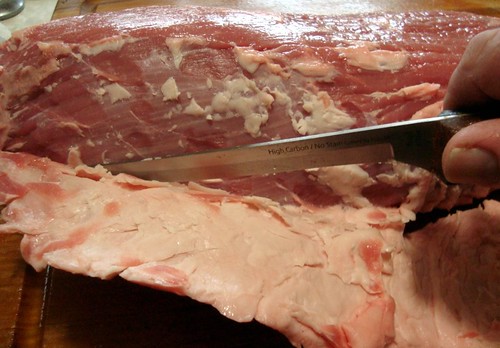
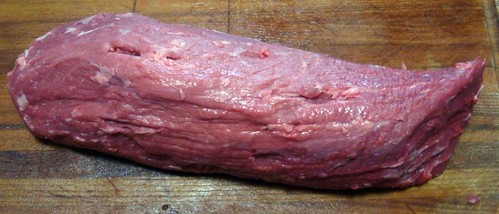
This is the eye round I started with, right out of the cryovac. Untrimmed, it weighed in at about 6½ pounds. Before I can start curing it, I'll have to trim off all the visible fat and any silverside that is still on it.

Trimming the round is fairly simple. I use a good sharp boning knife with a narrow blade, and pass it between the fat cap and the meat, in the same direction as the grain of the muscle. If there is any silverside, I just pull it away from the meat and use the knife in the same way as when I remove the fat. Small bits of fat or silverside might remain, but those are easily removed with small trim strokes.

All trimmed and ready for the cure, the round is down to a little shy of 6 pounds. At this point, I set it aside and made up the cure.

For the cure ingredients, I knew that I'd want salt, sugar, and InstaCure #2 ("pink salt") as a minimum, with perhaps some other aromatic ingredients to taste. After researching several recipes, I came up with the following proportions, which makes enough cure for up to an 8-pound round. Note that I am giving the amounts in metric weights rather than my customary American method of teaspoons/tablespoons. I did this to avoid clumsy measurements like "1/8 teaspoon" etc. and fractions of ounces. Decent digital scales are available for ten dollars or less online and in many stores, and nearly all of them can be toggled between ounces and grams.


Dave's Bresaola Cure
Sufficient for 8 pounds of beef

50 grams Kosher salt
60 grams sugar
10 grams InstaCure #2 ("pink salt" )
10 grams ground black pepper
15 grams fresh rosemary leaves, finely chopped
12 grams dried thyme, crushed
12 juniper berries, ground in a spice or coffee grinder

Combine all ingredients thoroughly until evenly distributed.

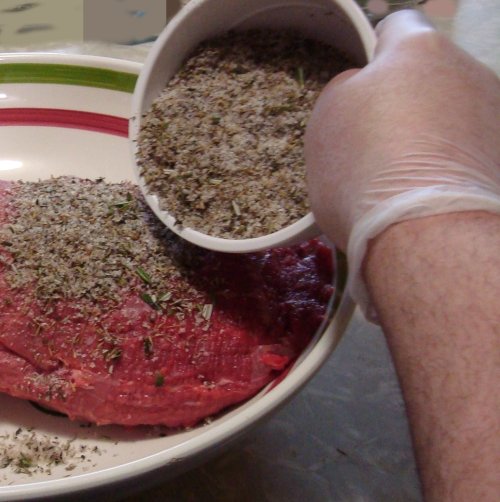
Once the cure was made up, I put the round into a large shallow bowl, pulled on a pair of vinyl gloves to protect my hands, and went to work rubbing the cure into the meat. I rubbed the entire round with the cure, making sure that all of the meat was covered. It only took a couple of minutes, and I had some cure left over when I was done (which I put away in a jar for next week. Saving the leftovers means I won't have to mix so much when the cure gets reapplied.)

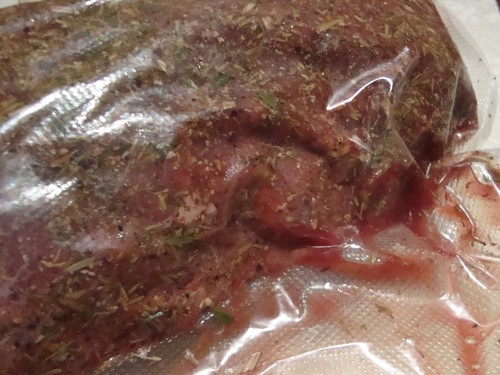
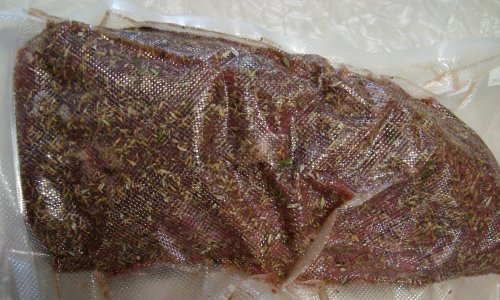
When the meat was thoroughly coated, I sealed it in a cryovac pouch using my vacuum packer. If you haven't got one, don't sweat it. Use a big ZipLoc bag and push as much of the air out of it as you can when you seal it up. Check it out: the meat had been for less than five minutes when I sealed it, and the cure had already begun to pull juices out of the meat to form a brine:

Right now the curing beef is sitting on the bottom shelf of my fridge. Every so often - whenever I open the fridge for something - I turn the bag and give it a quick massage. I'll be doing that for the next week. Sometime over the coming weekend, I'll open the package, rinse and dry the round, and apply fresh cure. Check back with me later and follow the progress.

.

24 July, 2009

Easy Empanadillas

Empanadillas are a Puerto Rican specialty - small savory meat pies, fried crispy and golden brown. They're delicious, but they can be time-consuming to make - especially for me because I am a clumsy moron when it comes to making pie crusts. So, I came up with a quick, easy, and delicious recipe for empanadillas. There are two secrets to my quick method:
  • Ready-made empanada shells. Many brands are available, but one of the most common, even in non-ethnic markets, is Goya. Check the frozen foods department, in the section with other Hispanic foods.
  • Lutenica, that delicious Eastern-Mediterranean combination of sweet and hot peppers and tomatoes.
Brown the meat with a bit of minced onion, add lutenica and cumin to spice things up, then put the mixture into the ready-made shells and fry a few minutes on each side until crispy golden brown. It's as easy and delicious as can be. The recipe below will make four empanadillas, but it's easily scaled up to make as many as you'd like.

Easy Empanadillas
Makes 4

2 tablespoons oil
1 small onion, finely chopped
1/2 pound ground beef
1 teaspoon cumin
2 to 3 tablespoons lutenica, to taste
Salt and black pepper to taste
4 empanada shells (thawed if frozen)
oil sufficient for shallow frying

In a medium skillet, cook the onion in 2 tablespoons of oil until soft and amber but not browned. Add beef and cumin, stirring as you brown the beef to coat everything with the cumin. When beef is brown, pour off excess fat if necessary, then stir in lutenica over low heat unil well-combined. Season to taste if necessary with salt and freshly ground black pepper.

Divide the filling into four parts. Spoon each part into the center of an empanada shell, then fold the shell over and seal the edge by pressing with the tines of a fork. Fry in medium-hot oil a few minutes on each side until crisp and golden brown; serve hot.

11 July, 2009

McDonald's Angus Third Pounder

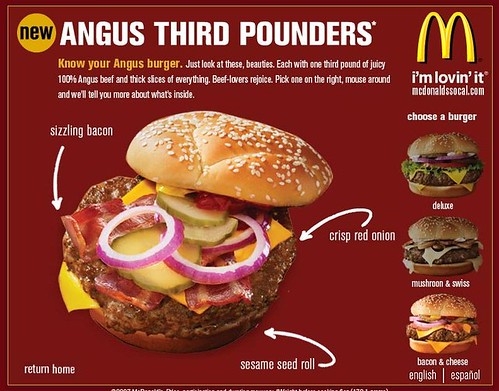
After extensive test marketing in California and New York, McDonald's has introduced their Angus Third Pounder burgers to the rest of the Northeast. I tried one today: the Bacon and Cheese variety. Here's a screencap of the official McDonald's Serving Suggestion burger on their website:


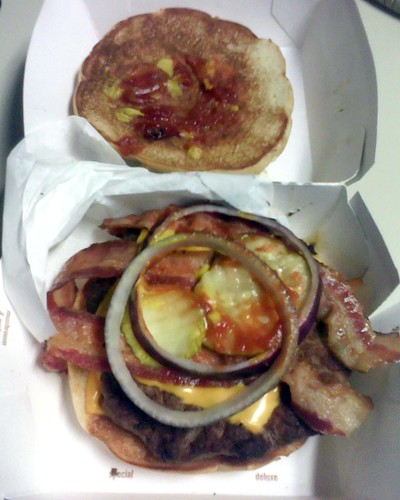
And here's an actual photo of the burger. As usual, it's a little less glamorous than the illustration - but unlike so many other fast food burgers I've reviewed - the real life burger does come close to the ideal picture, for a change.

McDonald's starts with what they advertise as a 100% Angus beef burger with a pre-cooked weight of one-third pound. The bacon-and-cheese version gets topped with thick slices of bacon, a slice of cheese, a few rings of red onions, and a generous layer of crinkle-cut pickles.

I liked the thick-cut bacon. There was a generous amount of it, too, more than one usually finds on fast-food burgers, and the combined flavors of burgers and bacon is always a winner, especially when paired with McDonald's cheese (which is a special mild cheddar made under contract for McD by Kraft.) I'm certain that they're crinkle-cutting the pickles to emphasize the difference between them and their standard pickles. This crinkle-cut ones taste almost like deli half-sours. And the red onion slices, sharper and more flavorful than standard yellow onions, were a good choice as well. The beef seems to be a slightly coarser grind and has a heartier mouthfeel than the familiar Quarter Pounder. It's a pretty decent burger - not decent enough to make McDonald's my first choice for a fast-food burger, but certainly better than almost anything else on their post-breakfast menu.

Unfortunately, there's more to the Angus Third Pounder than meets the eye.

Every other McDonald's burger sandwich starts with the same ingredient, listed in the McDonalds ingredients list as a "100% Beef Patty." The ingredients for said beef patty are "100% pure USDA inspected beef; no fillers, no extenders. Prepared with grill seasoning (salt, black pepper)." Beef, salt, pepper, that's it. But the Angus Patty is very different:
"100% Angus beef. Prepared with Grill Seasoning (salt, black pepper) and Angus Burger Seasoning: Salt, sugar, dextrose, onion powder, maltodextrin, natural butter flavor (dairy source), autolyzed yeast extract, spices, garlic powder, vegetable protein (hydrolyzed corn, soy and wheat), natural (animal, plant and botanical source) and artificial flavors, dried beef broth, sunflower oil, caramel color, partially hydrogenated cottonseed and soybean oil, gum arabic, soy sauce solids (wheat, soybean, salt, maltodextrin, caramel color), palm oil, worcestershire sauce powder [distilled vinegar, molasses, corn syrup, salt, caramel color, garlic powder, sugar, spices, tamarind, natural flavor (fruit source)], beef fat, annatto and turmeric (color), calcium silicate and soybean oil (prevent caking)."
Wow. Damn. That's quite a shopping list. How come McDonald's has to put all that stuff into their Angus patties?

Well, part of the reason is because they're using the term "Angus Beef" to coattail on the well-known and very familiar Certified Angus Beef® advertising by the American Angus Association. "Angus" is not a cut of meat, it's a breed of cattle which can be raised by anyone interested in keeping a beefer. Only a small percentage of beef from Angus cattle is selected by the American Angus Association to carry the Certified Angus Beef® brand. The Association has been almost too successful in their advertising campaign - it seems to have raised consumer awareness of all beef from Angus cattle, whether or not that beef is the Certified brand. So McDonald's - and Burger King, and the rest - buy generic Angus-derived beef, make a big deal of labeling it as "100% pure Angus beef" and trust that most consumers aren't going to notice the difference in taste or wording. I suspect that the extra seasoning cocktail Mickey D's dumps into the mix is to create a flavor difference between the "Angus" and the standard patties, helping reinforce their "special" status in the minds of consumers.

McDonald's Links:

McDonald's Angus Third Pounder website.

McDonald's USA website.

McDonald's USA Ingredients Listing for Popular Menu Items. This is a PDF file, so you'll need the Adobe Acrobat Reader to check it out.

Learn About Certified Angus Beef®:

The Certified Angus Beef® website explains what makes the brand special.

The American Angus Association website. More technical and business-related, but loaded with great resources about Angus cattle and beef.


02 July, 2009

Pemmican Beef Jerky - Marinades

Ever since I was a kid, Pemmican has been like the Filet Mignon of beef jerky. Wicked high quality, nicely-defined slices of beef with a minimum of crumbs and annoying shreds in the bottom of the bag, and decent flavors that weren't overly high in salt.

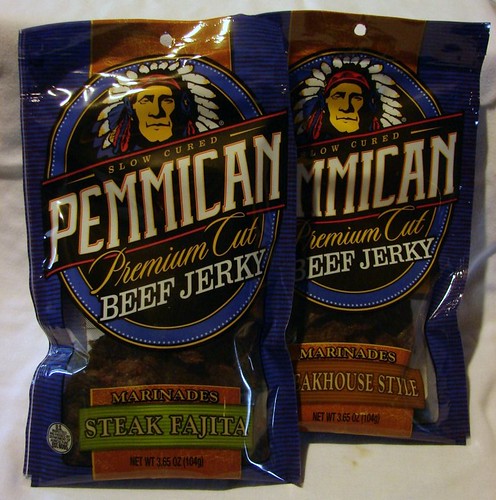
Recently, Jack Link's has been giving Pemmican a run for their money - especially with some of the very cool new varieties coming out - but still, Pemmican endures, and even brings in a few surprises now and again. Like their "Marinades" line of jerky flavors. I bought a couple bags of the Marinades recently and decided to see how they stacked up against each other. We tried "Steak Fajita" and "Steakhouse Style." I enjoyed both of them, but each for very different reasons.

Steak Fajita - The first thing that impressed me about this variety was the smell. As soon as I tore the pouch open, I was hit by the most delicious aroma of searing beef, roasting green bell peppers and caramelizing onions. It was amazing - like someone had placed a sizzling platter of fajita beef down in front of me. The taste, unfortunately, was not as intense as the aroma - alas! - but still, the pepper, onion, and "grill" flavors were all there to a degree, making this jerky one of the best and most interesting ones I've tried in quite awhile. Top notch all the way.

Steakhouse Style - When I was nine or ten years old, my parents would sometimes take us out to eat at Ponderosa, the big steakhouse chain that has since pretty much disappeared from New England. There was some kind of cheap-meal deal there so they could feed four kids fairly inexpensively. The steaks were thin, and kind of USDA-Not-Choice, and they had that softish texture that chemical tenderization gives beef. And also, they had a "flavor enhancement" that my nine-year-old self sort of liked despite being mildly suspicious of it. I hadn't thought about Ponderosa or their "marinated" steak in years, and they were still far from my mental radar when I bought the Pemmican Steakhouse Syle variety. Only after opening the bag did all those memories of Thursday night out at the Ponderosa Steakhouse find their way back. The smell of the jerky was so familiar...it was...damn, the memory was so close, but so fleeting, and I just couldn't pin it down, until I put a piece into my mouth and suddenly it all came back to me, and I was nine years old again eating a 3/8-inch-thick marinated sheet of beef. I should bring some over to my sister's house. We can reminisce about the flavor and I can flick peas into her hair again, just like when we were kids.

14 January, 2009

Remember Real Dried Beef?

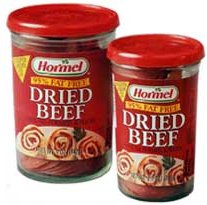
Dried beef is not what it used to be. Oh, the little jars are the same - small vacuum-packed tumblers with the snap-off lids - but the meat inside has changed. Once upon a time, dried beef used to be sliced from a real cut of meat; it looked like thin slices taken from a dried roast beef. Today, though, it's all "chopped and formed." Hormel and Armour make their dried beef out of some kind of dessicated hamburger.

A few years ago, when this changeover to cheapness was first happening, I found a bunch of jars of Beardsley brand dried beef in a local job lot store and bought every one of them I could grab. When my stash was all gone, though, I thought that was the end of good dried beef forever. I refuse to buy the chopped and formed stuff.

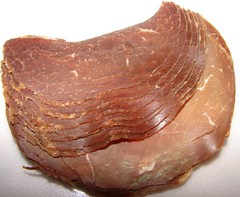
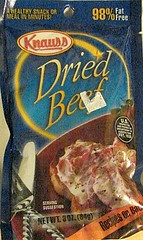
But joy has returned! Poking through the packaged-meat section of Food Zone International in Springfield, I found refrigerated envelopes of Knauss Dried Beef. I couldn't see through the packaging, but there was nothing on the label that indicated they were chopped and formed, so I took a chance and bought a couple. And to my joy and delight, I found that Knauss does indeed make the real thing (as shown on the left.)

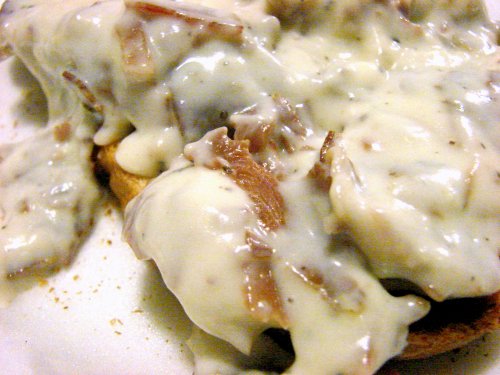
Probably because it's not meant to be entirely shelf-stable, the Knauss brand is not as salty as the Hormel stuff in a jar, so it needed no rinsing or pre-soak to take some of the saltiness away. This morning, I enjoyed a delicious breakfast of that time-honored classic "Shit on a Shingle" - also known by the less-colorful name "creamed chipped beef on toast" and it was great.

I am entirely convinced that the bad reputation this wonderful breakfast has is due to ignorant people who have only heard it referred to as "Shit on a Shingle" or "SOS" and have decided that if it's called something so awful, it must not taste very good. So, here's my recipe.

Creamed Chipped Beef on Toast
Serves 2

1 generous tablespoon of butter
1 package (3 oz) of Knauss Dried Beef
2 tablespoons flour
1½ cups of milk (approximately)
Pepper, nutmeg, and Worcestershire sauce to taste
4 slices of toast, buttered lightly

Melt the butter in a skillet over medium heat until it is foamy. Add the dried beef, breaking it up into little bits as you do so. Stir the beef around in the butter to sizzle it deliciously, and when it is all nicely coated with butter and just starting to brown and curl at the edges, sprinkle it all over with the flour. Stir the flour into the beef thoroughly, then turn the heat down to low and cook for a few minutes until the flour begins to color a bit - just enough to get rid of the "raw flour" taste.

With the heat back up to medium-high, stir in the milk all at once and continue to stir until the mixture bubbles and starts to thicken into gravy. You won't need much salt (and if you do, use celery salt!) but season with a good shot of Worcestershire sauce, some nutmeg, and as much freshly ground black pepper as you like - I like lots of it in this! Keep stirring until the gravy is thickened and delicious - taste and adjust the seasoning if you like, and if the gravy is too thick stir in more milk, just a wee bit at a time, until it's got the consistency you like.

Serve on toast - but if you happen to have a few freshly-made flaky and mouth-watering homemade biscuits on hand, split them and ladle the SOS right on top for heavenly delight.

UPDATE - 30 March 2009:

E. W. Knauss & Sons, the world's largest producer of dried beef, was acquired by Alderfer Inc. in 2004. Click here to go to Alderfer's website; there you will find a search function to help you locate a retailer near you that carries Knauss dried beef. And if you can't find it locally, Alderfer offers an online purchasing option and full contact info so you can write to them if you like.
.

12 January, 2009

How to Make Awesome Beef Stock

Good, flavorful stock is the foundation for so many wonderful things in the kitchen - gravies, soups, sauces - and can add rich, marvelous flavor to other things, like vegetables, as well. Although it can take some time to make, it's easy. If you're going to be home on a Sunday afternoon in January anyway, you might as well use the time to make a batch of beef stock. Then you'll not only be ready to make delicious French onion soup, but the kitchen will smell heavenly, too.

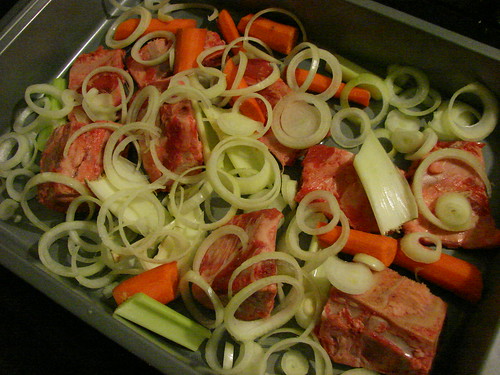
Start with a large, shallow roasting pan. Drizzle a small amount of olive oil onto the bottom of the pan. Add a couple of pounds of beef bones. Chop up some carrots, a few celery ribs, and a couple of onions and add them to the pan, too. Optionally, you can add a few quartered tomatoes and one or two sweet red peppers. Toss the ingredients around to coat them a bit in the oil, and then put them in the oven at 350 F to roast.

It'll take a couple of hours, but don't be in too much of a hurry. The secret to the flavor of a good stock is in the deep brown caramelization of the meat and veggies in the pan. Let heat and time work their magic, and don't try to rush things. Every half hour or so, pull the pan out and stir things around, turning them and flipping them so they brown evenly. Eventually, you'll see that everything is done.

Remove the nicely-browned bones and vegetables to a Dutch oven or stock pot. Add water to the pan and deglaze it thoroughly, then pour it off into the stock pot with enough additional water to cover the bones and veggies. Bring the pot to a simmer, and add a few peppercorns (whole or crushed as you desire,) a bay leaf or two, some parsley, and a bit of thyme. Cover the pot and let it cook.

In about an hour, you should start to smell the wonderful aroma of simmering stock. Check on the liquid level in the pot and add water now and again as needed.

In about four hours or so, any meat tidbits will be falling off the bone and the stock will be ready. Strain out the veggies, bones, and meat bits, and season to taste with salt, Vegeta, Maggi seasoning, or whatever secret ingredient your grandmother used to tell you about. You can skim the fat off the top of the stock now, but it will be easier if you chill it overnight - then you can just lift the solidified fat effortlessly from the top of the stock. (Leave a little bit of fat behind, though, for best flavor.)

There you have it - awesome homemade beef stock. An afternoon well-spent.
.

18 November, 2008

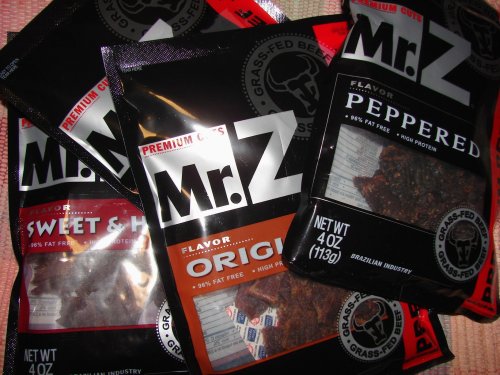
Mr. Z Beef Jerky

A month or so ago, Snackgirl over at Second Rate Snacks did a head-to-head comparison of Mr. Z to Jack Link (click here to check it out.) Her review was generally favorable, so I started to keep half an eye out for Mr. Z.

As it happens, I soon found a couple packages of Mr. Z Peppered beef jerky at one of the local job-lot places. It was a good price, and it turned out to be pretty decent jerky - real slices of real beef, and not any of that chopped and formed stuff that looks like it's been put in a blender and poured out to dry like some kind of barbecue-flavored Fruit Roll-Ups.

And then over the weekend, I hit the jackpot over at Dollar Tree: the full line of Mr. Z jerky, in full-sized four-ounce packages, for just a dollar each!

My first impression of Mr. Z was borne out as I tried the other flavors. Very high-quality beef jerky. The pieces were cut a little small, but they were still real slices of meat and not some bastardized puree. The label touts that the jerky is made from "grass-fed beef" which is probably meant to imply "free range" without actually saying so, but realistically, you'll never be able to tell the difference after all the processing is done and the spices and flavorings are added.

So, how is this stuff? Here's the run-down:

  • Original Flavor is pretty standard beef jerky. Snackgirl noted that there wasn't much difference between this and Jack Link, and she was right, but it also wasn't all that much different from Oberto or Jeff Foxworthy's, either.
  • Peppered is excellent. Very pronounced beefyness, loaded with delicious fruity-smelling fresh cracked pepper. Lots of black-pepper heat and a subtle sweetness behind it all. This is so much better than cheaper "peppered" jerkies I've had.
  • Teriyaki - Another winning flavor; delicious soy and ginger flavors shine through.
  • Sweet and Hot - Quite interesting. This flavor seemed to be lightly glazed with brown sugar and it had a very subtle cayenne-style pepper heat behind it. The sweet predominates at first, with the hot barely noticeable, but after eating more than one or two pieces, the heat begins to build and balance out the taste. Diehard chiliheads won't find this anything to scream about, and neither will pepper wusses (at first.) It's the cumulative effect that gets ya.
If you like jerky and you've a Dollar Tree nearby, get over there and check it out. But do it quick - the stuff is selling fast!


30 October, 2008

Meatloaf!

Don't you just love meatloaf? I do. It's one of my family's favorite suppers. In the summer, I often make it out on the grill, keeping the coals off to one side to be sure it cooks evenly.

My meatloaf recipe is very similar to the one I use to make meatballs (click here for that recipe) but it does have a few changes:
  • I leave out the Italian cheese and the chopped bell pepper and mix the meats together with just the onion and a single egg.
  • Instead of Italian seasoning, I mix freshly chopped parsley, salt, and pepper with the bread crumbs, and then combine the crumbs and the meat.
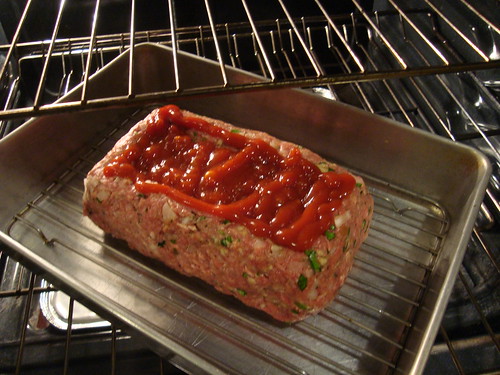
When the meat mixture is thoroughly combined, I form the whole thing into a rectangular loaf, and use my fingers to create a rectangular depression in the top of it, about half an inch deep or so. Then I fill that depression up with ketchup, put the loaf on a rack in a baking dish, and slide it into a preheated 350 F oven for about an hour and a half.

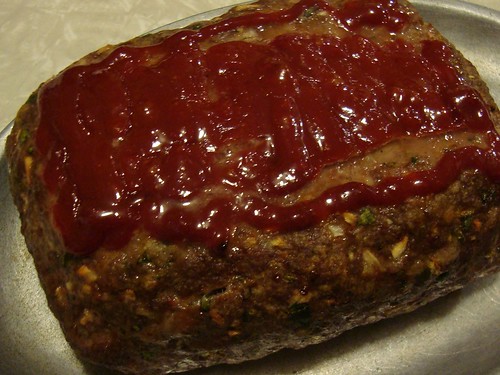
It comes out browned and crispy all around with a moist and juicy interior (this is why I don't use a loaf pan when I make meatloaf) and the ketchup cooks down to thick tangy/sweet tomato glaze on top.

I usually make mashed potatoes and open a can of corn to go with it. It's a perfect combo.