One of the best things about living in New England is the ready availability of bluefish. A cold-water Atlantic predator fish, they are a common sport and food fish here and are especially popular along the Connecticut coastline during the annual run that goes from mid-July through August.
Blues have dark and somewhat purple-bluish flesh which is oily and tends to be on the "fishy" side, similar to mackerel. If it's handled properly - iced immediately after catching, and kept cold - the flavor is no stronger than other oily fish like salmon or swordfish. People who prefer very mild white fish often don't care much for blue, however.
Personally, I love bluefish. It's great baked or grilled or to add a richer flavor to a fish chowder, and I also like cutting fillets into small bites and making "bluefish nuggets." But most of all, I love it smoked.
Smoking bluefish isn't complicated, but it does take some time. The process is similar to making homemade bacon with the biggest difference (besides the brine itself) being that the fish doesn't have to sit in a cure for a week.
Preparing the fish:
Blues have dark and somewhat purple-bluish flesh which is oily and tends to be on the "fishy" side, similar to mackerel. If it's handled properly - iced immediately after catching, and kept cold - the flavor is no stronger than other oily fish like salmon or swordfish. People who prefer very mild white fish often don't care much for blue, however.
Personally, I love bluefish. It's great baked or grilled or to add a richer flavor to a fish chowder, and I also like cutting fillets into small bites and making "bluefish nuggets." But most of all, I love it smoked.
Smoking bluefish isn't complicated, but it does take some time. The process is similar to making homemade bacon with the biggest difference (besides the brine itself) being that the fish doesn't have to sit in a cure for a week.
Preparing the fish:
 Start by making a brine. You can make as much as you'll need to completely cover the fish - I usually make it by the quart:
1 quart water
1/4 cup soy sauce
1/4 cup kosher or pickling salt
1/4 cup sugar
3 or 4 bay leaves, crushed
2 tablespoons mustard seed
1 tablespoon whole peppercorns
Combine the water and soy sauce. Add the salt and sugar and stir or shake to dissolve completely. Pour over the bluefish to cover in a shallow pan and add the bay leaves, mustard seed, and peppercorns. Cover and refrigerate while brining - a minimum of four hours.
Brining the bluefish is important. It adds to and enhances the flavor, of course, but it also helps the fish to retain moisture during the smoking process. You should leave the fish in the brine for at least four hours, but it's okay to let it go longer (even a couple of days if you're not going to get to it right away - the brine is a great preservative also.) Just remember that the longer you leave it in the brine, the saltier it may be.
Getting ready for the smoker:
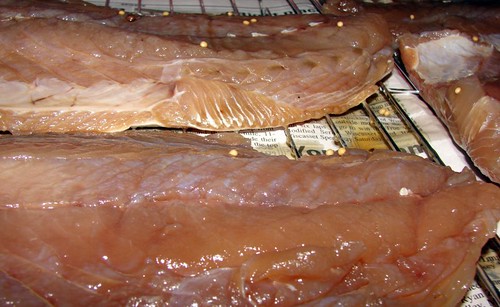 Smoke doesn't like to stick to wet surfaces, and the heat of the smoker can drive moisture out of the fish. And so, the next step is as important as the brine. When you take the fish out of the brine, place the fillets on a metal rack set above a few layers of newspapers. Allow the fish to dry for several hours, until the surface of the fish is dry and feels a bit tacky to the touch. It will take at least three hours, but if it's a damp day it can take five hours or more. If you're squeamish about leaving the fish out that long, make room in the refrigerator for the racks and dry them in there.
That dry, sticky surface is called a "pellicle," and it is formed by proteins on the surface of the fish as they are exposed to air. The pellicle will give the smoke a good surface to adhere to and protect the fish from giving up too much moisture while it's in your smoker.
Smoking the fish:
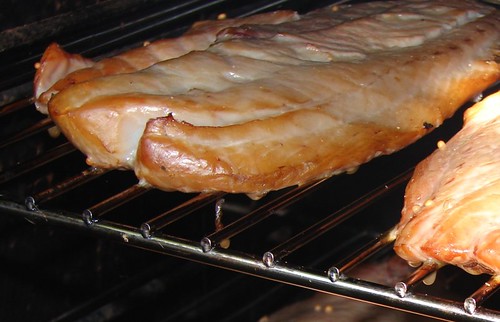 When the fish is dry, transfer it to the racks of your smoker. Bring the temperature of the smoker up to about 200 F for the first hour of smoking, then drop it to 150 F for another two hours or so.
At the end of that time, average-sized fillets will be done - moist but firm, flaky, and dry, perfect for snacking or using as an ingredient in a dip or paté.
Larger, thicker fillets may need more time. Just extend the time at 150 F for as long as needed to get the firm texture you're looking for.
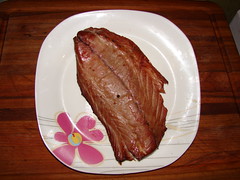 The delicious finished product will look something like this - a rich chestnut brown color, slightly darker around the edges, tender and moist but firm enough to pick up without falling totally apart. The flavor will be amazing: one of my friends described it as "fish bacon."
Bluefish has a strong flavor, so choose your smoking wood accordingly. You may want to go with an assertive smoke like mesquite, hickory, or even walnut or cherry to hold up to the taste of the fish rather than choosing a mild wood like maple or apple.
.