13 October, 2011
12 October, 2011
Cascal Fermented Soda Revisited
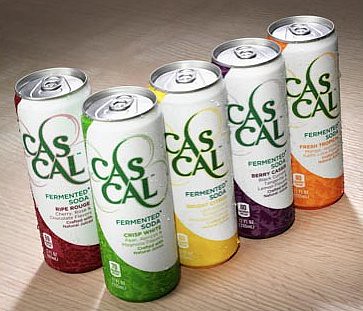
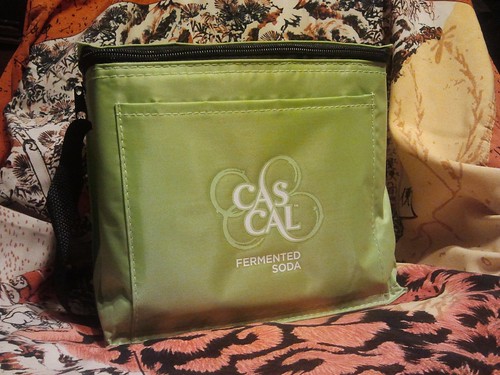
Back in September, I reviewed Cascal Fermented Natural Soda - specifically, the bottled Light Red version, which I enjoyed for it's refreshing fruity dryness. Not too long ago, the folks at Cascal got in touch with me and asked if I'd like to review their new line of fermented sodas, which are being offered in slender 12-ounce cans. I agreed, and they sent along a Cascal Lunch Pack - a five-flavor sampler of Cascal sodas and a cool little lunchbag cooler - for me to try out.
Now, I never really thought I'd say this about a soda, but I admit I'm rather impressed by the depth of flavor and complexity of Cascal's offerings. Soda pops these days are usually a blend of sticky-sweet syrup and fizzy water and there are few other options. There are some small-batch crafted root beers out there with rich and interesting flavors, but they're still really sweet. And there are plenty of unsweetened seltzers available, but the flavors are simple and sometimes uninspired. Cascal does a great job of putting together a soft drink with a decidedly adult appeal - a light, dry, and almost wine-like flavor developed by fermenting the fruit juice ingredients, flavorful without any added sugars, and lightly carbonated.
Here's what I thought of each of Cascal's canned flavors. Read to the end of the post, and I'll tell you how you can win a Cascal Lunch Pack of your very own!
Crisp White (Pear/Apricot/Magnolia) - A gently floral scent with a snappy pear flavor and just a hint of apricot overtones. Fruity and dry. I found it very refreshing. This was one of three blends that strongly reminded me of wine - Crisp White is kind of like a Riesling. Cascal suggests enjoying it with Brie or strawberry ice cream. I drank it with roasted chicken and it was delicious.
Ripe Rouge (Cherry/Rose/Chocolate) - Distinctively floral nose but with just a hint of rosy flavor. Cherry and stone fruit flavors yield to a phantom chocolate finish. The flavor profile reminded me of Merlot. It was great with a grilled cheeseburger.
Fresh Tropical (Mango/Jasmine/Kaffir Lime) - I'd describe this as a "dry mango" soda with a pleasantly tart lime finish. The label mentions jasmine, but I just didn't taste it - perhaps it was too subtle for me. Still, it was deliciously different and it was awesome with the pork rib tips I roasted for kind of an impromptu BBQ snack.
Bright Citrus (Lemongrass/Tangerine/Pineapple) - Probably my favorite of them all. Dry tangerine/pineapple flavor is well-balanced but leans a bit to the tangerine. Still, both flavors are distinct and distinguishable and I loves me some pineapple soda. Very crisp and quenching. Bright Citrus makes for an awesome rejuvenator after a few hours of early autumn yard work.
Berry Cassis (Black currant/Tangerine/Lemon) - Slightly citrus nose with rich black currant, cherry, and blackberry flavors. This was the third of the "winey" flavors, reminding me of Cabernet sauvignon. It held up well to a grilled steak.
It's easy for me to recommend Cascal Fermented Sodas. Despite my somewhat snarky first review of them last time, I really do think they have a good product, and one that there is a definite need for: An adult-oriented beverage that's a little more complicated than high-fructose corn syrup and water. Cascal has done it, and done a good job of it.
You don't have to take my word for it, you know. Cascal has generously offered to sponsor a giveaway here at the Cupboard.
Berry Cassis (Black currant/Tangerine/Lemon) - Slightly citrus nose with rich black currant, cherry, and blackberry flavors. This was the third of the "winey" flavors, reminding me of Cabernet sauvignon. It held up well to a grilled steak.
It's easy for me to recommend Cascal Fermented Sodas. Despite my somewhat snarky first review of them last time, I really do think they have a good product, and one that there is a definite need for: An adult-oriented beverage that's a little more complicated than high-fructose corn syrup and water. Cascal has done it, and done a good job of it.
You don't have to take my word for it, you know. Cascal has generously offered to sponsor a giveaway here at the Cupboard.
SORRY - THIS CONTEST IS NOW CLOSED.
WIN A CASCAL LUNCH PACK AND TASTE 'EM FOR YOURSELF!
Three lucky winners will each receive a Cascal insulated lunch bag and a five-can sampler of Cascal Fermented Soda.
There are two ways you can enter:
- Use the Contact Me tab near the top of the page and send me a message telling me you'd like to win some Cascal.
- Go to Dave's Cupboard on Facebook and comment on the status update that mentions the contest.
THREE WINNERS will be selected at random on MONDAY, OCTOBER 17 2011. Your entry must be received by 11:59 PM, Sunday October 16th 2011 in order to qualify. Don't wait for the last minute - I'm not responsible for misdirected or unreceived email. ONE ENTRY per person, please.
Should you win, your prize will be sent to you directly from Cascal.
| Dat Lunchbag |
05 October, 2011
Shameless Plug
If you ask my daughter Lynnafred what her earliest memory is, she'll tell you, "The time Dad was locked in the freezer."
She was about two years old, and we were grocery shopping at Edwards, a now-defunct store in Enfield. At the end of one of the frozen food gondolas, they had a large stand-up freezer case for bagged ice. It happened to be empty the day that we were there. I was walking on ahead of the wimmins - Lynnafred in the toddler seat of the shopping carriage Maryanne was pushing. I stepped into the freezer and waited, and as they came around the corner I pressed my hands and face to the glass and called out, "Maryanne! Help! Help me!"
Maryanne (briefly) looked surprised, but Lynnafred's reaction was awesome - an initial look of shock and then total, uncontrollable laughter - an "I BROKE YOU!" kind of laughter.
All of her life, I've tried to give her unique, challenging, and - most of all - stupidly funny experiences. She's grown into a exceptional human: confident, adventurous, curious, creative, and with a rare outlook on life that's part wonder and part cynical. She's been a writer since she could hold a pencil, and you've read some of her food and pop culture reviews here on Dave's Cupboard.
She's got a blog of her own: A Porchful of Geezers, where she's been posting book and video game reviews and, most recently, some of her more general writing. Check it out.
04 October, 2011
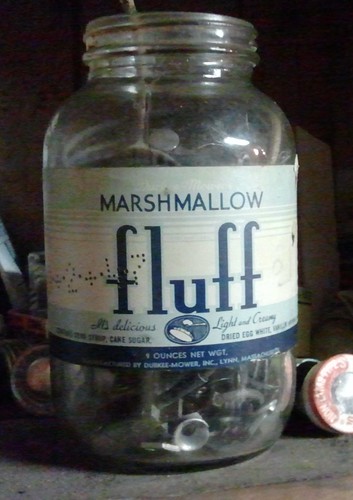
Vintage Marshmallow Fluff Jar
On weekends, I haunt estate sales. Some people look for jewelry, others go for rare books or vintage clothing. I usually check out the kitchen first and then head for the cellar or garage - wherever there might be a workshop. I have an old house, and I love discovering a handyman's cache of old repair/maintenance supplies that I can buy for use here. Most of the time, no one else is ever interested in that kind of stuff, and there is a significant quality difference in switches, light sockets, and other hardware that was made fifty or sixty years ago in the factories of Connecticut and New York over the flimsier stuff that now flows from overseas.
Anyway, last Saturday, down in the workshop of a house in Longmeadow, I found this awesome old 1940's Fluff jar (filled with pushbutton and toggle switches.) Too cool.
02 October, 2011
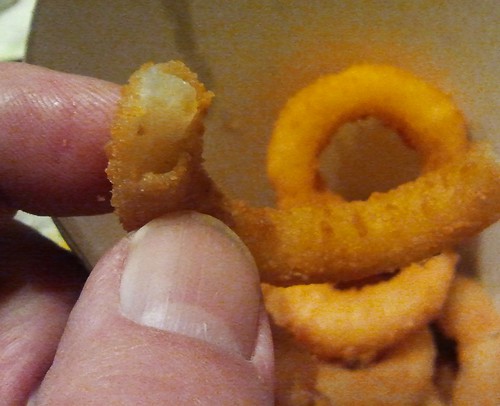
Burger King Onion Rings
Burger King's onion rings are on their "value menu" for a buck. They'd be too expensive at half of that.
Right out of the fryer, they're tolerable I guess, but the second they start cooling down the quality starts dropping sharply. They have a slippery mouthfeel, they have an artificial salt/onion powder flavor, and the grease coats the inside of the mouth.
I can't figure out why they're so damn bad. They're made from real sliced onions as far as I can tell, and they've got a fairly standard crumb coating. And yet, they're far and away the worst thing on the menu.
What's worse, I already knew all of that when I ordered them, so I have no one but myself to blame for giving them a second chance.
01 October, 2011
Because You Don't Poop Correctly
"Digestive Health" products are everywhere. The most famous, I guess, is Dannon's Activia brand yogurt, with ads starring Jamie Lee Curtis as The Poop Lady. And now the Jolly Green Giant jumps in the shit with DIGESTIVE HEALTH VEGETABLES.
| "I'm so proud of that last one that I left it in the bowl for you to admire." |
Yeah, that's definitely the smile of someone who takes regularly-scheduled dumps. I bet when he pinches one off, it's the size of a redwood.
30 September, 2011
Harvesting Black Walnuts
My house was built by Maryanne's grandfather in 1926. We have pictures of it, standing new and proud, surrounded by...nothing, for even though we live in the middle of a densely populated area today, in the 1920's this was farmland, only two blocks away from downtown Thompsonville.
Today, on the south side of the house, just the other side of the driveway, stands a magnificent old black walnut tree. It's somewhere around fifty years old or so, wide enough around that I can't embrace it, and taller than the peak of the house. In our family, no one alive today knows how it got there - whether it was planted, or grew from a seedling, unnoticed and unmolested until it was too large to bother with. There are several disadvantages to having a black walnut so close. They're filthy bastard trees that make a mess around them - twigs are always falling, and they have enormous compound leaves radiate from a stem that is heavy enough to be a twig in its own right. Anything the leaves or fruit touch gets stained black and that includes the paint on my truck. And the tree itself emits a chemical compound called juglone, which poisons the ground around the tree and prevents many other plant species from growing well. Juglone is present in every bit of the tree and, while harmless to humans, can be deadly to horses and dogs - even to the point that black walnut shavings shouldn't be used in animal bedding. And it ensures that I have to bag up the rakings from under the tree and put them out at the curb for the town to pick up (all my other yard waste is composted out back.)
For all that though, I enjoy my black walnut tree. It's large, spreading, and handsome and provides a lot of shade in the summer which keeps the house cooler (south side, remember?) And then there are the walnuts.
Once upon a time, black walnuts were more common than English walnuts in New England. They have a richer and deeper flavor than English walnuts and today they are very pricey when you can find them for sale commercially. Because the heavy, dense wood is prized for things like furniture and gunstocks, black walnut trees are a lot less common now than they once were (though small stands of them are still found here and there.) I have a feeling that these days, more black walnuts are harvested by foragers like me (and squirrels) than by the commercial segment.
Right now - late fall - is the time to be gathering and processing the nuts. By now, most of the nuts have fallen to the ground, and the ones still on the trees can be easily shaken loose. And so, I present to you this primer about how to gather and process black walnuts. Beware: it's a lot of work.
First of all, before I say anything else: If you intend to go through with this, be aware that it is MESSY. Before you go forward, get a good pair of heavy rubber gloves to protect your hands from the juices produced by hulling and handling the nuts. Black walnut juice is initially kind of a yellowy-green, but it quickly oxides to a dark brown, and it PERMANENTLY STAINS clothing, processing materials, and - especially - skin. Seriously. The first time I did this stuff, I used some shitty disposable nitrile gloves while hulling the nuts. The gloves leaked and I ended up with deeply stained brown hands that stayed that way for weeks.
OK, here we go:
1. Harvesting the nuts
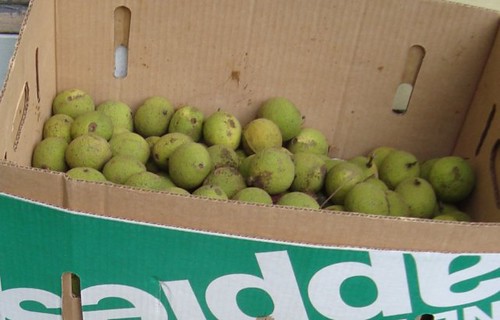
Black walnuts, ripening on the tree, look like slightly small green tennis balls. While they are green, they are immature and the nuts within will be of inferior quality. About in the middle of September, the tree's leaves will start falling and the nuts will finally be ripe enough to harvest. The hulls turn a lighter color - sort of yellowish green, and will develop brown spots. And you will easily be able to dent the hull by pressing it with your thumb. Gather the newly-fallen nuts from the ground or pick them from the tree at this point. Gather as many as you care to process, and as long as you don't mind the work, you will never have too many. It takes about a pound of unshelled nuts to make a cup of nutmeats.
2. Removing the Hulls
Here's where those gloves are essential.
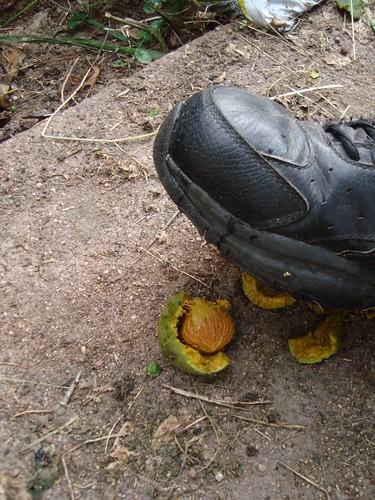
The hull is a little tough, but it cracks open easily. An easy way to do it is to simply put the nuts on a hard surface like a sidewalk and step on them. The hull will split open and you can remove the nut. Put the nuts in a bucket and put the hulls in a trash bag for disposal. Don't leave them out where your dog will find them and chew them, and don't compost them, remember?
Other ways you can remove the hulls:
- My favorite way it to put the nuts on the dropped tailgate of my truck and press them with the heel of my (gloved) hand. It works just as well as stepping on them and seems faster.
- Fill your driveway with nuts and drive back and forth over them until all the hulls are split. Your car tires will do nothing to harm the actual nut, but will split and remove the hulls. Don't laugh. There are several agricultural extension offices that actually recommend this.
OK, here we go:
1. Harvesting the nuts
Black walnuts, ripening on the tree, look like slightly small green tennis balls. While they are green, they are immature and the nuts within will be of inferior quality. About in the middle of September, the tree's leaves will start falling and the nuts will finally be ripe enough to harvest. The hulls turn a lighter color - sort of yellowish green, and will develop brown spots. And you will easily be able to dent the hull by pressing it with your thumb. Gather the newly-fallen nuts from the ground or pick them from the tree at this point. Gather as many as you care to process, and as long as you don't mind the work, you will never have too many. It takes about a pound of unshelled nuts to make a cup of nutmeats.
2. Removing the Hulls
Here's where those gloves are essential.
The hull is a little tough, but it cracks open easily. An easy way to do it is to simply put the nuts on a hard surface like a sidewalk and step on them. The hull will split open and you can remove the nut. Put the nuts in a bucket and put the hulls in a trash bag for disposal. Don't leave them out where your dog will find them and chew them, and don't compost them, remember?
Other ways you can remove the hulls:
- My favorite way it to put the nuts on the dropped tailgate of my truck and press them with the heel of my (gloved) hand. It works just as well as stepping on them and seems faster.
- Fill your driveway with nuts and drive back and forth over them until all the hulls are split. Your car tires will do nothing to harm the actual nut, but will split and remove the hulls. Don't laugh. There are several agricultural extension offices that actually recommend this.
3. Washing the Hulled Nuts
Keep your gloves on. Put the hulled nuts into a pail or bucket and spray them well with the garden hose. When the bucket fills up with water, agitate it so the nuts knock and rub up against each other - this will help remove the remaining hull fibers. A few nuts might float to the top of the water - those are no good; pick them out and throw them out. Pour off the water (which will be stained dark brown) and refill the bucket and repeat the process. After three or four times, the water will start running clear and the nuts are clean enough to cure.
4. Curing
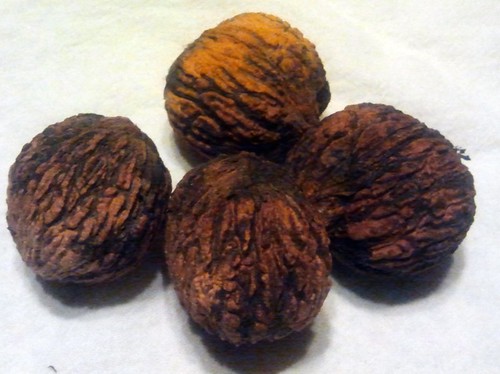
The nuts need to thoroughly dry and cure for two weeks or so before they can be shelled and stored. They should be spread out with plenty of air circulation in a cool, dry place out of direct sunlight. Traditionally, black walnuts were put into loosely-woven burlap sacks and hung from the rafters of the attic. However, I prefer to set up an old screen door on a couple of sawhorses in my cellar and spread the nuts out on them to dry, but there are other methods you can use if you don't happen to have an old screen door or some burlap sacks handy. You can spread them no more than a couple layers deep on racks, or put them in wicker baskets according to some sources. In a few weeks, they'll look like the picture to the left, and they'll be ready to shell and store.
5. Shelling and Storage
Black walnuts are damn hard to crack. They have a thick shell, and they are nearly impossible to break with handheld nutcrackers - and even most lever-action crackers will quickly become destroyed trying to break them open. You can hit them with a hammer (which has to be done carefully to avoid smashing the nutmeats to tiny bits) or you can slowly squeeze them in a bench vise until they split. Best of all, though, is a device called the Master Nut Cracker, invented by a gentleman named Gerald Gardner in Sarcoxie, MO and made in the USA from very high-quality parts. This cracker, which Mr. Gardner sells on eBay and from his website, has the muscle required to split all sorts of very tough-shelled nuts like black walnuts, butternuts, hickories, and macadamias.
| The Master Nut Cracker. Photo by Gerald Gardner. |
After the nuts have been shelled, pick the nutmeats from them and store them in the refrigerator. They'll keep in the fridge for three months or so, but remember that nutmeats are filled with oil that easily goes rancid, so they won't keep forever. For long term storage, nutmeats should be frozen.
I told you it was a lot of work. But I think it's worth it.
28 September, 2011
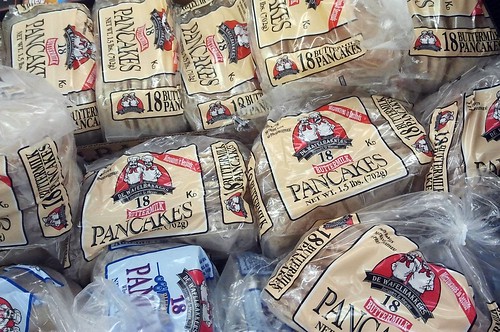
A Sack Of Frozen Pancakes???
Really, now...is it that difficult to make pancakes?
No, of course it isn't. And homemade pancakes are a small fraction of the price of bagged, and they taste better, and they don't take all that much time to whip up.
Now, you really should have a pancake recipe somewhere in your recipe collection, but just in case you don't, here's the one Maryanne uses. It's easy to remember, too, because the ingredients are "a symphony of ones."
Maryanne's Pancakes
Makes about 10 4-inch pancakes
Recipe may be doubled
Makes about 10 4-inch pancakes
Recipe may be doubled
1 cup of flour
1 tablespoon of sugar
1 tablespoon baking powder
1 egg, beaten
1 cup of milk
2 tablespoons vegetable oil
In a large bowl, stir the flour, sugar, and baking powder together. In a smaller bowl, beat the egg, milk, and oil together. Stir the milk mixture into the flour mixture with a fork just long enough to make a smooth batter. Set it aside for a few minutes to allow the baking powder to start to work.
Heat up a skillet until drops of water flicked off your fingers onto the skillet dance around and sizzle. If you have a non-stick or well-seasoned cast iron skillet, you will not need any grease, otherwise grease the skillet lightly. Pour batter by the ladle onto the skillet and allow the pancakes to cook until the edges are kind of dry and the top surface is studded with little bubble craters. Turn the pancakes and cook briefly to brown off the top.
Blueberry option: After the batter is mixed, stir in half a cup or more of blueberries.
In a large bowl, stir the flour, sugar, and baking powder together. In a smaller bowl, beat the egg, milk, and oil together. Stir the milk mixture into the flour mixture with a fork just long enough to make a smooth batter. Set it aside for a few minutes to allow the baking powder to start to work.
Heat up a skillet until drops of water flicked off your fingers onto the skillet dance around and sizzle. If you have a non-stick or well-seasoned cast iron skillet, you will not need any grease, otherwise grease the skillet lightly. Pour batter by the ladle onto the skillet and allow the pancakes to cook until the edges are kind of dry and the top surface is studded with little bubble craters. Turn the pancakes and cook briefly to brown off the top.
Blueberry option: After the batter is mixed, stir in half a cup or more of blueberries.
27 September, 2011
Doritos Creator Arch West Dies at Age 97
| Photo courtesy of the West family. |
Arch West was a marketing vice president for Frito Lay, Inc. in 1964 when he took a family vacation to San Diego that would change the snack food industry forever.
Hungry for road munchies, the family pulled up to a roadside stand and bought a bag of tortillas which had been cut up and fried to greasy, crispy awesomeness. Arch knew with one bite that he had stumbled upon an epic snack.
Back on the job, Arch pitched his idea to his corporate overlords: a thin tortilla chip - heartier than the company's best-selling Lays Potato Chips, lighter than Frito's Corn Chips. The company was skeptical, but when they agreed to do some consumer testing and found that the chips were very well-received, the new snack dubbed Doritos were introduced to California test markets in 1966. They were so popular that Frito Lay rolled them out nationwide in 1967, and Doritos have been unstoppable ever since.
Today's Doritos are a little different than the originals. Besides being available in a wide variety of regular flavors, Frito Lay brings out a stream of special flavors and packages every year. And in a mid-1990's revamp of the recipe, the chips were made a little thinner, a little larger, and given rounded corners.
Mr. West was born in Indianapolis in 1914 and graduated Franklin College where he was a member of the Delta Rho fraternity. He served as a Lieutenant in the US Navy during WW2 and worked in advertising on Madison Avenue in NY before being lured to Texas by the Frito Company, which offered him a vice presidency in marketing. After retirement, he and his late wife Charlotte served as volunteers on his local FEMA's disaster relief team. He's survived by three sons, two daughters, and eighteen grand- and great-grandchildren. The family plans an October 1 service and burial, and daughter Jana Hacker says the family plans to sprinkle the grave with Doritos before lowering his remains to rest.
View Mr. West's obituary on legacy.com here.
Various news stories were used as sources for this post.
25 September, 2011
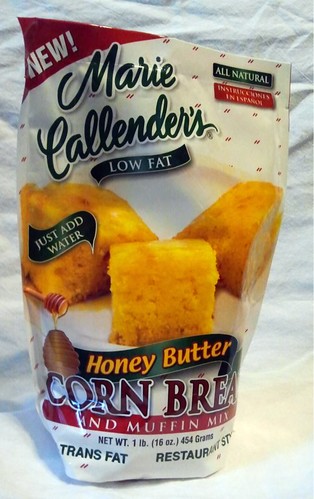
Marie Callender's Baking Mixes: Honey Butter Corn Bread
I bought an assortment of Marie Callender's baking mixes a little while ago - back when the weather cooled down and I thought that autumn was finally here and I'd be running the oven more. Here it is a week later, and it's been kind of warm and humid again, much more like summer, and I only had time to make one of the mixes before the weather turned. So I've decided to review the mixes one at a time, as we make them, rather than go on a baking bender and review all of them at once. This review - for Marie Callender's Honey Butter Corn Bread Mix - will be the first of four reviews over the coming weeks.
First, though, let me explain a little about the difference between Northern corn bread and Southern corn bread.
Northern-style (or New England style, if you prefer) corn bread is generally moist, rather dense, and somewhat on the sweet side. Some of my Southern friends have described it as being more like a cake. I never thought of it as particularly sweet - at least, it wasn't all that sweet the way my mother made hers, but it is certainly sweeter than most Southern recipes.
Southern-style cornbread calls for less sugar, has a drier and more delicate texture, and crumbles more easily.
Which variety you prefer seems to depend entirely upon where you grew up and what kind of cornbread your mother made. Serving a pan of each variety to a mixed crowd of Yankees and Southerners can be a real hoot: the Southerners mock the Northern corn bread for being a cakey dessert, while the Northerners choke and grab for glasses of milk to wash down "that dry-ass Southern stuff."
Now, the reason I've gone off on such a long tangent about types of corn bread is because Marie Callender's Corn Bread Mix produces a dense, sweet, and very moist corn bread - Northern style - and I want to forewarn Southern readers that they might want to skip it because it's not going to be anything like you've come to expect. On the other hand, it's wicked easy to whip up - just add water to the mix and stir, then pour the batter into an 8 x 8-inch brownie pan and bake - and it makes quite an excellent corn bread (to my New England palate.)
Speaking of tangents:
As far as I can tell, there are at least three entities out there in Corporate Food Land, operating more or less independently under the Marie Callender's name:
- The original California restaurant chain, Marie Callender's Restaurant and Bakery
- A line of frozen foods produced under license and made since 1993 by ConAgra, who purchased the frozen food company and retained the rights to the name, and
- Marie Callender's Gourmet Products, which make the baking mixes.
Other than the name, I don't think the companies have much in common. It's all very confusing.
Subscribe to:
Posts (Atom)