08 May, 2010

Traces of the Past (A Photo Essay)

OK, here's a post about KFC that has nothing whatsoever to do with Double Downs.

KFC has had kind of a checkered past in my hometown, with restaurants opening and closing, coming and going as taste (and the real estate market) changes.
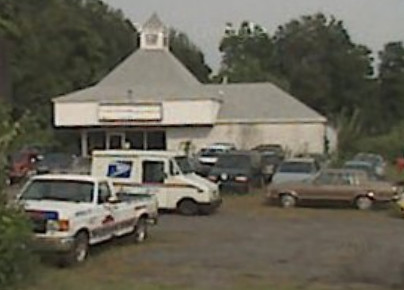
Photo (c) Google
The first Kentucky Fried Chicken restaurant that I remember in town was on US 5 in North Thompsonville.  After KFC closed, it became a fish market.  There were lobster tanks running along the north side of the building (behind the big window on the left in the picture.)  After the fish market moved, the landlord - a garage/filling station located across the street) never rented it out again. They use it as a parking lot for vehicles in various states of disrepair, but the building is still recognizable as a former "classic" KFC.
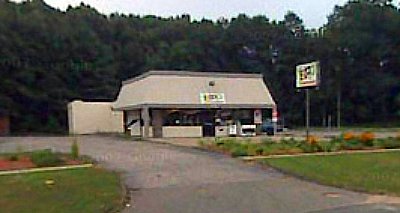
Photo (c) Google
Then there was Kentucky Roast Beef.  You might not even remember that chain, but I remember them for the really massive roast beef sandwiches, and how the roast beef was the real deal, and not that chopped/compressed/loaf-shaped garbage that somehow passes for "roast beef" these days. It was a short-lived experiment round these parts, though, and the building stood empty for a few years before it was bought by a graphic arts printing and design company.  Nowadays, it's a convenience store, but it still retains the overall lines of a Kentucky Roast Beef.

This really doesn't have anything to do with KFC itself, but outside the restaurant I saw what might very well be the last functional Yugo in the state of Connecticut.  (I was going to say "New England" but I bet there are at least a handful of these up in Maine and New Hampshire, beat to hell but still running, being used as disposable tote-road vehicles in the woods.)

Anyway, after Kentucky Roast Beef closed their doors, the Colonel must have decided that Enfield was more trouble than it was worth, because it was a long time before they were back.  A new strip mall was developed on Route 190, and the developers set the stores back a way from the road and sell "pad sites" up by the street for fast food places. We got a McDonald's (our third, hooray for us I guess,) a Dunkin' Donuts, a Taco Bell, and a D'Angelo's sandwich place.  And a combination A&W - Kentucky Fried Chicken. The KFC side did well, but the A&W part never really got off the ground, thanks to a lease restriction:  McDonald's lease claimed exclusive rights to selling burgers at that strip mall, and A&W didn't find out until they were forced to pull all the burgers from the menu after they opened.  Root beer and hot dogs weren't enough to keep the logo on the walls, so eventually, A&W  gave up and moved every bit of their stuff out - except the single piece of furniture in this picture -  the "Mug Return" station - which waits patiently for the mugs which will never come back.

.

07 May, 2010

KFC's Double Down WITH GRAVY

I got out of work late the other night, and I really wasn't in the mood to cook...I was just too beat to think about spending an hour or so in the kitchen.  So I called home and had Maryanne make up a green salad, while I swung by KFC for a batch of Double Downs.

And gravy.

Now, when I was a kid, Colonel Sanders was still in charge of Kentucky Fried Chicken, and the gravy was absolutely awesome.  The Colonel himself was so proud of his gravy that he once said, "This gravy's so good you can throw the chicken away and just eat the gravy."  Over the years, with the Colonel now having rung down the curtain and joined the Choir Invisible, the gravy recipe has changed and cheapened and it's not the same as it used to be.  And yet, in it's own not-really-chicken-gravy-any-more way, it's still delicious.  

As I drove to KFC, I was thinking about how good their gravy was, and how good a Double Down would be with some of that gravy.  So when I left KFC, Double Downs in hand, I had a tub of gravy with me as well.  Usually, the gravy is just sold as a part of the "Mashed Potatoes & Gravy" side, but if you ask nicely the folks behind the counter will sell you just the gravy separately.

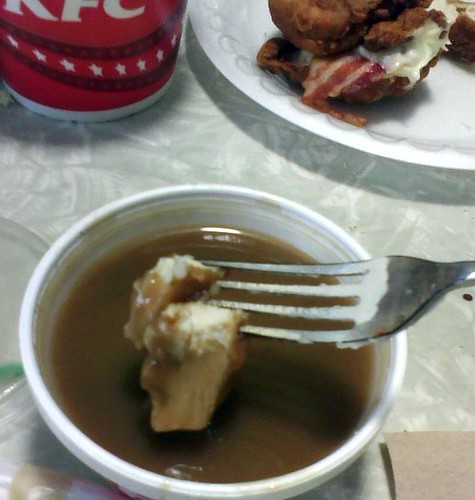
I cut an experimental bite of Double Down and dipped it with a fork into the gravy.  It was awesome.  So I just kept the sandwich on the plate, ladled it with gravy, and nommed with knife and fork.

If there was any way to make the Double Down even more badass than it already is, gravy is it.

By the way, Double Downs are only here for a limited time - come the end of May and they'll be gone - so if you haven't yet gotten your share of EPIC, now might be a good time.  Ken Hoffman of the Houston Chronicle couldn't have put it better when he said, "This one will be a legend, as in, 'remember the time KFC came out with a sandwich with two chicken breasts on the outside and no bread?'  No joke."

.

06 May, 2010

Mike & Ike Naughty Bits

So the past few times Lynnafred has picked up Mike & Ike candies, there's been an unusual number of...misshapen candies in the box.  Little Mike & Ike beads, or candies with flat ends, or candies with - ahem - unusual ends.

Like this one.  A Mike & Ike pen0r fruit.  Also just the right size for Barbie to strap on and turn the tables on Ken.

Yes, my inner 12-year-old has a riot with stuff like this.

.

Out of the Can: Canned Golabki

Thanks to an interestingly gelatinous gravy, canned golabki maintain their cylindrical shape remarkably well.

.

05 May, 2010

Fishy Delights 37: Almond Fish

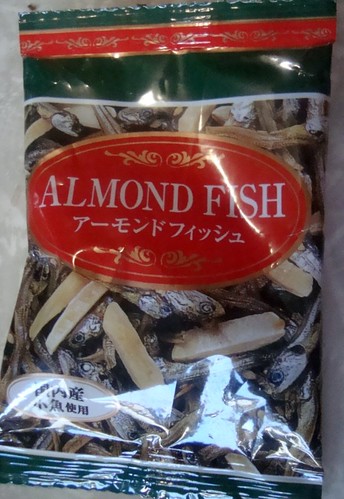
Behold Almond Fish, another in the series of strange and unusual snacks sent to me in a CARE package from Stephanie in Shanghai. Almond Fish are exactly as the name implies:  Tiny whole dried silver minnows and slivered almonds, lightly seasoned and ready to eat.

Almond Fish are delicious and very satisfying, especially if you really like fish as I do.  The dried fishies are crispylicious and very slightly sweet - I suspect they're sprayed with a weak sugar solution before they're processed - and the almonds compliment the flavor nicely.  Strongly flavored but in a pleasant "clean" fishy way, I found them to be much more delicious than the dried eel I reviewed earlier.

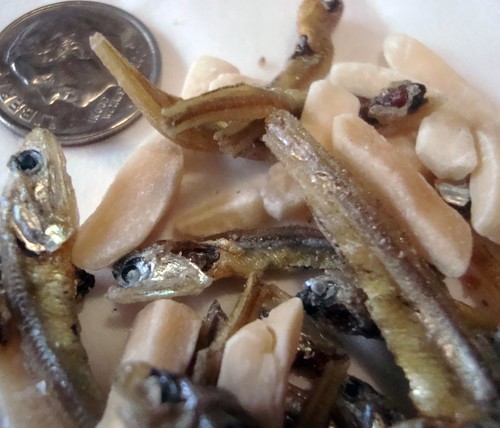
Here's what you get inside the package (dime not included, I put that there so you can get a sense of scale.)  You can see that the quantity of almonds and fish are well-balanced, so you never have to get stuck eating just one or the other near the end of the pouch.  Cracker Jack could learn a thing or two from Almond Fish - they never put enough peanuts in.

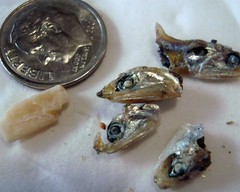
I noticed something else:  Tiny dried fish seem to be most fragile right  behind the head.  If you sort of just randomly eat Almond Fish by nomming little portions pinched out of the bag, you wind up with a bunch of little tiny fish heads in the bottom of the pouch.  They're still tasty and crunchy, though, so you might consider this to be a kind of "saving the best for last" situation especially if you're really into fish heads.

As usual with this kind of snack, I couldn't get Maryanne or Lynnafred interested in trying them.  Actually, I couldn't get either of them to stop calling them "disgusting."  Zim, however, is always up for a new flavor experience (especially when it tastes of fish) so here's a gratuitously goofy-looking picture of him enjoying a crispy fish.

.

04 May, 2010

New Crystal Light Pure Fitness

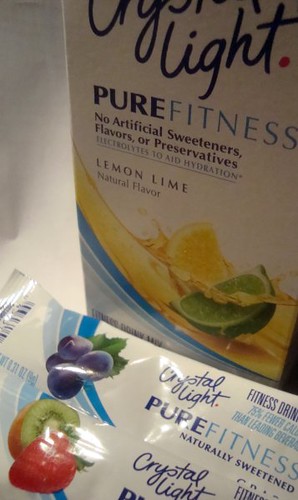
A short time ago, Kraft Foods sent me a sample assortment of their latest addition to their lineup of Crystal Light drink mixes:  New Crystal Light Pure Fitness.  They gave me samples of all three flavors - Strawberry Kiwi, Grape, and Lemon Lime - and asked me to try them out.

The timing couldn't have been better. My wife Maryanne and I had a full weekend of outdoor labor scheduled, with temps set to be in the 80's.  We both considered ourselves fortunate that Kraft had chosen this particular week for the review, since we had a lot of work lined up:  building raised vegetable beds, setting up that new pair of rain barrels, I wrote about yesterday digging out these damned tenacious vines that keep trying to swallow the house, and more.  All in full sun. It was exhausting work.

Each 9g packet of Crystal Light is meant to be dissolved into a 16.9-ounce bottle of water.  Each one contains a few grams of sugar and some rebiana (a stevia-derived sweetener) for flavor, and some electrolytes to take care of thirst.  The promo literature with the packets mentioned that Crystal Light had a lot fewer calories than many other sport drinks.  They sounded pretty good, and we tried all three flavors:

Grape was similar to many other grape-flavored sports drinks we've had.  The flavor was subtle and surprisingly tart, which took all of us by surprise (it was the first one we tried and I guess we were expecting something sweeter.)  I thought it was pretty good, Maryanne liked it, and Lynnafred said it was too much like Kool-Aid for her tastes.

Strawberry Kiwi was Lynnafred's favorite.  Sweeter than the grape with a more pronounced flavor, she thought the flavor was very authentic and natural.  I didn't find it quite as quenching as the grape, but that's probably because it was sweeter.

Lemon-Lime was very good; Maryanne and I both enjoyed this one the most.  Like the grape, the flavor was milder than lemonade or most sport drinks, while still being noticeable and enjoyable.  Tart and very quenching, this is the flavor that we both turned to the most during our "drink breaks" as we worked.  We found it hit the spot just right.

All in all, we thought that Pure Fitness was a great drink mix.  Maryanne is tucking the remaining packets into her gym bag.  It may sound funny to hear a guy recommending something so heavily marketed to women, but there ya go.

Links etc.:


.

03 May, 2010

The Rain Barrel Project

When Maryanne and I first moved to our current house - The Last House, we call it - she wanted a rain barrel.  When she was a kid, her grandparents had an oak rain barrel at the corner of the house. She liked the looks of it, and she liked the idea of watering the garden without using city water.  After we were more or less settled in, I found an old oak barrel in our barn.  Well, it had been a barrel at one time, anyway - a collection of staves with a round bottom and a collection of rusty hoops.  I took the pieces out and found that it could be reassembled - sort of like putting together a 3-dimensional jigsaw puzzle, but I figured it out and hammered the hoops down until the barrel would hold its shape, and then I put the hose in it and filled it with water, letting it soak until the staves swelled up and make the thing watertight.

Did you know you can grow about
40 pounds of potatoes in a barrel?
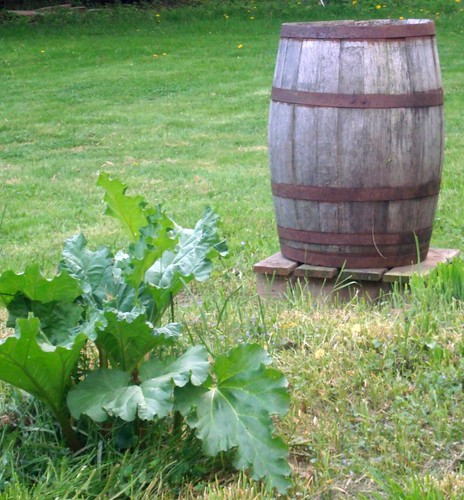
We used it for two years, but eventually things "happened" with the barrel - it was loosening up, and leaked, and then the bung just kind of popped out and we couldn't keep more than half a barrel of water anymore.  The barrel certainly had issues when we first started using it - it must have been in the barn for at least forty years - but it had served its purpose and it was time to retire.  It's out in the garden now, close to the rhubarb, with a layer of seed potatoes in some soil on the bottom of it.  Yep, it's our Potato Barrel now.

We both still wanted a rain barrel, though, so I started looking around for some alternatives.  Rain barrels are pretty popular right now, and I noticed lots of retailers sellling purpose-designed rain collection "systems" for pretty steep prices - as much as $250 - way too rich for my blood.  I decided to come up with a system on my own.

Much as we both liked our old oak rain barrel, it has certain disadvantages.  For one thing, the open top allowed in too much junk - falling leaves, disgusting insects, tree pollen (last year was a particularly heavy year for tree pollen, and for a while the water in the barrel had a half-inch-thick cake of pollen floating on the top, no exaggeration.)  For another thing, there's no good way to thread in a spigot in a wooden barrel, so we resorted to dipping a ladle or pan into the water, just the way Maryanne's grandparents did so many years ago.  Not very convenient - it would have been much easier to just attach a hose to a faucet and then run out the hose to where it was needed.  And then there were the mosquito larvae.  I had to keep a supply of bacterial "cakes" on hand to inoculate the water and kill off the swarms of larvae that would otherwise infest it.

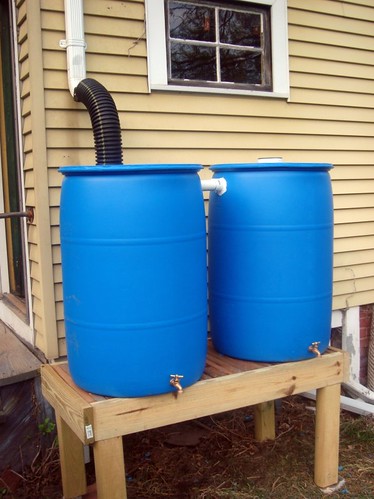
I found my answer in a pair of USDA-approved food-grade plastic 55-gallon drums that I bought from a seller on Craigslist.  The construction took most of the day on Sunday, but it was well worth it.

I started off by building a 2-foot-high platform for the barrels. I wanted them off the ground so we could access spigots set near the bottom, high enough to work comfortably with them and have a place below to stash watering cans, clay pots, and so on. I built the platform out of sistered 2x6 and 2x4 pressure treated lumber, held up by stout 3x5 landscape timber legs. The decking is 2x2 red cedar deck railing pickets salvaged from a friend's deck replacement.  This construction should be able to hold the combined weight of the two filled barrels.  We'll see, but the worst that can happen is they tip over into the yard and spill some water.

To fill the barrels, the downspout on the back of the house goes into a 4-inch black downspout extender which is fitted to the top of the first barrel.  The hole and the diverter are the same diameter to prevent insects and other nasties from finding their way inside.  A few inches below the lid of the barrel, I cut a 2-inch hole and fitted it with a PVC pipe that connects to a similar 2-inch hole in the second barrel. When the first fills up, the overflow will enter this second barrel.  The second barrel also has an overflow hole, directly opposite the filler hole.  When both barrels are filled to capacity, excess water will run out this overflow and travel down a 2-inch PVC pipe just as though it were coming directly off the roof.

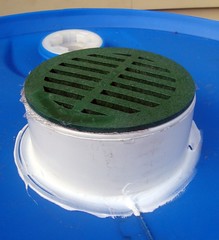
Because the fit is fairly tight on all of these connections (and, in fact, I sealed the connections with silicone caulk to keep them that way) there needs to be a vent to allow air out as water comes in.  So in the center of the second barrel's lid, I cut a opening large enough to receive a standard 4-inch coupling. With that, I put a plastic grate with a fine-mesh aluminum screen behind it.  The grate will keep out leaves and twigs and so on, while the screen will block the mosquitoes.

Finally, I used a spade bit to drill a 1-inch hole near the bottom of each of the drums - the perfect size to accept a threaded hose bibb.  The brass bibbs screwed directly into the relatively soft plastic of the barrels, tapping the threads as they went and providing a spigot on each one without a lot of complicated plumbing work.

Because I had most of the tools for this job on hand and almost all the wood for the base was either salvaged or leftovers from other household projects  (there's a lot to be said for being handy around the house) the job was quite affordable - $50 for the two barrels and about $20 for other materials - and I have double the rainwater storage that I once enjoyed.


02 May, 2010

Vintage Sunday: An Antique Portable Oven

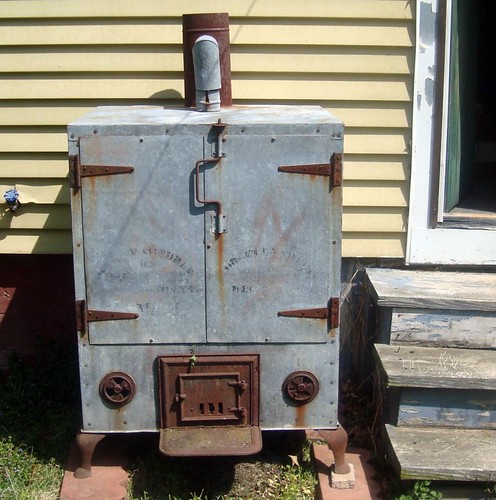
About 20 years ago, I was driving through Stafford CT when a big galvanized box caught my eye.  It was a small cast-iron wood stove enclosed in a double-walled square structure. The outside wall was galvanized steel and the inside walls were tin.  There were three cast-iron racks spaced a foot apart on the inside, and it was obvious how a stove pipe would rise along the back inside of the box to emerge at the top.  The smaller galvanized vent at the top of the box had a damper in it before leading into the big stovepipe.

At the time, I I figured it for a camp oven (there are handles on either side of the box to facilitate lifting, but when I need to move it I always have just tipped it onto a hand truck - two guys lifting from the side have all they can do to move this beast around) but I also considered the possibility that it was a small smokehouse, hot smoker, or similar device.  Whatever it was, I liked it for it's oddity and it ended up coming home with me.

The inside tin was very rusty when I first brought this oven home.  I thought I might clean it up and use it as an outdoor oven - or convert it to a big smoker - but other projects and chores always seemed to get in the way.  Eventually, the stove took it's place right next to the barbecue/smokehouse area where it serves as a convenient and weather-tight way of storing outdoor cooking equipment when not in use - things like my big outdoor propane burner, fire starters, ash shovels, the little Weber Smoky Joe grill, and so on.  The rusty tin inner wall has, sometime in the past five years or so, started completely rusting out from the bottom up, so I reckon I'll never bother restoring it now.

And that's kind of a shame, because I've finally managed to figure out exactly what I've got here, and it's kind of cool.  From the faint traces of stenciled paint remaining on the front doors, my outdoor barbecue storage unit is a Blodgett & Sweet No. 4 Galvanized Iron Oven, made by G. S. Blodgett & Co. in Burlington VT, around 1889.

In 1848, a Vermonter by the name of Gardner Spring Blodgett invented and patented a portable galvanized oven, very much like the one you see in the photo above.  It became wildly popular around the globe ("in use throughout almost the entire civilized world," according to one source) and the company he founded - G. S. Blodgett & Co. - is still in business as Blodgett Corporation, a leading manufacturer of commercial ovens even today, after more than 150 years.

.

01 May, 2010

Cintron Liquid Energy

Closeout stores and job lots are among my favorite places for getting energy drinks. They're cheap, they're plentiful, and I'm only throwing away seventy cents or so if the drink ends up tasting completely nasty (which they usually do.)

But I was given a very pleasant surprise the last time I was down at the local Ocean State Job Lot. In the corner by the other beverages were a couple flats of Cintron Liquid Energy drinks, all in assorted flavors. And the blue one caught my eye, because Dave and I love our blue foods.

So, seventy cents later, I have a strange new energy drink sitting on the kitchen table. And much to my surprise, it was good. Granted, it was sweet like most other energy drinks, but it had a full-bodied citrus flavor - oranges and grapefruit and something else - and had a subtle touch of tangy blue raspberry in the background. I was shocked at houw good it was, but can see why it failed in a market dominated by big names like Nos, Full Throttle, Monster, Red Bull, and Rockstar. But I can forsee myself going back and picking up another can or two within the week so that I can savor its deliciousness again.

.

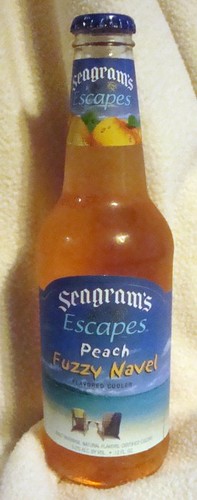
Seagram's Escapes - Peach Fuzzy Navel Flavored Cooler

I hardly know where to begin in describing this beverage.  Like most bottled drinks of its kind, which are meant to sort of imitate "real" cocktails, it's alcoholic without containing any hard liquor.  No, these drinks are actually pretty closely related to beer - they are malt beverages, fermented without hops to avoid too much of a beery taste, then sugared up and flavored to appeal to, I guess, a younger demographic.  One that has grown up drinking Coke and Mountain Dew and which doesn't care for the bitterness of hops or the full body of a "real beer."

So, with that part understood, and accepting this Seagram's Peach Fuzzy Navel for what it is, I will tell you this:  it's pretty good.  Refreshing, even, in the same sort of way you might be refreshed by a soft drink.  It's lightly carbonated, somewhat more sweet than I'd like but that's the nature of the beast I guess, and it tastes like a juicy fresh peach (albeit with a very slight back taste of malty brew.).  They go down easy.  On a warm spring evening, standing over the grill and keeping an eye on the hot dogs, the Fuzzy Navel is a great quaff. 

That leads me to another point.  The Fuzzy Navel is fairly low in alcohol content at 3.2% alcohol by volume.  It's sweet peachiness and gentle fizz make it easy to guzzle, and therefore easy to pound down quite a few without feeling the alcohol sneaking up on you.  3.2 or not, if you drink enough of them in a short enough time, you're going to feel it.  It's up to you to decide whether it's worth paying premium alcohol prices for a mildly-intoxicating alcopop.

.