Showing posts with label shellfish. Show all posts

25 September, 2014

The Big E 2014 - Matunuck Oyster Bar


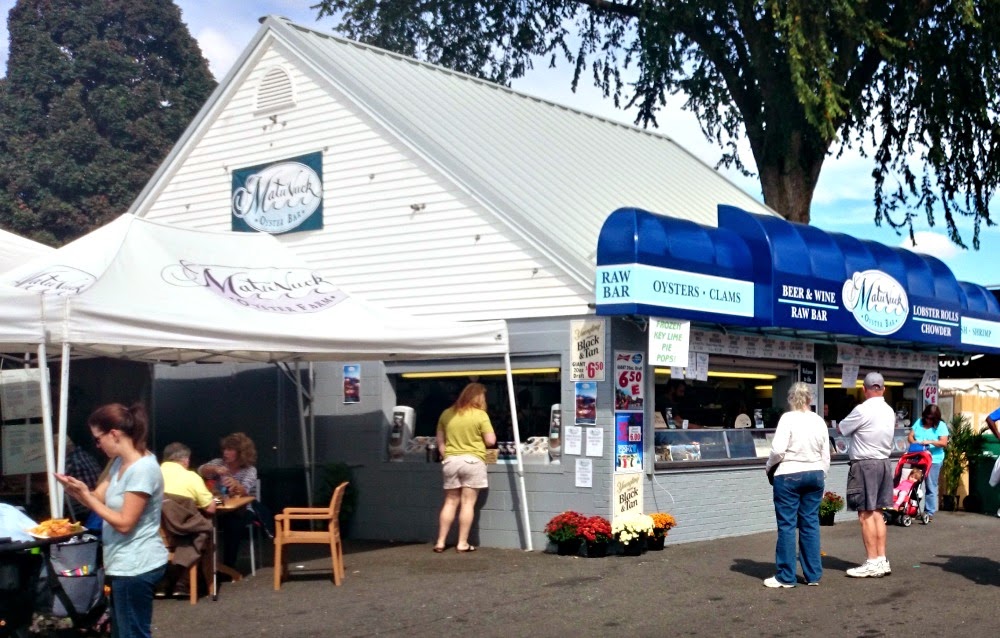
In Rhode Island, the Matunuck Oyster Bar is justifiably renowned as one of the state's - indeed, even the country's - best oyster bars. And so it was great excitement that it was announced that they'd be opening up a raw bar at the Big E. While anything new is welcomed at the Exposition (existing businesses tend to become entrenched and the waiting list for new vendors to come in can often be years long) having Matunuck arrive at the fair was treated as an especially big deal, particularly by the local news media who went bonkers over the idea of a raw bar at the Eastern States Exposition! 

[To tell the truth, I was pretty excited by this news too - this is a New England state fair, after all, and we need more New England-oriented attractions and fewer stupid copycat crap attractions like the faux "Mardi Gras" parade.  Mardis Gras? Really? In fucking September??]
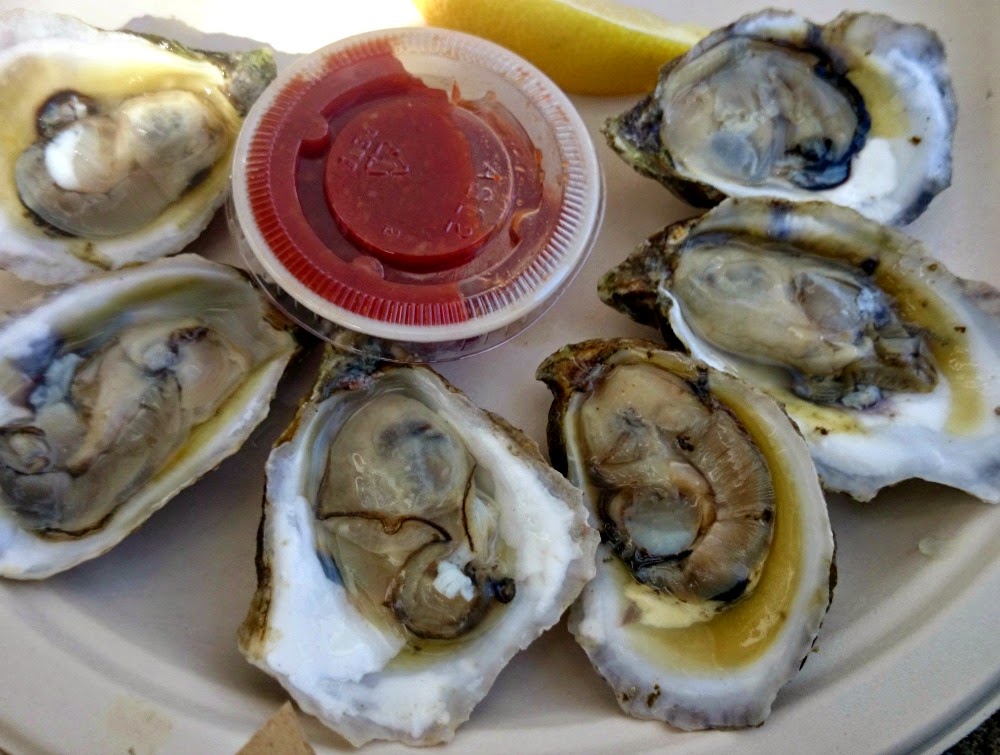
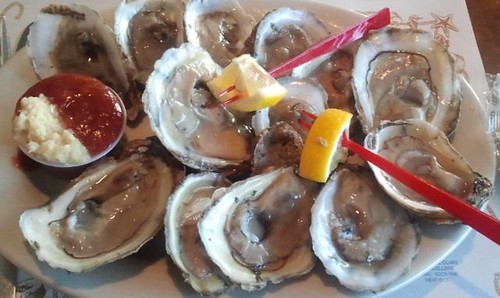
So anyway, I wandered by the oyster bar to see what all the fuss was about. The shellfish was nicely iced and looked pretty decent, and they were taking the time to shuck oysters as they were ordered to make sure everyone got the best experience possible. So I ordered half a dozen oysters for a light early lunch.

They were...okay.  Just okay. Nothing stellar, and I'm really glad I decided to order when I did, because when the fair gets crowded, there is a long queue at the ordering counter here and these oysters were, quite frankly, not worth an extended wait time. They were good enough for oysters trucked inland far from the sea, but also they were small, not very plump, and not very sweet or briny. Go to one of Matunuck's Rhode Island restaurants and you will have an awesome experience. Go to their Big E building and you will have supermarket oysters.

The condiments available for the oysters are low-grade standard as well - a slice of lemon and a cup of very bland and ketchupy cocktail sauce on the plate, and a bottle of unexceptional hot sauce at the pickup window for optional sprinkles. Horseradish was missing and very sadly missed - I would have take a big scoop of it just to mix with the cocktail sauce to try and kick up its Heinz 57ness.

Matunuck's auxiliary seating bench (a concrete flower bed.)
I'm also going to take this opportunity to bitch about the seating. Many of the food vendors (and restaurant operators) at the Big E take a crowd-oriented view of seating: they set out picnic tables in their areas and benches at the perimeters, and as folks order they find seats with strangers along with friends, kind of "boarding house" style. Sharing a space like this is common and traditional and it gets people, if not talking to each other, at least introducing themselves and exchanging a little small talk. Not at Manutuck Oyster Bar, though. They set out tiny little tables which can just about fit four people. Except a great number of couples claim tables in such a way that it makes it difficult or impossible for anyone else to sit and share a space, effectively cutting their seating capacity in half. The result of this misguided attempt at "intimate bistro seating" is that those unlucky enough not to find a seat are forced to wander out to the back alley and sit on the concrete edge of the flower bed ringing the New England Center building. There's a great view of the electrical transformer and the service area/trash barrels for the various food vendors. At least it was convenient to be able to just walk a step or two to throw away the shells.

05 August, 2012

Low Priced Lobsters...Maybe.

You may have been hearing about record low lobster prices - reportedly as low at $1.25 a pound in some unnamed places - and figured it might be a good time for buying some bugs. But you need to be aware that these low prices are the ones being paid by wholesalers to the fishermen, and the savings aren't always being passed along the chain of middlemen to retail buyers like you, visiting the lobster pound or shopping at the fish market.

My wife Maryanne and I recently took a drive up the southern Maine coast from Kittery to a little north of Portland. The news had been reporting lobsters at record low prices, and we thought we'd combine a pleasant day trip with some bug buying (cryovac'd or packed tightly in freezer containers, cooked lobster meat freezes well, and if prices were really as low as the chatter indicated, I figured we'd buy a dozen or so lobsters to cook, pick, and freeze.)

Prices for lobsters vary widely, and if you're a New Englander hoping to get some really cheap bugs at the shore, you may be just as well off buying lobsters on sale at your local supermarket. In my area, over an hour inland, lobsters are running on sale at $4.99 a pound - and despite everything you might have heard on the news, that's about what you're going to pay at the lobster pounds in Maine.

There are three terms you need to be familiar with when you're buying lobster at a pound:

Culls - These are lobsters that have lost one of their large claws.

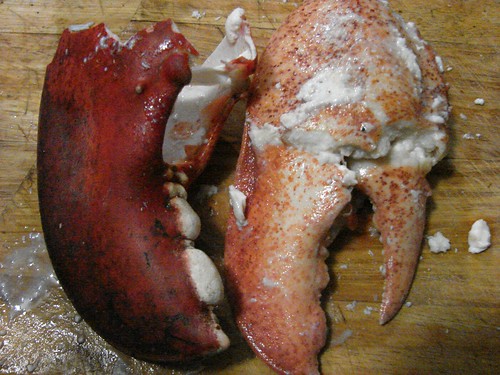
Soft-shells - Lobsters moult annually, losing their hardened shells and growing a new one. The new shell is thin and soft enough to be torn away with your fingers - no crackers needed! - but it is also much larger than the meat inside, because the lobster needs enough room inside the new shell to grow for the coming year. Just remember that when you buy a soft-shell lobster, there's not as much meat inside as it looks.  Check out the picture at left: I took a photo of a soft-shelled lobster claw against a bright light. The dark area in the shell is the shadow of the meat the shell actually contains.

Hard-shells - Lobsters contain the most meat when their shells are thick and hard - they have grown into the shell they created when they last moulted. Lots of meat, but it's more difficult to get out because the shell is thick and hard and needs to be cracked open with a cracker or even a crab mallet.  Here's a picture of the meat from a hardshell claw.  See how much larger it is, and how it fills the shell? But you can also see that the shell was about ¼-inch thick - I needed a hammer to get into it!


Okay, lesson over - back to the story about lobster prices. We found that the lowest prices - anywhere from $2.99 to about $4 a pound - were for small, soft-shelled culls weighing about a pound, and for small whole lobsters up to about 1¼ pounds.

Pound-and-a-half lobsters - the size you most often find in restaurant lobster dinners - were ranging from $3.75 to about $5 a pound for softshells.

As the sizes got larger, the prices increased steeply. One lobster pound in Portland, ME started their prices at $7.95 a pound for small softshells.

No matter where we were, hard-shell lobsters were about a dollar a pound more expensive.

Our biggest surprise, though, was the price of lobster dinners in restaurants, which averaged about $16.95 with a couple of places charging upwards of $24. Clearly, diners are not seeing the benefits of the lower lobster prices on the dock.

If you're heading for the coast in search of a New England Shore Dinner, welcome! You will find some good deals if you take some time and look around.


29 August, 2011

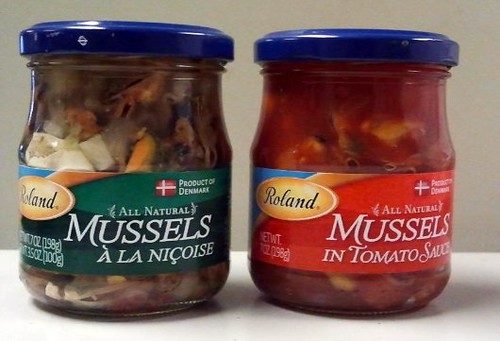
Fishy Delights 44: Roland Mussels a la Nicoise & Mussels In Tomato Sauce

Roland Mussels a la Nicoise and Mussels in Tomato Sauce.  I turned the jars over in my hands at Ocean State Job Lot, peering through the glass at the shucked and prepared mussels inside, trying to make up my mind whether or not to put them in my shopping cart.  On the one hand, they were by Roland, a company I have come to trust through long experience with their truly excellent (and generally low-cost) products. On the other hand, they were mussels, which are delicious but somewhat delicate, and my prior encounters with canned mussels have been less than ideal.  In the end, curiosity won out. Of course.

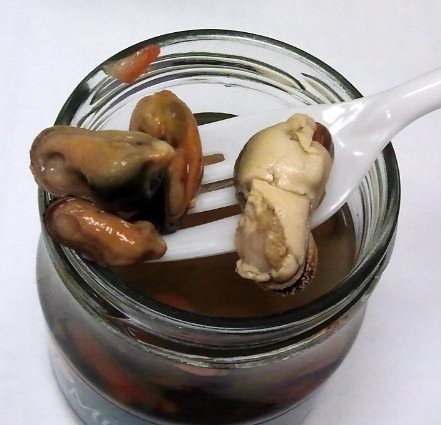
Mussels a la Nicoise was more of a mussel salad. Tiny tender mussels, pickled in a vinegar brine along with small bits of cucumber, onion, celery, and red pepper. The vinegar was a bit overpowering but I have to admit the mussels were rather awesome - nicely prepared and not at all similar to the nasty tinned smoked mussels I've had in the past, which taste and feel like little lumps of smoked clay. These would be quite worthy served as one portion of a relish plate.

The Mussels in Tomato Sauce are equally well-prepared and tender but I thought they were somewhat less successful. I guess I was just not expecting the tomato-sauced variety to be pickled (though I have to admit the flavors of the vinegary brine and the thin but very tomatoey sauce blended nicely.) As with the mussels a la Nicoise, I wouldn't hesitate to put them out on a relish plate. I think I would dress them up with some horseradish, though.

Available at some Ocean State Job Lot stores in southern New England while supplies last.


24 August, 2011

J's Oyster, Portland Maine

This isn't so much a review as it is a recommendation:  If you like oysters and you're in Southern Maine (even just passing through!) you really should get yourself into Portland and stop in for oysters at J's.

They're an unassuming little joint on Portland Pier (right off of Commercial Street) and they serve perhaps the best and freshest oysters around.  On our most recent visit, the weather was truly amazing - low humidity, lots of sun, temp in the 70s - so the outdoor seating along the edge of the pier had a wait time of about 45 minutes. There were plenty of seats inside, though, at the central bar or in one of the booths arranged around the perimeter of the building. Since we were there for oysters and not to gawk at a bunch of boats, we chose the immediate inside seating and were given a booth on the pier side with huge windows that looked out over the water anyway.

NOT what you'll find at J's.
J's has not changed much inside since my first visit 35-some-odd years ago.  The inside is dark wood and low ceilings.  The waitresses and bartenders are friendly and attentive and there's always laughter and conversations going on at the bar and in the booths. It's always reminded me of the kind of comfortable neighborhood bars I've hung out it in, only with oysters and clams instead of peanuts and bowls of Filthy Little Things. The hostess shows you to your seat, you order a baker's dozen oysters and a locally-made Shipyard IPA or two, and for a little while everything is all right with the world.


The oysters are delicious: absolutely fresh, sweet and briny, served up with a bit of lemon for squeezing and a little cup of cocktail sauce and extra horseradish. No matter how you like to eat your oysters, though, try at least one with nothing on it but your lips just so you can experience the awesomeness of really good bivalves.

J's has other stuff too, of course (their bacon cheeseburgers are quite decent if you're with a friend who inexplicably doesn't like oysters) and their bucket of steamers - local Maine softshell clams steamed and served hilariously in a galvanized metal pail) are excellent. I really can't recommend them highly enough.

Check out their website here - it's very simple and loads quickly, and you'll find a menu there as well (menu items seem to be current, but I think the prices are out of date - they were very slightly higher than show online when we were there on Monday.)

06 March, 2011

Fishy Delights 42: Crunchy Whole Green Mussels

"Crispy Tahong," aka Crunchy Whole Green Mussels, are made by the same company which packages Crispy Squid Heads (previously reviewed here.) I try never to assume that I'm going to like a given product based on a different product by the same company, but I was thinking something like, "What the hell, it's just a buck, what have I got to lose?" when I put a packet of Crispy Tahong into my cart.

When I opened the bag, I  first started to suspect I might not be enjoying these as much as the squid.  The murky smell of low tide on the salt flats flooded my face. It wasn't just a briny seaweedy smell, either - it was more of a concentrated and slightly rancid nori odor that carries hints of salt water and seaweed slowly dessicating in the sun, of dead shellfish yawning in the sun as seagulls pick at them, of fish heads rolling up and down the shingle with the tide.

The flavor wasn't horrific, though.  Extremely strong and concentrated essence of shellfish.  Old shellfish right on the cusp of being where I wouldn't want to eat it, but shellfish nonetheless. The little mussels had been dried not fried, and they were certainly crunchy, but in a brittle and shattery way that spread tiny mussel crumbles around my mouth, over and under my tongue, between cheek and gum like some sort of algaenated snuff. Crispy Tahong overloaded my Shellfish Sensors and sent them into a death spiral.

While I'm probably never going to enjoy them as a snack, I did find that they weren't bad as an addition to a bowl of seafood ramen (just sprinkle a few of them into the bowl before added the water - the mussels will plump up and rehydrate with the water and add their noriness to the soup.)  Remember to just sprinkle a few, because believe me that will be all you need.

22 September, 2010

Everything Likes To Eat Lobster. Even Lobsters.


Lynnafred took this pic of a lobster in the tank at Waldbaum's in West Hartford.  He was right in the middle of chowing down on his cellmate, whose partially-eaten corpse may be seen, belly-up, in the lower left corner of the picture.  Notice that the lobby has enough strength in his left "crusher" claw to open up a little despite the rubber band supposedly holding it shut.  That's just enough to be able to get a grip on an opponent who's too weak to resist.

You may not know it, but that is the real reason why lobsters are marketed with their claws held shut by rubber bands.  Fishermen already know how to handle lobsters without getting pinched.  Wholesalers and retailers really don't care all that much if some mook poking the bugs gets a claw-induced blood blister.  No, they clamp the claws because in the stress of the overcrowded holding tanks, the unfed and agitated lobsters turn on one another and would tear each other apart before they can be sold.
.

08 February, 2010

Maine Cold Water Shrimp

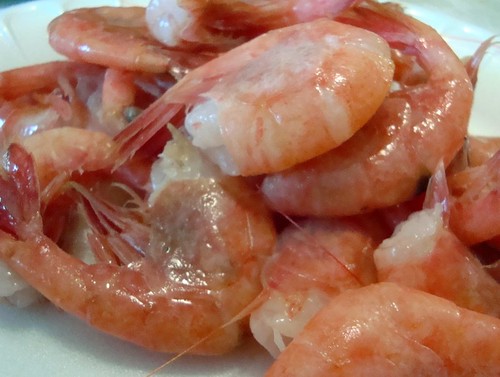
One of the things I look forward to every year is the annual Maine shrimp season.  For a couple of months every winter, Maine fishermen bring in a harvest of delicious small pink shrimp (Pandalus borealis) from the cold, clean waters of the North Atlantic.  The shrimp are tiny but unparalleled in flavor, and most important to me, they're a seasonal New England product and fit my general philosophy of eating locally-sourced foods in season (when I'm not eating canned crap that no sane individual will try, like Banner Sausage or Pork Brains in Milk Gravy.)

Although these shrimp are on the small side, I favor them over most other varieties for a number of reasons.  The taste is one: they're sweet and tender with a clean shrimp flavor.  They're easy to shell whether you peel them raw for a recipe or wait until after you cook them.  And most importantly, I know where they come from.

The fact is, the more I learned about how imported farmed shrimp are raised, processed, and transported,  the less eager I was to want to eat them, until I finally just quit the imported southeast Asian prawns altogether. 

Over the weekend, I picked up a four-pound bag of shrimp at the local Shaw's, and we had a great time cooking with these little treasures.

  • Fried Shrimp - After shelling a bunch of the shrimp, I ran them through a egg/buttermilk wash and lightly dredged them in flour seasoned with good Hungarian paprika and Old Bay Seasoning.  With a tossed salad and a basket of waffle fries, we had a wonderful Friday night feast.
  • Leave the shells on and plunge the shrimp into a pot of boiling water for a little over a minute; chill with a rinse under cold running water, and you're ready for cold peel-and-eat shrimp.  Small but satisfying, the flavor even comes through when you serve them with your own homemade cocktail sauce.
  • How about a delicious pasta dish?  Cook a package of spinach foglie d'ulivo (olive leaf) pasta.  Drain the pasta, toss it with some olive oil to keep it from sticking together, and set it aside.  Meahwhile, melt four tablespoons of butter in a skillet.  Add three small crushed and chopped garlic cloves, a sprinkling of mixed Italian Seasoning, a sprinkling of Hungarian paprika, and a grind of black pepper to taste.  Add about 2 pounds of shelled Maine shrimp and squeeze a fat wedge of lemon over them; shake and toss over medium-high heat until the shrimp is just done - about a minute and a half, and don't overcook them!  To serve, pile up some pasta leaves on a plate, top with as many shrimp as you like, and spoon over some of the sauce that will have formed in the pan as the shrimp was cooked.  It's awesome.
We're lucky this year: The Atlantic States Marine Fisheries Commission's Northern Shrimp Section approved an extension of the 2009-2010 shrimp fishing season to 180 days thanks to abundant stocks and the absence of overfishing, and there are plenty of shrimp hitting seafood counters around New England.  Take advantage of it, and give the Maine shrimp a try. 
.

28 July, 2008

Summertime is Steamer Time


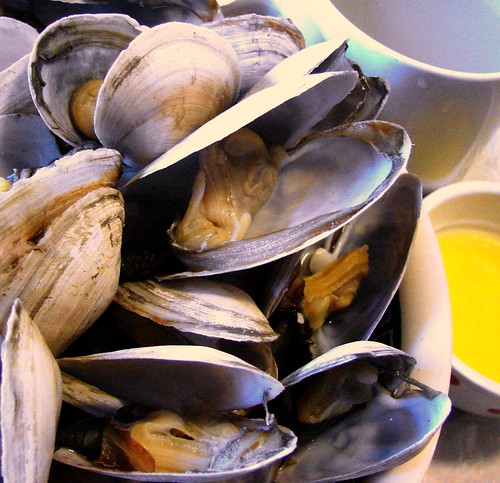
New England soft-shelled clams - Steamers - are one of my all-time favorite foods. They're easy to prepare, they're delicious, and they're perfect as either an appetizer or as a light meal all by themselves.

Steamers are sandier than their hard-shelled cousins, so there's a bit more preparation involved. I dump them into a big colandar and then gently scrub them all around - including the edges - with a stiff vegetable brush. Discard clams with broken shells, or those that don't close up tightly when you grab and scrub them, or any that stink. (Clams smell fresh and briny, like the salt spray from a cold wave breaking on the rocks of a North Atlantic shore. If you get any that smell like low tide at the salt flats, chuck it.) As I scrub each one, it gets placed in a large Dutch oven and set aside. When all of the clams are scrubbed, I add a bit of fresh cool water to the pan - not too much, and no salt, they'll have plenty of their own - cover, and put the pan over medium heat to let the little bivalved morsels steam. When the clams have yawned open in their sauna, they're ready to eat. I serve them with melted butter and a mug of the clam broth from the pan. Swish the clams in the broth before dipping them in butter and any remaining grit you couldn't scrub away earlier is left behind.


Somehow, word spread around that steamers were "better" if they were allowed to set a while before cooking, sprinkled with cornmeal. Supposedly, the clams would eat the cornmeal and purge out whatever clam food they'd been eating, and this would make them "sweeter." I've tried that, and there are a couple problems with it.

The clams don't really eat much cornmeal in the time before scrubbing and cooking, if they eat any at all. Checking out the bellies of sprinkled and unsprinkled clams shows hardly any cornmeal in their stomachs - certainly not enough to replace all the other stuff in there.

It adds an extra step to the preparation/cooking process. The clams can't be steamed with the cornmeal still in the pan with them - cornmeal expands and gets thick when it's cooked, so the pan has to be dumped and the clams and pan rinsed out and the water replaced.

And finally, soaking in fresh water doesn't do the clams any good. Their "feet" - that funny-looking tube thingy that sticks out of their shell - gets swollen up and sick-looking from prolonged exposure to fresh water. You're better off just scrubbing the clams and steaming them, without any intermediate tricks.


01 July, 2008

The Best Crab Cake Recipe Ever

I love crab cakes. They're pretty easy to prepare, make a great "impress-your-friends" appetizer for a dinner, or you can serve them as a main course for a light summer supper with a salad, corn on the cob, and chips. The secret to great crab cakes is excellent quality meat, a minimum of filler, and a light hand with seasonings that enhance rather than mask the wonderful flavor of the crab.

Any type of crab is good in a crab cake, but most of the native crabs here are on the small side and would take forever to pick. So, I start with a pair of good-sized Dungeness crabs. They're cooked on the boat and frozen for shipping to me here on the East Coast. Put them in a steamer for five or ten minutes and they'll be thawed and ready to use. Dungeness crabs also have a very good meat-to-weight yield. You'll need about a pound or so of crabmeat, so plan on buying two crabs, about 2 pounds each (heavier is okay - the ones in the picture were just over two pounds each.)


Pick the crab well; try not to break up the big meaty pieces that will come out of the legs and claws. Save any body fat and tomalley in a separate small container. You can use that later to make a delicious spread for bread and crackers, or blend it with cream cheese to make an awesome crab dip for chips.

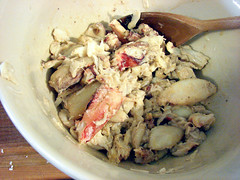
When you're done picking the body and legs of the crabs, you'll have just over a pound of meat. Set it aside while you prep the other ingredients.


In addition to the crabmeat, you will need:

1 egg
2 tablespoons mayonnaise
1 tablespoon Worcestershire sauce
1/2 teaspoon of celery salt
1/2 teaspoon of Old Bay Seasoning
Paprika to taste
2 slices of fresh soft bread, grated into soft, bulky crumbs
A small amount of dried panko breadcrumbs


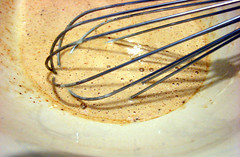
In a large bowl, combine the egg, mayonnaise, Worcestershire sauce, celery salt, Old Bay, and paprika. Whisk it until smooth.


Add the picked crabmeat to the egg mixture in the bowl and lightly fold the meat into the liquid until all the crabmeat is coated.


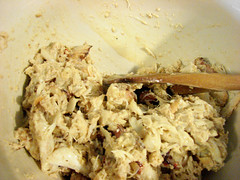
Next, add the soft fluffy breadcrumbs you made by grating the fresh bread. As you did before, lightly fold the crabmeat and breadcrumbs together until the crumbs are incorporated into the mixture. The mixture will look rather dry, but that's okay - you only want a small amount of binder to hold the crab cakes together. Remember - crabmeat should be the main ingredient in a crabcake, not breadcrumbs.


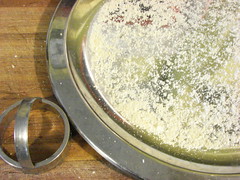
Prepare a tray large enough to hold all your crabcakes by sprinkling it with the dried panko breadcrumbs. The panko will help make the crabcakes crispy later, when they are fried.

You can form your crabcakes by hand, but it's easier if you use a biscuit cutter as a form (and they will come out more uniform, too.) For a main course, use a large or medium cutter. If you're making appetizers, you may want to use the smallest size cutter to produce bite-sized crab cakes.


Pack the biscuit cutter with crabmeat. Be gentle so larger pieces remain intact. Press the crabmeat firmly but carefully into the form, using some pressure so the patty will stay together.


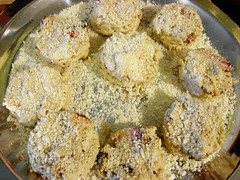
Lift the cutter to the platter with the panko, and carefully unmold the crab cake onto the platter. Repeat until all the crabmeat mixture is formed into patties. With a medium-sized biscuit cutter as a form, you should get about eight or nine crab cakes (exact number will vary depending on the size of the crabs and how much meat you've gotten out of them, of course.)


Sprinkle the tops of the patties lightly with a little more panko and place the tray in the refrigerator for about an hour to chill thoroughly.

Refrigerating the crab cakes before cooking them is important. It allows the egg-and-crumb binder to "set" so the crab cakes don't fall apart when they are cooking. Don't omit this step!


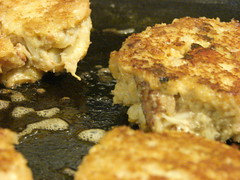
Melt a few tablespoons of butter in a heavy skillet until foamy, then carefully transfer the crab cakes to the hot skillet. Fry over medium heat three or four minutes, until browned, then turn over and brown the other side as well.


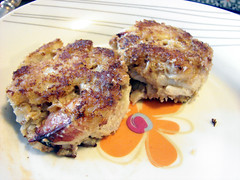
Delicious crab cakes are delicious.


.

20 May, 2008

Stuffies!! (Stuffed Clams)

Stuffies! Gorgeous, rich, delicious stuffed clams: Made with huge quahogs (hard-shelled clams) these are a longtime Southern New England favorite. If you've only ever had store-bought or restaurant stuffies, you owe it to yourself to try the real thing.

Here's what you'll need:

5 or 6 very large quahogs (four inches wide or larger - get 'em huge!)
1 stick of butter (1/2 cup)
1/2 cup finely minced onion
5 cloves of garlic, crushed
8 ounces Ritz or Keebler Townhouse crackers
1/3 cup finely chopped parsely
1/2 tsp paprika
1 rounded tsp Old Bay Seasoning
Salt and pepper to taste

Buy the largest hardshell clams you can find. Hardshell clams have different names depending on what size they are. The smallest ones are called "littlenecks," and the biggest are called "quahogs" or "chowders." In between, they're usually sold as "cherrystones."

Scrub the clams well to remove mud and grit from the outside shells. Don't worry about inside; they should be tightly closed anyway, and there won't be much (if any) grit inside. Put them into a pot with an inch or so of water.
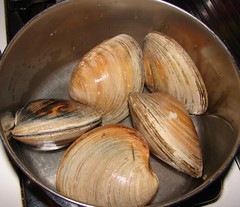
To give you an idea of how big the clams I used were, the picture on the left shows five quahogs in a 6-quart Revere Dutch oven (about 12 inches in diameter.)

Try to set the clams with the hinge side down. They won't steam any faster or more efficiently, but it ensures that the shells have room to open because they won't be wedged up against one another.


Turn on the heat and cover the pan. Keep an eye on it as the water starts to boil. The clams will begin to open up and you want to stop steaming them as soon as they start to open. Steam them too long and they'll be tough and rubbery.

They don't have to be open very far - as little as an eighth of an inch is fine - as long as you can slip a knife in, sever the adductor muscles, and remove the meat from the shell.


Remove the meat from the shells and set them aside until they are cool enough to handle. Pour the broth from the pan over the meat to keep it from drying out.

Don't throw away the clamshells! You'll need them later to hold the stuffing. Select six of the halfshells, scrub them inside and out, and set them aside for later.


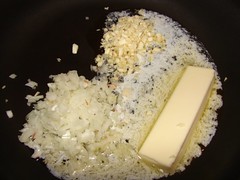
With the clam meat set aside to cool, it's time to prepare the stuffing. In a skillet over medium heat, melt the butter. When the butter heats up, add the garlic and onion. Sautee them gently and don't let anything brown (including the butter!) The idea is to soften the garlic and onion while transferring their wonderful flavors to the butter.

While this is cooking, whirl the crackers in your food processor to make fine crumbs.


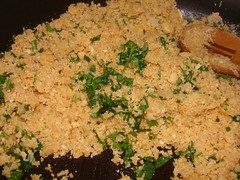
Pour the cracker crumbs into the butter-garlic mixture as it is frying; stir and toss it well as you mix. Add the paprika and the Old Bay Seasoning as you mix in the crumbs.

Turn off the heat under the stuffing mixture when the crumbs are all mixed in and the stuffing is clumpy.


Continue to stir and toss as you add the parsley and season the stuffing liberally with freshly ground black pepper.

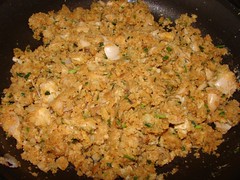
Chop the clams coarsely and add them to the stuffing along with any clam juices that run out as you are cutting them up. Mix well to distribute the meat evenly throughout the mixture.


The stuffing is ready to use when the clams and seasonings are all tossed in. Give it a taste to be sure the seasonings are correct - you may have to add a bit of salt, but don't do that before tasting; the butter, the clams, and the Old Bay all have some salt in them to begin with.

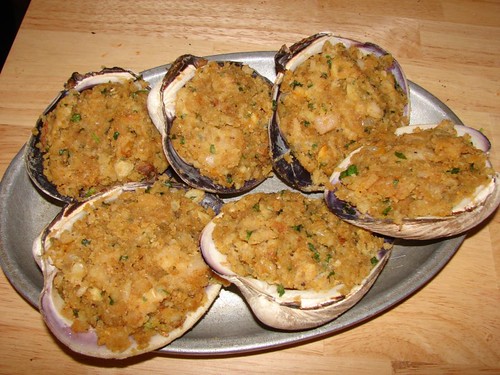
When the seasonings taste right, pack mounds of stuffing into the six clamshells you saved earlier. Arrange them on a platter and pop them under the broiler or into a toaster oven for a few minutes, just to lightly brown the crumbs. Serve them hot.

Makes six stuffies. (Appetizers for six, lunch for three. Or two, if you really like 'em.)


Want more information about quahogs? Check out this Rhode Island Sea Grant fact sheet about them.


18 January, 2008

Fishy Delights 8: Chicken of the Sea Premium Crab


18-01-08_1113.jpg at Flickr

When choosing crabmeat, canned has never been my first choice. Picking a crab is tedious work, but the quality of fresh-picked crab is so much better than just about any alternative that I really don't mind (though some brands of frozen crabmeat come up a close second.)

But I kept hearing good things about these new "pouched" seafood things, so when one of the local markets had a sale on their Chicken of the Sea brands, I thought maybe it was worth a try.

It would be a lie to say that I was disappointed, because I didn't have very high expectations to begin with, so let's just say that I got exactly what I thought I was going to get, no more and no less.

Even given that the picture on the front label of the pouch was most likely a highly retouched, best case scenario, the crab inside looked nothing like the photo. There were no enticingly pink edges, and far more little shreds than the package art suggested. Instead, the crabmeat was bone-white, in tiny bits that looked like they were picked from the body clusters of small crabs.

Afteer pouring off the processing water, I was left with a smidge over two ounces of the most bland and flavorless crab I have ever tasted. I might as well have been eating surimi, it was that dull. Even adding some mayo and relish to make an impromptu crab salad didn't help - it was like eating mayo and relish on a cracker. Blah.

To add insult to injury, Chicken of the Sea gives a stunningly awful recipe for "easy crab cakes" on the back of the pouch. The recipe calls more more filler than crab. Feh.