14 January, 2010

Mannheim Steamroller Cinnamon Hot Chocolate

I was at Ocean State Job Lot and this brightly-colored canister of hot chocolate caught my eye. My whole family enjoys cinnamon-tinted hot chocolate (Nestles Abuelita Mexican chocolate for example,) and the price of this big 24-ounce container was quite attractive at just $2.00.

When I think "Mannheim Steamroller" (which is somewhat less than one time per decade) several things come to mind, none of them very complimentary. "Mediocre Christmas music," for example, or "Albums That Suck." I never think of "delicious hot chocolate." In fact, when I bought the stuff, I didn't even notice the "Mannheim Steamroller" banner at the top of the label.

As it turns out, this is really good hot chocolate. Really good. Unlike some mass-market just-add-water hot chocolates, this one isn't incredibly sweet. It has a rich chocolate flavor with a hint of cinnamon as a backnote - just the right amount. Two scoops in a mug with water just this side of boiling makes an amazingly awesome mug of hot chocolate. One heaping scoop in a mug of coffee makes fantastic mocha.

New Englanders can look for it at Ocean State Job Lot stores, where it is an astonishing bargain at two bucks. If you simply must have some and hang the cost, Mannheim Steamroller Cinnamon Hot Chocolate can also be purchased online from the Mannheim Steamroller Online Store (something else I had never heard of) for the astonishing non-bargain price of $7.98 plus $4.50 shipping, I kid you not.

.

13 January, 2010

I Expected To See Blood

BBC America runs a series called Last Restaurant Standing, which is a rebroadcast of the BBC Two reality series The Restaurant. The premise of the show is simple: a number of couples are given "trial restaurants" to run as they compete for the chance to own a "permanent" restaurant in partnership with French chef Raymond Blanc; over the course of the series couples are eliminated via challenges and assignments until one couple remains and open their establishment. The first two series were captivating - the contestants were a mix of professional workers in the restaurant or hospitality industry and talented, passionate amateurs. It was fascinating to see them face the problems M. Blanc presented to them. Occasionally, circumstances conspired against the contestants, but more often than not they were their own worst enemies.

And so it was that when the third series arrived in the US on BBC America, my family and I were eagerly anticipating it. We all watch Last Restaurant Standing together, chatting and laughing and occasionally slapping our foreheads at the successes and failures of the people chasing their dreams. But this season seems different than the previous two.

For one thing, there are fewer challenges. And here it is, Week 2, and the contestants haven't even been assigned their trial restaurants yet. But worse yet, the caliber of contestants is shockingly low. We expect some lack of experience among the hopefuls, but this time there seems to be a level of actual incompetence involved.

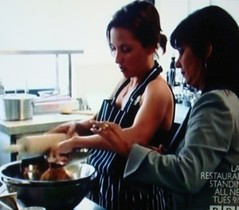
On the premier episode of the lastest season, each couple was asked to prepare a "signature dish" for Raymond and his judges. One couple, a mother-daughter team named Sandy and Natalie, decided that their signature dish would be fresh fruit with a coconut mousse. From the instant they hit the kitchen and tried to open their coconut, it was clear that these two had no business competing to run a restaurant.


Attempt No. 1:
It is important that they catch every drop of coconut milk for their mousse, so obviously the best way to crack the coconut is to do it inside a stainless steel bowl. At left, Sandy looks on as Natalie gets to work - holding a chef's knife by the blade, she hammers the back of the knife with a rolling pin in an effort to split the shell.


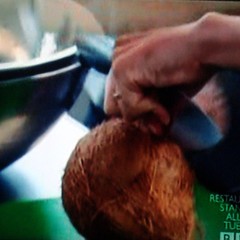
Attempt No. 2 (above): Apparently, the bowl was not a very stable platform for hacking through the shell of a coconut, so Natalie decided to try a slightly different approach. Sandy carefully steadied the coconut while Natalie lined up the chef's knife (again, holding it by the blade) and whacked at it with the rolling pin. The level of risk and stupidity involved here isn't quite clear in the screen capture on the left above, so I also added the closeup on the right to properly display Natalie's blade-gripping technique.


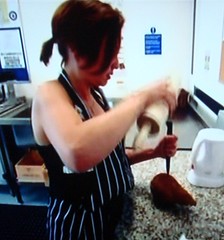
Attempt No. 3: Natalie decides that the chef's knife is the wrong tool for the job, so she changes over to a paring knife. She gets a good strong grip on the blade of the knife - wrapping her fist around the blade and part of the handle) and begins beating on the butt of the knife with that trusty rolling pin. After several tries, she finally gives up and lets Sandy try on her own.Sandy , displaying somewhat more common sense than her daughter, leaves the knife behind and just pounds on the coconut with the rolling pin until it splits open. Hooray! Now they can finally continue with the recipe!


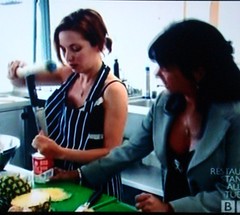
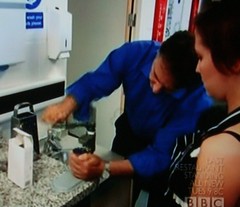
Above: Natalie once again demonstrates her mad chef knife skillz by attempting to open a can of sweetened condensed milk using the "rolling pin plus handheld knife" technique. By this time, Raymond Blanc is sufficiently horrified to step in and demonstrate the use of a bench-mounted can opener.

I was surprised (and a little disappointed) that Natalie didn't open her hand instead of the tin of milk.

Natalie and Sandy's mousse was a disaster. They served it in a martini glass, and by the time it was brought out for the tasting, it was runny and starting to separate. Raymond took a taste and actually spit it into a napkin - the first time I've ever seen him do that with any food a contestant presented to him - and immediately told them that, thanks to the horrible quality of the dessert and the terrifying knife handling they had demonstrated in the kitchen, that they "must leave now."

Wow. Where the hell did the BBC find these people? And don't they have some sort of screening process? It's pretty obvious that the standards are going to be a bit lower in Series 3. In previous seasons, we watched the show and enjoyed the process that the contestants went through as they learned the ins and outs of the restaurant business. This time, I think we'll be watching for the trainwrecky lulz.

Check out Last Restaurant Standing Tuesdays at 8 pm on BBC America.

.

12 January, 2010

Slab Bacon That Can Not Be Unseen

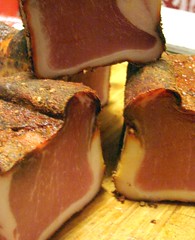
Sometimes when you buy slab bacon the piece you get is cut from the teat section of the belly. Yes. Delicious cured and smoked pig nipple:


Slab bacon has to be sliced before frying. If you do it just right, you can cross-section the nipple:


Don't be squeamish; once the bacon is cooked, you can't tell the difference:

So feel free to serve fried pig nipples to your guests. They'll never know the difference, though they might wonder why you're snickering while they NOM NOM the bacon.
.

11 January, 2010

Wendy's Spicy Chicken Nuggets

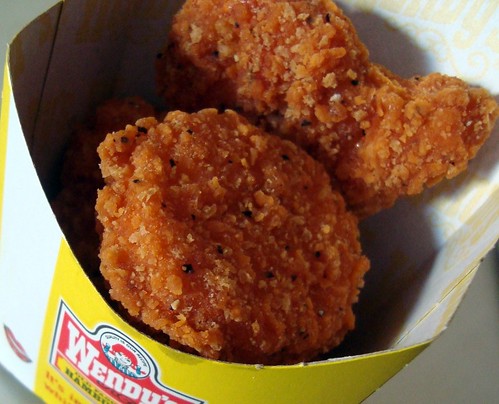
I've been seeing the ads for Wendy's Spicy Chicken Nuggets for a couple weeks now, and finally decided to give them a try.

They're okay, I guess, but nothing really special. The spongy, meatlike chicken patties are solidly average. The breading is crispy, tinted red with paprika and cayenne pepper, and studded with bits of cracked black pepper. The contrast between the crunchy coating and soft meat inside is pretty enjoyable.

The flavor isn't all that great, though. Salty with a canned-chicken-broth flavor, they are disappointing as a spicy food. The characteristic cayenne heat hits at the back of your mouth as you swallow, with a harsh and flavorless heat that offers little else than a vague burning sensation.

That's not really what I look for in a spicy food. I don't generally use cayenne pepper at all because I prefer hot and spicy foods to have a depth of flavor that cayenne can't offer. I can't really recommend these, but if Wendy's in on your way home and want a fast spicy hit, check it out for youself.
.

10 January, 2010

Vintage Sunday: Strange Products from the Past

Today we're going to take a look back at a few food products from the pre-internet era which were too unusual to survive in the competitive environment of the American supermarket.

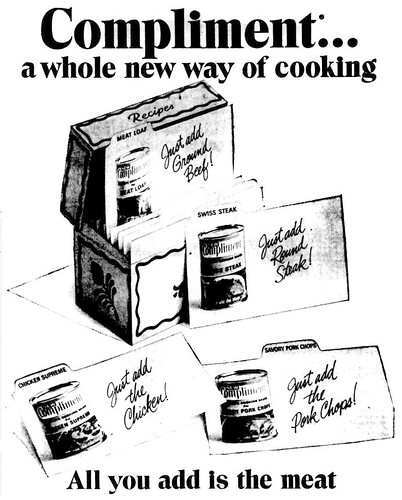
Compliment Complete Cooking Sauces - Introduced by PET in 1969, Compliment was billed as kind of a "gourmet dinner in a can." It was available in five varieties (Compliment for Meat Loaf, Compliment for Swiss Steak - Tomato Style or Brown Style - Compliment for Pork Chops, and Compliment for Chicken Supreme.) Most of these were pretty straightforward sauces: brown the meat of your choice, add a can of Compliment, and simmer until done for a delicious supper. The Meat Loaf variety, though, was truly odd:
"Just open a can of Compliment for Meat Loaf and add the ground beef. Shape it. Bake it. That's it! No eggs. No bread crumbs. No fixing. Everything is ready...already in the can."
Cream of Mushroom soup was the long-standing king of "add-a-can cuisine" and PET was obviously hoping to use that as a springboard for Compliment. But cream of mushroom soup was well-entrenched in American kitchens and incredibly cheap as well. Compliment was never able to make much of a dent in the market and was soon discontinued. Meanwhile, forty years later, cream of mushroom soup is still the king of "add-a-can cuisine."


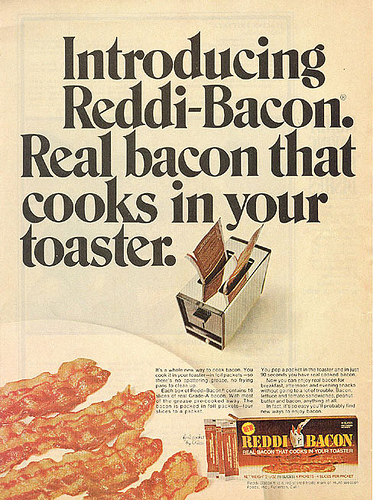
Reddi-Bacon was brought to market in 1964, by the makers of Reddi-Wip aerosol whipped cream. Pre-cooked bacon was packaged with absorbent paper between sheets of aluminum foil. These packets were designed to be inserted into a standard toaster and heated to serving temperature. Thanks to the Internet Bacon Meme, Reddi-Bacon has attracted a lot of attention lately, most of it negative in the "What the hell were they thinking?" way. There are plenty of bloggers out there telling stories about blazing toaster fires caused by rivers of bacon fat flowing from leaky foil packages. The stories are entertaining, but they're also mostly bullshit.

Reddi-Bacon was precooked and there was very little extra fat involved when the foil packets were heated. However, there was occasional slight leaking from torn or damaged foil packages, and that undoubtably caused some smoking and ruined toasters. The problems with the packaging was vexing enough to the company that Reddi-Bacon never really made it out of test markets before the product was pulled from the market.

Those who mock Reddi-Bacon should remember, however, that this really wasn't a failed product in the long run. In 1964, microwave ovens were not common household appliances, and American kitchens just didn't have the kind of technology that would enable the pure awesomeness of SIZZLING BACON ON DEMAND. Today with microwaves in nearly everyone's kitchen, fully-cooked bacon - ready to heat and eat - is available everywhere and relatively safe to heat up in the ol' nuker.

You can view a PDF of the patent for Reddi-Bacon's packaging here.

And you can read about the introduction of Reddi-Bacon in the American marketplace in the 22 November 1964 Hartford [CT] Courant.


Gerber Singles - Gerber had the best of intentions with their line of Singles, introduced in 1974: Heat-and-eat foods packaged for people with limited time, culinary skills, or kitchen access. By most accounts, the offerings were fairly tasty (for canned foods) and might have been accepted more readily had Gerber not decided to hold down costs by using their existing stock of baby food jars as packaging. Apparently, no one likes to think of themselves as so pathetic that they have to eat their meals out of baby food jars. Alone.

Like Reddi-Bacon, though, Gerber Singles weren't really a bad idea, just too far ahead of their time. After all, Abbott Labs sells millions of cans of Ensure every year, and that's little more than baby formula for adults.


09 January, 2010

Mountain Dew and Pepsi Throwback Are Back!


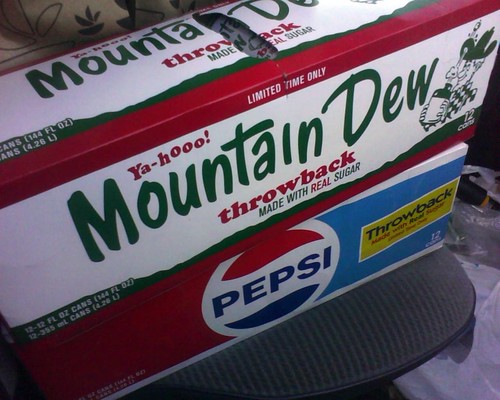
PepsiCo certainly took their sweet-ass time getting them into stores around here, but Throwback versions of Mountain Dew and Pepsi - the vintage-style formulations that use good ol' sugar instead of high-fructose corn syrup - are finally on retail shelves here in Southern New England. Stock up while you can - this is a limited-time release.
.

08 January, 2010

Last Call For Coconut M&Ms

If you missed out on Coconut M&Ms during their very limited release last summer, your second (and perhaps last) chance has arrived. Right now, as I type this, the candy aisles of Dollar Tree stores have what are probably the very last Coconut M&Ms available. Get there quick!

.

07 January, 2010

Easy Bake Kids' Dessert Kits: Cotton Candy Parfaits

When Dave and I hit the food section of job lot stores, it's always going to be a unique experience. But there's a huge difference in what we look for when we go. Usually, while Dave is inspecting some kind of dubious canned meat and prowling for oddly shaped pastas, I'm busy looking for some kind of strange confection or decent quality chocolate that I haven't tasted before. But on one of our latest outings, we were both struck by the same thing: a box of Easy Bake Cotton Candy parfaits. At $1.50 per box, we decided to try it out.

Preperation for these is as easy as making instant pudding, because that's essentially what they are: Two packets of colored cotton candy flavored pudding (in attractive pastel pink and it's-a-boy blue), and a packet of those hard marshmallows you get in hot cocoa or a box of Lucky Charms cereal. After mixing up the pudding according to the package directions, I spooned it into the plastic cups that were included in the box. After filling each cup halfway, it was time for the marshmallows to go in.

The package said to divide them evenly between the four cups. Now, partly because I'm a loser and partly because I had nothing better to do at the time, I decided to count up the hard, dehydrated bricks to see how many were in the packet. The total was 220.5, making that about 55 marshmallows per cup. After adding the marshmallows as the middle layer, I topped the desserts off with the remaining pudding and chucked them in the fridge to set.

Acouple of hours later, Mom, Dave, and I enjoyed them for dessert. Overall, they weren't bad. Artificial cotton candy flavor is very much like a burnt sugar taste, and these were no exception. It's nowhere near as delicious as pulling apart fresh cotton candy at a county fair or something, but these little treats were certainly passable. After sitting in the fridge, the marshmallows had begun to soften and start to melt between the wet layers of pudding, so those were kind of nasty. However, the package says to eat the pudding within three hours, and with good reason: the fourth parfait got to sit in the fridge overnight, and when I looked at it the next morning, the marshmallow center had melted into a very odd layer of pale white slime. Yuck.


The best place to look for these dessert kits are in job lot stores, I guess. They're made by Jel-Sert, the same company that makes Royal Gelatine, Royal Pudding, and My-T-Fine Pudding and Pie Fillings. A check at their website doesn't even mention Easy Bake Kid's Dessert Kits, so I think it's safe to say they're no longer in production.

Link:

Jel-Sert Website
.

06 January, 2010

Capicola Reminder

If you're planning to make your own capicola this year, now's the time to get to your local butcher and order the boneless pork loins you'll need. Most butchers who can take special orders will also be able to get you the beef bung cap that you'll need for the casings.

05 January, 2010

Royale Canned Ham

I've always considered canned ham to be a somewhat inferior product. Every time I've encountered one, it's been of less-than-optimal quality, and I'm not really willing to pay five dollars a pound and up for something that seemed more like unseasoned SPAM than real meat.

But I broke down recently on a trip to Ocean State Job Lot and bought a Canadian-made Royale brand canned ham, partly out of curiosity to see if these things were really as bad as I remembered them, and partly because they were only $2.50.

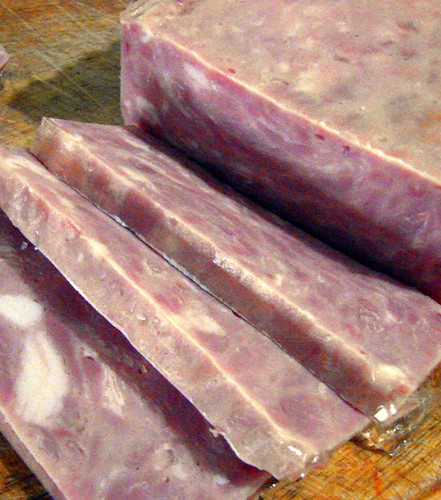
The picture on the front of the can - the Serving Suggestion - depicts a meaty and fairly solid ham. The photo looked a lot like slices of high-quality ham, which should have been my first clue that something was amiss. I know damn well there are no laws saying that the photographic representation on packaging must have anything to do with the actual contents of the container, and most of the time the picture provided is simply an outright visual lie. When I dumped the ham out onto the cutting board to slice it, the quivery pinkish meat inside was exactly as I suspected it would be: randomly-sized chunks of ham ranging fron marble-sized hunks to tiny flecks, compressed together with clumps and lines of fat. Fairly typical canned ham, as a matter of fact.

The resemblance to SPAM was remarkable, though the aroma was much fresher and, of course, not as spicy since this was just a ham and not dressed with Hormel's proprietary seasonings. The canned ham sliced easily and cleanly and fried up nicely in the pan, though the texture was rather strange and spongy as the fat and added water rendered out from the interior of the slices.

The final verdict: Okay-minus for a fried breakfast meat; would probably be much better and more suitably used as an omelet filling, quiche ingredient, or on a breakfast sandwich (as long as it was sliced thinly enough.)

For the most part, though, if I were tempted to buy a canned ham again for actual culinary use, I would probably just go to my local deli and buy a 1-pound chunk of Krakus deli ham (unsliced.) Krakus' deli ham is gorgeous, solid, delicious real ham, not this chopped and formed bastardization, and my local market sells it for $4.99 a pound - the same price most places charge for a 1-pound canned ham.
.