18 May, 2010

Beverage Flavored Dessert Toppings?


Spotted these "Dessert Toppers" at Price Chopper the other day.  Somehow, pouring Dr. Pepper Cherry syrup on anything doesn't really appeal to me (same goes for Orange Crush and even A&W Root Beer.) They're basically a blend of corn syrup and high-fructose corn syrup and artificial flavorings.  This is one strange product that I will probably never review, but if any of you have tried it, feel free to leave a comment.
.

17 May, 2010

Stone Ridge Creamery's Awesome New Flavors

I love this retro-1940's logo.
Stone Ridge Creamery, as you might know, is the brand name used by SUPERVALU Stores for their house-label ice cream.  I have always been mighty impressed by the quality of the product - they deliver premium-brand quality at store-brand prices - and originally wrote about them over a year ago.  SUPERVALU operates a number of regional supermarket chains, including Acme, Cub Foods, Farm Fresh, Hornbacher’s, Jewel-Osco, Shaw’s/Star Market, Shop ‘n Save, and Shoppers Food & Pharmacy, so chances are you've got one nearby.  Stone Ridge Creamery ice cream is one of the reasons I really miss having a Shaw's in town.  It was always great.

Recently, I was contacted by SUPERVALU.  Knowing how much I love Stone Ridge Creamery ice cream, they sent along a press release about three new ice cream flavors that were created as a result of an employee contest.  Pretty cool.

Here's the backstory:  SUPERVALU sponsored a sweepstakes for their employees called the "Stone Ridge Creamery Name Your Dream Flavor Sweepstakes."  Associates were asked to submit their "dream" ice cream flavor, and three flavors would be selected for addition to the Stone Ridge Creamery lineup.  Not only would the winhners see their dream flavors put into actual production, but they'd also get their charicatures featured on the carton, a $500 gift card, and  - most awesome of all - free ice cream for a year.

The winners, announced on April 29, 2010 and listed along with their caricatures, were:

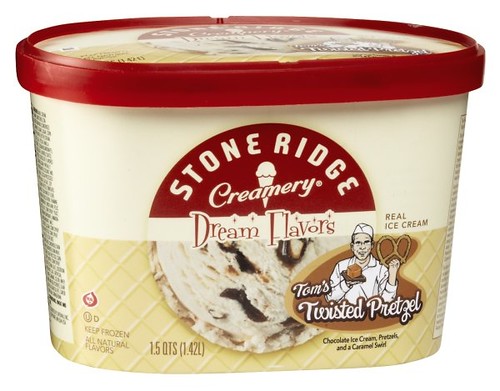
Tom Lindberg, retail technology specialist for SUPERVALU’s supply chain services northern region in Minneapolis, for his “Twisted Pretzel” flavor;

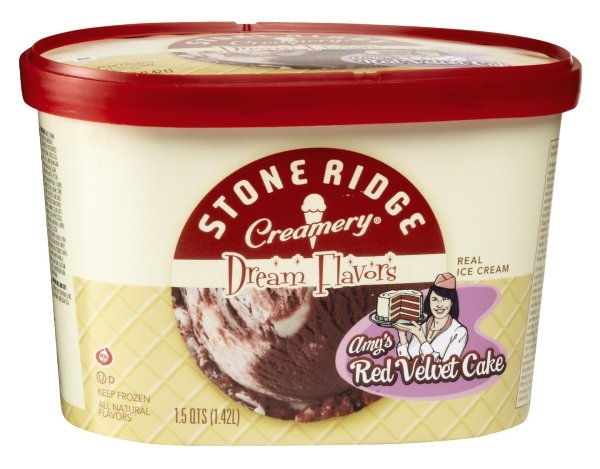
Amy Youngblood, senior business support specialist at SUPERVALU’s innovation center in Minneapolis, for her “Red Velvet Cake” flavor; and

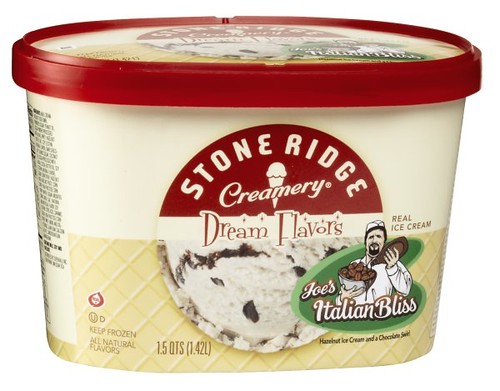
Joe Agrusa, direct store delivery receiver at the Albertsons store in Chula Vista, Calif., for his “Italian Bliss” flavor.


Along with the press release, SUPERVALU also sent me a container of each of the new flavors to try out, and let me tell you:  these ice creams are awesome.  Maryanne, Lynnafred, and I have been enjoying them for a few days now, and all three of them are incredible.  We've tried to pick our favorites, but each of them is so good in its own way that we're finding it impossible to chose.  So, without any further gushing, here's our reviews of each one:

Tom's Twisted Pretzel - Chocolatey-covered pretzel bits swirled with caramel in caramel ice cream.  Although the pretzel bits had a bit of a problem staying absolutely crunchy in the ice cream mix, this flavor is a truly unique winner.  The caramel ice cream is made even more rich and decadent with the ribbons of caramel running through it, and the addition of the chocolatey pretzels was just ingenious.  Besides the crunch and chocolate hit, the nuggets of salt here and there make for a fantastic flavor contrast and a wonderful enhancement.  "Sweet and salty" is a combination that seems only recently to have gained a wider acceptance, and treats like this one just serve to confirm how delicious it can be.  In fact, the saltiness was one of the things that Lynnafred liked best, and I agree.

Joe's Italian Bliss - Hazelnut flavored ice cream with ribbons of hazlenut fudge and chocolately chips.  The first time Lynnafred tasted this one, she just closed her eyes, smiled, and sighed.  If you could wave a magic wand and turn chocolate hazlenut truffles into ice cream, this is what you would end up with. Joe's Italian Bliss is so good, you could turn this into a dinner party dessert just by adding a few wafer cookies and a dot of freshly whipped cream.  Maryanne loved the texture contrasts between the crunchy thin ribbons of fudge and the smooth, creamy ice cream.

Amy's Red Velvet Cake - Red velvet and vanilla bean ice cream, swirled with cream cheese frosting.  Lynnafred and Maryanne both thought that this ice cream was perfect.  "It tastes exactly like a red velvet cake!" Lynnafred said,  "So much better than those 'birthday cake' flavored ice creams that are out there."  Maryanne agreed.  The red velevet and vanilla bean ice creams are perfect compliments to one another, and the cream cheese frosting swirls give it the crowning touch.   Maryanne baked a red velvet cake yesterday because this ice cream awakened a "red velvet cake craving" in her.


Stone Ridge Creamery has hit three consecutive home runs with these new flavors.  No matter which one you try, you won't be disappointed.

Links:


SUPERVALU Brands website - check out other SUPERVALU house brands.

.

16 May, 2010

Vintage Sunday: Hot Dog Ads

Notwithstanding the past week of damn cold temperatures, the weather is getting warmer, and that means it's hot dog season.  I admit to enjoying hot dogs (locally-made natural casing franks, please) all year 'round, but summer is special because hot dogs are at their best when they're cooked over coals outside.

According to the National Hot Dog & Sausage Council, more than 730 million packages of hot dogs were sold last year at retail (this is based on an analysis of supermarket scanner data, and it's a low estimate, since it doesn't include sales at non-reporting stores like Walmart.)  More than 21 million hot dogs were eaten at ballparks last season, and American soldiers stationed at military bases around the world ate an additional two and a half million wieners.  And of all those hot dogs, nearly 40% of them were eaten between Memorial Day and Labor Day - Hot Dog Season.
And so, I thought it would be kind of cool to share a few old hot dog advertisements with you.   These were published by the Table Supply grocery store chain in the Palm Beach [FL] Post newspaper in the 1930's.


.

14 May, 2010

Kraft Spaghetti Classics: A Time Capsule of Crap

You know, it is really easy and fairly cheap to make a good spaghetti dinner.  There is plenty of decent and inexpensive pasta on the shelves of your local grocery store - chances are, even the store brand is made of 100% Durhum  wheat flour - and even if you haven't got time to make your own sauce you can get a bottle of Ragu for a couple of bucks.  (And yes, I occasionally use Ragu sauce.  Despite what some outdated websites might tell you, most Ragu sauces contain no HFCS and the ingredient list is pretty close to what I put in my homemade spaghetti sauce anyway.  Read labels.)  Anyway, the point is that a really authentic and delicious spaghetti dinner is so easy to make and so cheap to put on the table that I have to wonder why anyone would bother with Kraft Spaghetti Classics.  It takes more time to make than the real thing, and even a can of Chef Boyardee tastes better.

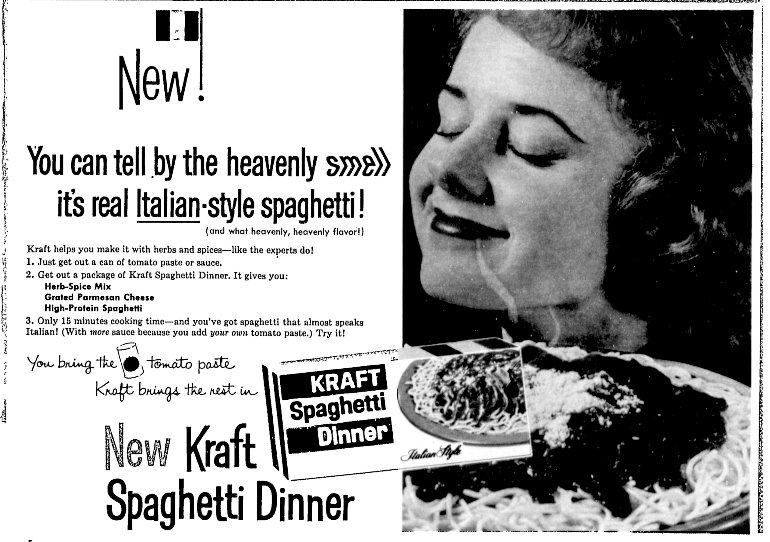
Actually, it was the very preposterousness of this stuff that made me buy it to begin with.  They might be calling it "Kraft Spaghetti Classics" today, but the product itself is actually the horrid "Kraft Spaghetti Dinner" from the 1950's with updated graphics on the box. 

This newspaper ad originally appeared in October 1958.
Everything about Kraft Spaghetti Classics is a throwback to the 1950's - a time in culinary history when Italian food was apparently still viewed as "ethnic" and "exotic."  Even the preparation instructions are unchanged:
  1. Bring water to a boil and add the spaghetti, cooking until tender (10 - 12 minutes.)
  2. Meanwhile, mix the Italian Spice Mix, a 6-ounce can of tomato paste, and two cans (12 ounces) of water in a medium saucepan, bring to a boil on medium heat, then reduce heat to medium-low and simmer for 10 minutes, stirring occasionally.
  3. Drain the spaghetti and tip it onto a serving platter.  Top with the sauce, then sprinkle with the enclosed grated Parmesan cheese.
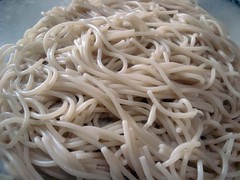
The spaghetti in the package is really low-grade.  Good pasta is made from 100% Durum semolina flour - a hard wheat flour that stands up well to boiling, and produces a firm yet tender pasta with a slight pale yellow tint.  Kraft's spaghetti is made from regular flour which leaches gluey starch into the cooking water.  It cooks up sticky, bland, and flaccid and the color is a rather unappealing greyish-white.  Although we monitored the cooking carefully, and pulled strands out to check doneness frequently, the pasta still came out soft and slippery.  Even giving it a rinse before serving didn't help.  The texture was just awful and the flavor was - not surprisingly - closer to boiled flour than to boiled pasta.

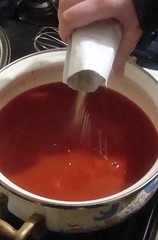
Adding two can-measures of water to a can of tomato paste makes for a mighty thin sauce, as Lynnafred noticed during the sauce prep.  As the sauce came up to a simmer, she added the Tangy Italian Spice Mix and stirred it in.  The sauce thickened in minutes - thanks to the modified food starch in the Spice Mix.

The resulting sauce is sharp-edged and very rough.  I could be charitable and call it "tangy," but the tang is a byproduct of the unsophisticated "dump in some powdered stuff" method of preparation.  Even the most basic supermarket sauce in a jar has a depth of flavor that comes from long simmering.  Kraft's "quicky" method with the limited flavorings in the Spice Mix results in a harshly underseasoned sauce which tastes exactly like what it is:  tomato paste and pixie dust.

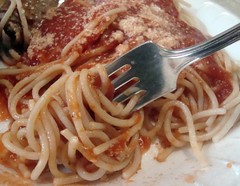
The final ingredient pouch in the kit was the Kraft 100% Grated Parmesan Cheese, and it's kind of sad that the cheese was the best component of the assembly.  For me, I suppose that's partly out of nostalgia; when I was growing up, my mom always had a container of Kraft Parmesan Cheese in the fridge (probably because it was inexpensive and easy to find back then, in the years before every supermarket had a huge WORLD OF CHEESE display by the deli counter.)  It's not my first choice for grated table cheese, but I confess that it is adequate.  In keeping with the spirit of our 1950's faux-Italian experience, we sprinkled the Parmesan cheese atop the spaghetti and dug in.

The presence of sauce and cheese did absolutely nothing to improve the taste or, especially, the texture of the pasta, which continued to be gummy and gluelike and thoroughly nasty, only twice as bad because it was topped with that awful sauce.  We actually had tons of leftovers that night - unusual for Spaghetti Night.

Kraft Spaghetti Classics?  Never, ever again.
.

13 May, 2010

Why My Front Yard Temporarily Looks Like Hell

Ipherion uniflorum,
Every year around this time, I stop cutting the grass in front of the house for a couple of weeks.  The yard looks pretty shabby but I don't mind, because the Spring Starflowers in the grass are in bloom.  They infest the front yard in little clumps; throughout most of the year, they look and behave just like grass - thin green leaves in clusters that continually need mowing to keep them trimmed.  But when the middle of May rolls around, the plant send out stalks about six to eight inches tall which blossom into small white flowers shaped like stars.  Despite the inconvenience of letting the neighbors tsk tsk at my lax lawn care, I love the little bastards and stop cutting the grass while they're flowering.

A couple years ago, when we first moved here, I did a little research about them.  Their botanical name is  Ipherion uniflorum, they're native to South America, and they grow from clumps of tiny little bulbs.  Apparently, many gardeners hate them because they spread so readily from their bedded areas.  Plant them as a border, and you'll soon find them all over the lawn (I think that's how they wound up all over the front yard - Maryanne's grandmother probably had them bordering the daffodils along the front porch.)  The only way to get rid of them - not that I ever would - is to dig up the clumps and thoroughly sift through the surrounding soil to remove all the bulbs.  Rototilling and reseeding the yard won't help a bit: the tiny bulbs slip between the tines of a rototiller and become spread out to form new clumps.  Tilling may actually make the invasion worse!

If I could find more of them, I'd plant them all through the yard in a heartbeat.  When their flowering season is over, the plants look like ordinary grass and they're relatively drought-resistant, staying green through dry spells much better than many kinds of grass.

And besides, I have all summer to keep the front yard trimmed.
.

Why The KFC Double Down Isn't As Bad For You As the Media Wants You To Believe

An Editorial by Lynnafred

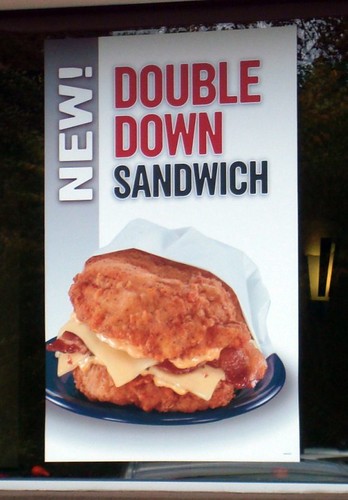
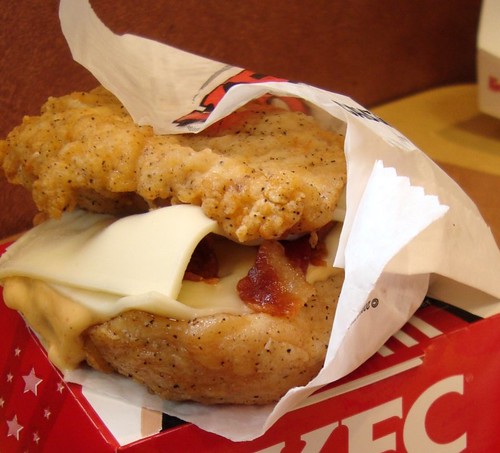
On April 12th, KFC's Double Down rolled out across America after having been a test-market-only sandwich in Summer 2009. By this time, the Double Down needs no introduction, but if you haven't heard of it yet, it's two boneless chicken breasts, two slices of cheese, three strips of bacon, and a spicy mayonnaise sandwiched together, with no bun. This breadless sandwich has created quite the media splash - and I'm astonished at how much of it is negative. Statements such as "Look at the calories in that thing; it's an artery clogger," "I felt myself getting bloated as I ate it," and "I saw it in the store and was so disgusted I couldn't bring myself to buy one, but I know it's gross," are extremely common in the buzz about Double Downs.

But how bad is the Double Down for you, really, in comparison to other fast foods that people consume on a semi-regular basis? I did some digging to find out, studying nutrition information and taking personal interviews from people who work in fast food, and then stacked it against the "evil" Double Down. And my results are interesting and, at times, shocking. (At least, they were to me.) I learned that compared to commonly ordered items from fast food giants like Taco Bell, McDonald's, Burger King, and even Dunkin' Donuts, a breadless chicken sandwich could really be considered the least of your concerns, as far as eating habits go.

That doesn't mean that I'm preaching that the Double Down is the best thing out there for you. It doesn't even mean that you should go get one. I'm just trying to relay that, perhaps, the Double Down isn't the Satan's Sandwich the media has made it out to be. And where better to start than with the specs of the Double Down itself?

The Fried Double Down is a pretty hefty sandwich. It weighs in at at least 1/3 lb. It's got 540 calories, 32 grams of fat, and 1380mg of sodium. But the sandwich has hardly any carbs (11g for the regular DD and only 3g for the grilled) due to its lack of bread, and has 53 g protein because of all the meat.

Okay, so now to put those numbers into perspective. A friend of mine who works at a local McDonald's said that the item he sees selling most is a large Big Mac combo. That Big Mac has 540 calories, 29 total grams of fat, and 1040mg of sodium. The fries have 500 calories, 25 total grams of fat, and 350mg of sodium. Add that up, and you get a total of 1040 calories, 54 total grams of fat, and 1390mg of sodium, and none of that is including your drink. You also get 108 grams of carbs in that meal.

But that doesn't affect you, because you're a salad person. Okay, fine. According to Burger King's nutrition facts, found on their website, a Tendercrisp garden salad has 410 calories, 23g of fat, and 1000mg of sodium, and that's without your dressing. A Tendergrill chicken salad is only marginally better for you, with 210 calories, 7 total grams of fat, and 780mg of sodium. But as soon as you add dressing onto that, however healthy you were trying to be goes right out the window. At only 50 calories, the best dressing you could get would be the fat free ranch, but you'd be sacrificing the rest of your daily sodium count. With 740mg of sodium, that brings your Tendergrill salad up to 1520mg of sodium, and your Tendercrisp salad up to a whopping 1740mg of sodium.

According to the manager of a local Dunkin' Donuts, the two most popular non-donut food items  his location sells are a sausage, egg, and cheese on a croissant, and the turkey, cheddar, and bacon flatbreads. Those have 640 calories, 43g of fat, 1250mg of sodium and 410 calories, 20 grams of fat, and 1110mg of sodium, respectively. By themselves.

Suddenly, that Double Down doesn't look so bad, huh?

But the Double Down does take up a little over 1/4 of your daily calories, if you're on a 2,000 calorie diet. And that's assuming you're eating three square meals a day. Many people nowadays rely on heavily processed foods from the grocer's freezer section, and frozen "dieter's meals" like Healthy Choice, Lean Cuisine, and Smart Ones are all loaded with added sodium to compensate for the lack of fat (and, therefore, flavor.) But, if you only eat, say, twice a day, a Double Down may not be as bad for you as you think it might be. I'll use myself as an example. Three days of the week, I get up at about 6:30, and by 7:30 I'm on the road to school. I don't have time for a breakfast, unless you count the Mtn Dew I chug on the road. I have classes almost back-to-back throughout the day (except for the campus-wide "activity period" from 11-12), and I don't eat again until I get home at about 2:45. So, if I took my activity period and ran up to the nearest KFC, getting a Double Down wouldn't hurt me. I'm not saying I'd want to get one every day, but getting one every now and then certainly wouldn't lead to my demise.

As the saying goes, "everything in moderation." If the sodium content bothers you that much, you should really take a good, hard look at what you eat on a regular basis. You'll be shocked at the amount of sodium tucked away in the things people eat every day. And, after a good look at the rest of the fast food world, you'll see that a breadless chicken sandwich should really be the least of anyone's fast food concerns.

Links/Worls Cited:

KFC's Nutrition Facts website
Burger King Nutrition Facts
McDonalds Nutrition Facts
Dunkin' Donuts Nutrition Facts
Consumerist.com's 10 Fast Food Items Worse For You Than The Double Down
.

12 May, 2010

Homemade Breakfast Sausage

The Stop & Shop in my town is one of the most sausage-friendly stores in the area.  They always carry natural hog casings, and they're really good about carrying inexpensive cuts of pork for grinding up batches of homemade sausage.  And they're the only store in town that routinely sells pork fat, an essential ingredient for good sausage. (You can talk about lean sausage all you want, but I guarantee that you wouldn't like the stuff if it were less than 20% fat.  It's a fact of life.)

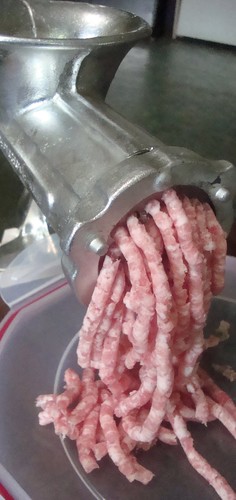
Last weekend, I scored a nice batch of Stop & Shop's pork fat that was slightly more meat than fat; since the ratio looked so good, I decided to just grind it as is and make some breakfast sausage from it.   I broke out my ol' faithful meat grinder - a massive Porkert No. 10 - and threw both the grinder and the pork trimmings into the freezer to condition them for processing.  Partially freezing the pork makes it grind much easier and better, and putting the huge, heavy grinder into the freezer gives me about half an hour or more of thoroughly chilled equipment for perfect grinding.

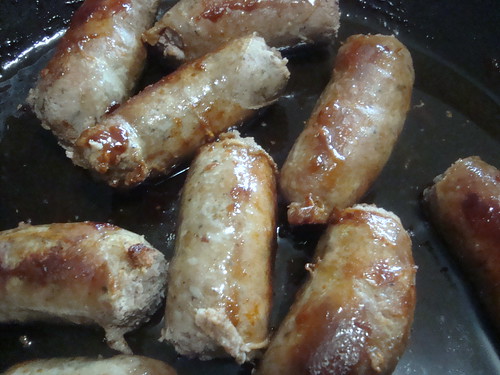
After mixing in the spices and letting the flavors blend for a few hours in the fridge, I stuffed the sausage meat into the casings, twisted them off into links, and set them back into the fridge overnight.  We fried them up the next day.  They were awesome.

Breakfast Sausage
Makes 2 pounds of sausage

2 pounds of fatty ground pork - 20% minimum, 30% is better
2 teaspoons salt
1 teaspoon dried marjoram
3/4 teaspoon rubbed sage
1 teaspoon coarsely ground black pepper
3/4 teaspoon of dried thyme
1/2 teaspoon of crushed red pepper flakes
1/2 teaspoon coriander
1/2 teaspoon MSG

Mix the ground meat with the remaining ingredients and allow to rest, refrigerated, for a couple of hours for the flavors to blend.  Stuff into casings for sausage links, or just form into patties and fry.

Notes:  
  • Use less ground black pepper for a milder sausage.
  • I used Turkish Aleppo pepper instead of the crushed red pepper flakes. You could also sub hot Hungarian paprika or cayenne pepper if you wish
  • Skip the MSG if you want.  I've tried it both ways, and I definitely prefer the MSG version.
These really should be stuffed into a small-diameter natural sheep casing, but all I had was the wider-diameter hog casings.  So they came out the same diameter as Italian sausage.  They were still delicious, though.

Sizzle, sizzle.
.

11 May, 2010

Hormel Kid's Kitchen Cheezy Mac 'n Cheese

If a handful of these Hormel heat-and-eat lunch tubs hadn't been on markdown over at Stop & Shop last week, I never would have tried them.  But they were priced to move at 50 cents each, so I tossed a couple into the cart on impulse as I went past.

I guess the packaging is designed so that kids with little kitchen experience can heat it up themselves in the microwave.  Pop the metal top off, give it a stir, put the plastic lid on and nuke it for a minute. Then stir again and eat.  Pretty basic.  

The ingredients are pretty basic as well, mostly macaroni and cheese (well, pasteurized processed American cheese but it still counts) with other stuff like butter, cream cheese, milk, and water.  And salt and flavorings.  I give Hormel props for bucking the usual practice in processed foods, however:  this product contains no high-fructose corn syrup.  It's fairly light in calories (230 for the tub) but there's a heavy sodium load at 750 mg.

So, enough of this nutritional jibber jabber.  Let's get to the important stuff:  Taste.

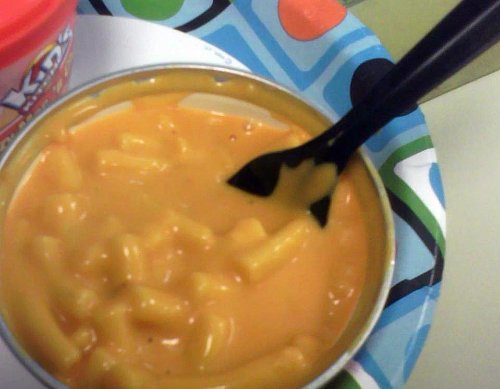
The sauce is decidedly Velveeta-like: orange, mild, with actual cheese flavoring more predominant than saltiness.  Although it was smooth and creamy, it's strong processed-cheese flavor actually worked against it for me (I would have preferred a more complex cheese sauce flavor with perhaps a bit of blue cheese or even a couple of dashes of Worcestershire sauce in the pot to liven it up) but this is a common mistake with big food conglomerates - they assume that kids have wooden palates and deliver kind of bland food to them, training them to continue having wooden palates.

Also, there's a ton of it.  Stir the pot after taking it out of the microwave, and you reveal a huge amount of cheesy orange lava below the top surface of macaroni.  The little macaroni tubes are swimming in a seemingly vast amount of it.  I know that when Lynnafred was about 10 years old, this would have been like a meal from Paradise to her, but I got ahold of a spoon and ladled some of that stuff right out.   Once the surplus cheese was removed and I got to douse it in ketchup like I do with all macaroni and cheese, it wasn't all that bad.  I might even give it to a kid for a snack, as long as I kept an eye on how much salt they were going to take in for the rest of the day.

.


10 May, 2010

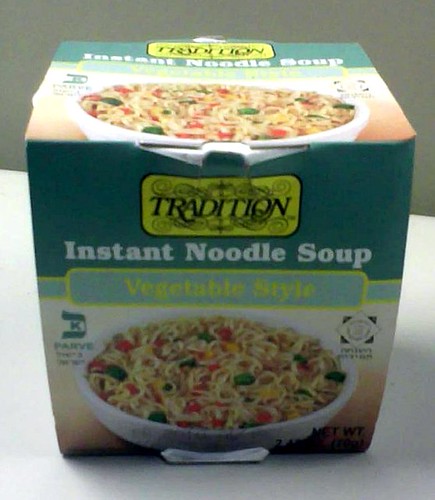
Ramen Review 15: Tradition Instant Nood Soup - Vegetable Style

I found Tradition Instant Noodle Soup in the Kosher Foods section of the supermarket.  How odd, yes? 
  • They're made in Canada (and distributed by Tradition Foods in Los Angeles.)  I don't know why I find that so strange, but I do.  I guess because when I think of Canada, I think of poutine and maple syrup and curling, but I never seem to think of ramen.
  • They're Kosher for Passover.  That's kind of cool.
  • Notice that they're "Vegetable Style," and not "Vegetable Flavored."  I don't know what the distinction is.  Maybe "Vegetable Flavored" was too long to fit in the little banner there.
Ease of Preparation: 10/10
Just add hot water and wait a few minutes.

Vegetable Packet: N/A
Like most cup noodles, these have a small sprinkling of dehydrated veggies in the cup, but there is no packet to open and mix.

Seasoning Pouch: N/A

Taste: 8/10
Fairly delicious.  I'm not usually a fan of vegetable-flavored ramen - chicken or pork is my first choice - but the Tradition broth was tasty, with elements of soy, onion, and umami (and, of course, plenty of salt.)

Spiciness: N/A
This is not marketed as a spicy ramen.

Overall:  9/10
The combination of tasty broth and nicely-textured noodles is a winner, even stacked up against industry standard Nissin Cup Noodles.  Recommended.

Link:


.

09 May, 2010

Vintage Sunday: Rhubarb

I've always been fond of rhubarb, though I didn't get to have it very much when I was a kid.  My mother didn't really like it, and we didn't have a garden (I never had a garden of "my own" until I got married - Maryanne and her family always gardened, so I kinda married into it.)

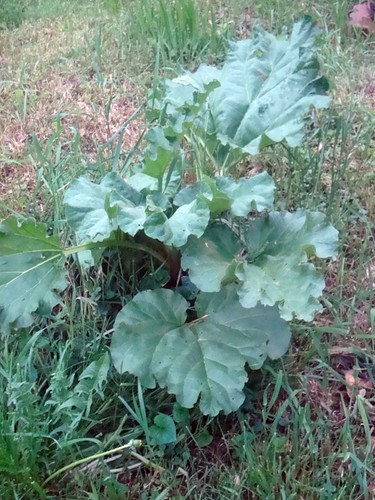
Anyway, one of the plants on the edge of the garden at our old house was a big rhubarb cluster - one with a geneology, no less.  The original roots were one of the few things that Maryanne's grandmother brought with her when she immigrated to the US in the early 1900's.  Planted and divided and recultured whenever she moved, they finally found a permanent home in the 1920's when she and Maryanne's grandfather built their permanent home.  Some of the roots were moved to her son's house a few towns over in the 1950's, and were moved again to Maryanne's mother's house in the mid-1960's.

By the 1970's, what was left of the original roots were gone from the old homestead, having been distributed out to family members or allowed to die off.  When Maryanne and I moved to the house we are in now - the house her grandfather built - we took a couple clumps of the heirloom rhubarb with us and it's back again at it's old home.  The soil here hadn't been worked as constantly as at our old place and it's kind of poor; we keep working compost and natural fertilizer into it to bring it up to standard, but it's taking awhile.  The rhubarb isn't as full and gorgeous as it was before we moved, but I'm pretty sure it will make a decent comback, given some time and TLC.

Rhubarb and New England are old friends.  The first rhubarb plants in the US came in through Massachusetts and Maine in the 1820's, and spread out from there.  It winters over well, and emerges in the spring fairly early - in fact, it's one of the very first things that can be picked out of the garden.  I can imagine that in dirt-poor New England farming towns of the mid-1800's, having a fresh rhubarb pie on the table after a long winter of root vegetables and salt pork was a huge treat.  It's so closely linked with early-season pies, in fact, that one of rhubarb's nicknames up here is "pieweed."

Over the years, rhubarb has moved out of pies and into salsas, chutneys, and sauces in ways that Maryanne's grandmother wouldn't have dreamed of.  There are tons of recipes all over the web for that stuff.  I'm just going to share a the boring old recipe for rhubarb pie that I've been using for years.

Rhubarb Pie
Makes 1 pie

3  cups  rhubarb, in 1-inch slices
3/4 cup sugar (I like my pie a little tart, use more if you wish)
1/2 tsp cinnamon
3  tablespoon  flour
a dash of salt
2 tablespoons butter
Pastry for a 2-crust pie

Combine rhubarb, sugar, cinnamon, flour, and salt.  Toss well to combine, and allow to stand while you prepare the pastry and line a pie plate.

Tip the rhubarb mixture into the pie plate and dot with bits of the butter.  Cover with a pastry top - a lattuce crust is traditional for rhubarb pie, but I like to cover it with a sheet of pastry and then cut interesting decorative vents.

.