Showing posts with label info. Show all posts

07 November, 2014

New England Clam Chowder Update Coming

I'm working on updating the comprehensive guide to canned clam chowder, which was first published in June 2011. There have been a few minor updates over the past couple of years, but since I first posted it, Campbell's has discontinued some of their products and introduced others, and there has been at least one major recipe and/or label change. Look for a heavily revised guide to come out soon.

In the meantime, if there are any canned (or plastic-pouched) New England-style clam chowders you think I should try, let me know about it in the comments here or through the Contact Me form and I'll do my best to find them. Remember that I have to have some way to get them (online ordering or from a store close to the Western Massachusetts / Northern Connecticut area.) Also please remember that I do not accept manufacturer's samples or freebies.

18 September, 2014

Hickory Syrup Making Update

I've gotten a lot of emails from people having problems with their homemade hickory syrup crystallizing. So I've updated the page about making syrup to offer tips about how to prevent (or correct!) crystals in syrup. Clicking here will bring you directly to the new section about crystallizing.

.

01 September, 2014

Cleaning silverware with SCIENCE!

Maryanne and I picked up a really nice antique silverplate service Saturday at a little antique shop outside of Pittsfield with the intent of putting it to use as our everyday flatware. It was moderately tarnished, and today I set to work with the silver polish to try and get it back to lustrous beauty.

And after about an hour of work to get half a dozen pieces done, I decided there had to be an easier way. Dr. Google, as usual, had some great suggestions. I decided to use the one that presented the least amount of work.


Set a large pan on the stove and line it with aluminum foil and lay out some silverware on the foil. Every piece of flatware must be touching the aluminum somewhere, even if it's only a small point of contact. Pour water into the pan to cover the silverware by a couple of inches and turn the fire on under the pan. Bring the water to a full boil.

Shut the heat off under the pan and sprinkle the water liberally with baking soda. The water will appear to foam as the baking soda works, and there may be a "rotten egg" smell. That's hydrogen sulfide, a byproduct of the chemical reaction cleaning your silver.

Hydrogen sulfide is poisonous, but you'd have to seal yourself inside a plastic bag along with the reaction to get a dose big enough to do you any harm.

The foaming will stop after a few minutes. Leave the silverware in the solution for a little while longer to allow the reaction to work as completely as possible.

Remove the silverware to a dishpan filled with warm, soapy water and clean it thoroughly. The tarnish should be mostly gone, and the silver will have a lovely matte finish. If you want a more shiny look, finish off the cleaning job by quickly buffing it up with a bit of silver polish.

<<- Before


After ->>


So how does this all work?

Silver combines with sulfur compounds in the air to form silver sulfide, which is black, and appears on the surface of the silver as tarnish. Removing the silver sulfide coating from the surface makes the silver shiny again..

You can remove the silver sulfide two ways: scrub it off the surface (i.e. use silver polish) or reverse the chemical reaction (i.e. turn the silver sulfide back into silver.) The method I used uses a chemical reaction, sped up by heating the water, to turn the silver sulfide back into silver.

Aluminum has a lower ionization energy than silver - it takes more energy to remove electrons from a silver atom than it does from an aluminum atom. During the cleaning process, the aluminum foil is oxidized (loses electrons) and the silver is reduced (gains electrons.) The silver turns bright and the aluminum foil darkens as the tarnish is "transferred" from the silver to the aluminum.  Because this is an electrochemical reaction, the silver and the aluminum must be touching.


25 August, 2014

Shortening In Bread

Most of the time when I make my own bread, I don't add any shortening - it's just flour, water, yeast, salt, and maybe some sugar or dairy whey to"feed" the yeast. That's not to say I don't understand why bakers put it in there - adding fats to the dough prevents the gluten from developing fully, so it gives the bread a more cake-like crumb and softer crust. It's very common for soft "sandwich" breads.

Commercial breads and those produced by supermarket bakeries often use shortening in their dough because that soft bread with a tender crust is really popular (just look at how many loaves of squishy white bread fly off supermarket shelves) and that's another reason why I always read the labels before I decide to buy something:


Finding "shortening" on the label doesn't bother me. I don't use it personally, but it's pretty much unavoidable unless you personally make every scrap of food you eat and that is impractical. But I will not buy anything using "partially hydrogenated" fats. Partial hydrogenation produces trans fat, period.

22 August, 2014

A Discussion of Fats, A Defense Of Lard, and an Amazing Biscuit Recipe.

Lard. Once upon a time it was the most common cooking fat in American kitchens. But it's been vilified for nearly a century now - bad for you, they say; causes heart disease, they say. Use shortening instead, it's made from heart-healthy vegetable oils, they say.

This is going to sound odd, coming from a guy who survived a heart attack and a five-way bypass operation but here it is: Despite its saturated fat content and the attendant bad publicity, lard isn't all that bad for you. It's actually less harmful than butter, which enjoys awesome press. And if you pay attention to labels when you buy it (or if you make your own) it's less harmful than shortening. One simply cannot make proper biscuits or pie crusts without lard, so it is important to understand how it compares to other fats and how, even after heart surgery, a dab of lard can be a good thing in the kitchen.

http://www.adclassix.com/ads/18snowdrift.htm
First of all, let me come right out and tell you that I don't use shortening at all. Although most shortening is made from vegetable oil and should, in theory, be "better for you" than some other fats, the reason why it stays solid is because it's been hydrogenated. You might be familiar with the huge flap a few years ago about trans fat and its proven direct link to heart disease. When vegetable oils are partially hydrogenated, it creates trans fats. Although vegetable shortenings today claim not to contain trans fats because they are fully hydrogenated, I still don't really trust them. To quote from University of California's Berkeley Wellness website :
Fully hydrogenated oils are being used as a supposedly healthier replacement for partially hydrogenated oils. But food companies often blend fully hydrogenated oils with liquid vegetable oils and put them through a process called interesterification. This changes the structure of the oil so that it performs like a partially hydrogenated oil without the trans fat. Sounds great, but we don’t yet know whether interesterified fats might have their own adverse health consequences. 
Read the ingredients list. If you see “partially hydrogenated oil,” that means some trans fat is present, even if the label says “0” trans fat, which is allowed if a serving contains less than 0.5 grams. Some products, such as Crisco All-Vegetable Shortening, contain both partially and fully hydrogenated oils. If the label just says “hydrogenated” oil, you don’t know if it’s fully or partially hydrogenated. Moreover, you can’t always tell from the label if a fully hydrogenated oil has been interesterified.
Also, shortening makes a softer and less flaky pie crust, so there.

Heart-friendly Olive Oyl.
I'll be honest, though: if I need a high-heat oil for stir fry, I use peanut oil. For the occasional deep-fried food, I use canola oil. And I always have a bottle of sesame oil on hand - it burns at a relatively low temperature, but just a dash of it added to the usual frying oil imparts a rich nutty flavor. And, of course, I use olive oil for all-occasion sauteing and stuff. Olive oil is rich in monounsaturated fat (almost 75%)  and has a fair level of polyunsaturated fat (about 11%) and there are 760mg of Omega-3 fatty acids in every 100 grams.  There's a reason why it's considered "heart friendly."

But it doesn't make very good biscuits or pies. And let's face it, every now and then ya like to have a biscuit or a slice of pie.

Enter lard.

Yes, lard has a lot of saturated fat. At 39%, it's got triple the saturated fat of olive oil (but more than a third less than butter!) But it's also made up of 56% unsaturated fats and in 100g of lard you'll find 1000mg of Omega-3s. Compare that to butter, where the fat is 51% saturated and only 24% unsaturated. And while olive oil and shortening have no cholesterol at all, 100g of lard has only 95mg of cholesterol compared to butter's 215mg.

The fact of the matter is for an occasional baked treat, lard is a good choice for a shortening agent. It's not nearly as cardiocloggy as butter. (If you're making delicious biscuits, you might also consider rendered chicken fat for a shortening agent as well - the profile is very similar to lard, but with less cholesterol and more unsaturated fat.) But be careful: Most commercially-available lard contains, according to the labels, "Lard and Hydrogenated Lard" (these include brands like Armour, Morrell Snow Cap, and Goya.) This is why it's important to read the label. If you can't find locally-produced small-farm lard near you (or if you can't afford it, because let's face it, small batch lard is damn expensive) there are a couple of alternatives. Lundy's brand lard, for example, is refined but not hydrogenated and so is Hatfield brand. (In the Hartford CT / Springfield MA area where I live, you can find Lundy's at Save-A-Lot stores.)

All of this is why I believe that an occasional slice of pie or biscuit for breakfast is no real danger. Moderation is the key.  And truly, there isn't much lard in a single serving of a baked good shortened with lard. My favorite pie crust recipe, for example, calls for 1-3/4 cup of lard and makes enough for two double-crust pies. If you cut one of the resultant pies into 8 slices, each slice has less than two tablespoons of lard in the crust. That's not really that much.  And my favorite biscuit recipe, which calls for a bit more than half a cup of fat, works out to less than a tablespoon of shortening-fat per serving (though I admit you get a little more total fat than that what with the buttermilk in it.)

Best Buttermilk Biscuits

4 teaspoons baking powder
1 teaspoon baking soda
5 cups flour
4 tsp salt (salt substitute may be used to reduce sodium)
1/2 cup + 2 tbsp lard or other fat (see note)
2 cups chilled buttermilk
Melted butter (optional)

Preheat oven to 475 F

Sift together baking powder, soda, flour and salt. Add the fat with a pastry blender until the flour is coarse and mealy-looking.

Make a well in the center of the flour and pour in the buttermilk. Quickly mix the ingredients together until moistened. Add a bit more buttermilk if it seems to dry.

Turn the dough out onto a floured surface and knead only about ten times, until a ball forms. Pat the dough out to a 3/4-inch thickness and, using a fork, poke holes all over the dough at half-inch intervals. Use a 2-1/2 or 3-inch biscuit cutter to punch out biscuits (remember, go straight down with the cutter, never twist!) When you run out of room to cut more, gather up the scraps, pat it into a 3/4-inch thick pad again, and cut out as many more biscuits as you can. Arrange the biscuits on a parchment-covered cookie sheet and bake 12-15 minutes or until golden.

Brush with melted butter if desired while they're still warm and serve them up.

A note about the fat: You can use any kind of chilled fat for the shortening. I've made them with lard, drippings from a pork roast, and chilled rendered chicken fat. The pork roast ones were AWESOME.

Adapted from a recipe by Chef Scott Peacock via the New York Times.


12 February, 2012

App Review: Where Is My Milk From?

Back in 2010, I wrote about a website called Where is My Milk From?  Using the lookup function on that website, a user can enter the Plant # code from just about any commercial dairy product and find out which diary it was produced at and the actual location of that dairy.  The only drawback is that you need to be at your computer to use it - fine for looking up the stuff in your refrigerator, but not as helpful when you're in the supermarket checking out the store brand yogurt and wondering who actually made the stuff.

Screenshot by
whereismymilfrom.com
If you have an Android device, you can now do that lookup right in the supermarket as you shop, with the Where Is My Milk From? app. It's awesomely easy to use and provides you with a bunch of info.  Search on a Plant # code and you'll instantly get the dairy name and location; click for more info and the app will display the processor name, city, products they make, and even a Google map with the location.

I spend a lot of time in the supermarket reading labels. I want to know what's in the food I buy, but I also want to know where it comes from - especially when it comes to dairy foods because I try to buy New England-sourced dairy products whenever I can. It's also useful to find out where generic products are from. Recently, for example, ShopRite was running a sale on their own house brand of Greek-style yogurt. I was able to run the code through the app right there at the dairy case and find out that the yogurt was made by HP Hood at a facility in upstate NY. That was good news to me, because Hood is based in New England - in Lynnwood, MA - and has local processors in neighboring Agawam MA and Suffield CT. And just as importantly, they're a processor that I and my family have trusted for years.

The Where Is My Milk From app costs 99 cents from the Android App Marketplace, and I think it's well worth it. I found it almost by accident - I was in the store looking at a container of sour cream, wishing that I was at my computer so I could look up the code number on the tub, when it suddenly occurred to me that the website owners might have turned it into an app. When I checked...there it was! I'm happy I have it installed.


05 July, 2011

Test Your Ingredient Panel Literacy

The online magazine Slate has a cool activity up right now - The Slate Ingredients Quiz.  The quiz presents the published ingredients list from various processed foods and offers you an opportunity to select the product corresponding to the ingredients.  Select the correct one, and the panel will turn green and allow you to continue with the quiz.  There are eleven questions in all, and the average Slate reader got a little better than 5 of the eleven correct.

I scored 9 correct out of 11.  Can you beat my score?  Click here to find out.

18 May, 2011

USDA Inspection Marks: Find Out Where Your Food Was Made

The more you know about food labels and how to read them, the more you can make informed decisions about the products you buy. With that in mind, I'd like to show you an easy way you can discover where many of the canned, frozen, and otherwise processed foods you buy were manufactured.  This is especially useful in the case of generic foods, many of which are packed for private labels by large, well-known national brands.

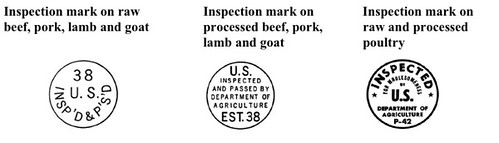
All processed foods containing meat for sale in interstate commerce are required to pass inspection by the USDA Food Safety and Inspection Service (FSIS). Companies producing the foods are assigned "Establishment Numbers"  which appears on the label along with the inspection mark. The type of mark varies depending upon the type of meat in the product:

The first inspection mark - for raw beef, pork, lamb, and goat - was once commonly stamped on the fat side of the meat in purple ink, and if you're an old guy like me, you might remember having seen those marks or their remnants on the side of your steak or pork chop.  Back in the days when meat was sold by the side and shipped whole to the butcher for cutting, those purple marks were very familiar to consumers. Nowadays, with meat pre-cut into primals and cryovac'd before shipping, the purple marks are rarer and the inspection marks often appear printed on the outside of the plastic wrap.

The second and third marks are commonly found on the labels and outer boxes of canned and frozen foods which contain meat and poultry. They are generally a standard size - about half an inch in diameter - and placed in an easy-to-find location on the label.

Remember how I mentioned that every processor has been assigned "Establishment Numbers?" Those numbers are the key to finding out which company processed the product, and at which plant it was done. The FSIS maintains directories in PDF and XLS format at this website. There are two files, one organized by establishment name, and the other by establishment number. I find the one sorted by number to be the most useful, since it's the number that appears on the mark. All you need to do is click on the link, bring up the file with Adobe Acrobat reader, and search by the number to find the name and address of the processor.  And  if you have a smartphone, it's even better: you can use your phone's browser to download the file of your choice and then use a PDF reader app to look up the establishment right there in the store.

Let me give you a couple of examples.

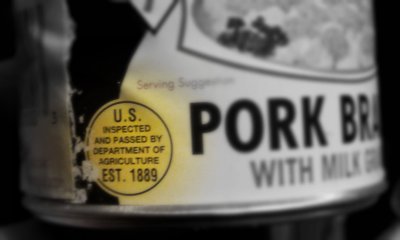
Here's the inspection mark on a can of Rose Pork Brains in Milk Gravy. The inspection mark says that this product was processed at Establishment 1889. Checking the FSIS directory, we find that Establishment 1889 is Bost Distributing Co. Inc, 2209 Boone Trail Rd., Sanford NC 27330, and that they own five labels, one of which is Foell Packing Company (the actual company listed on the Rose Pork Brains label.)  The directory also lists the primary phone number of the company. It doesn't take much imagination to realize how useful this kind of information can be to the consumer.

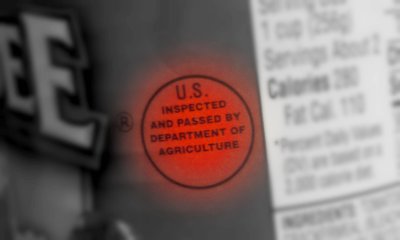
Sometimes, a product will have an inspection mark without an establishment number printed inside it, like this one from a can of Chef Boyardee Meat Ravioli. This is most common on stuff processed by huge companies (such as ConAgra, in this case) which have many processing plants across the country.

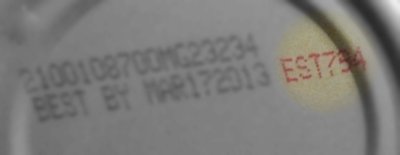
When you find an inspection mark like this, look at the ends of the can or box for the production codes, which will be either printed there or stamped into the packaging.  That's where you'll find the establishment number - in this case, Est. 794.  This can of Chef was processed by ConAgra at their plant located at 30 Marr Street in Milton, Pennsylvania.

Okay, so now I've shown you how to use the inspection marks to find out a bunch of information about where the stuff in your pantry and freezer is coming from. And that brings me to a hugely practical application of this info: Finding out who is really behind the store brands and generics that you might want to buy to save a few bucks on your grocery bill. You may remember this post from November 2010 reviewing ALDI's Kirkwood Brand frozen fried chicken.  I thought it tasted just like ConAgra's Banquet frozen fried chicken - and it turned out that it really was just like Banquet.  ConAgra processes Kirkwood chicken for ALDI at establishment P-7131 in Batesville Arkansas. The biggest difference between the two brands of chicken? The price, of course - Kirkwood sells for up to $2.00 a box less than Banquet.

Links and other useful information:

Click here to go directly to the download page for the USDA Food Safety and Inspection Service's Meat, Poultry and Egg Product Inspection Directory. The directories are downloadable from that page. The USDA periodically updates the directory, so if you choose to download it to your smartphone for mobile use, you may want to sign up for email notification of new files using the link provided there.

Click here for the home page of the USDA FSIS. There are tons of links there, with information available on food safety education, product recalls, Q&A board, and more.