Showing posts with label asian. Show all posts

05 August, 2011

Shrimp Egg Rolls

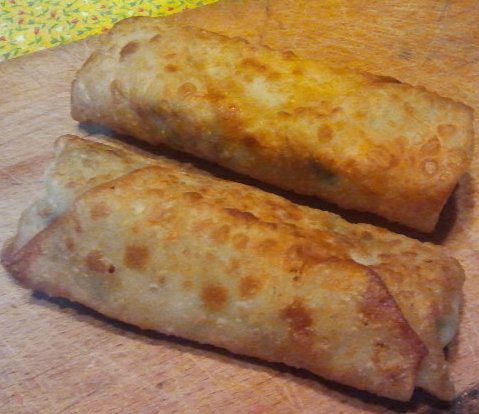
Home made eggrolls. Still akin to magic, BTW
When I was a kid, I considered egg rolls to be something akin to magic.  They were filled with shredded cabbage, but they were delicious! Not at all like the nasty cabbage my mother would make. There were other things in there, too - things I only saw inside egg rolls and had no hope of identifying.  And sometimes, there were shrimp, except much tinier than any other shrimp I'd ever seen.

Couple all that with the fact that Chinese food in general was totally mysterious (no one could ever in a million years figure out how to make it as good as the stuff you got in a Chinese restaurant!) and there you have it:  Egg rolls. So delicious and so rare, because they could only be obtained via takeout.

That was many years ago, and Asian food is not such a mystery to me any more. Good recipes on the internet, an excellent Asian supermarket nearby, and some practice have all helped me learn how to make some top-notch Chinese food.  Even the most delicious and rare delicacy of them all, the egg roll.

This recipe makes a lot of egg rolls - like thirty or more. The last time I made them, I made twenty of them right away (which were totally nommed in no time at all) and then used whatever filling was left to make another 20 which disappeared just as fast. I had originally intended to make a huge batch of them and freeze some for later, but...  damn, these things are so good you'll be eating the filling out of the pan with a fork.

Shrimp Egg Rolls
Makes about 30 rolls or so

¼ cup sesame oil
3 eggs, beaten
2 pounds of baby bok choy, finely shredded
1 cup of finely shredded cabbage
8 ounces bean sprouts
1 small carrot, finely julienned
1 can (8 ounces) shredded bamboo shoots
1 cup dried wood ear mushroom (aka black fungus) rehydrated
3 finely sliced scallions
2 tablespoons soy sauce
3 tablespoons Chinese Shaoxing cooking wine
1 teaspoon salt
1/2 teaspoon MSG
1 12-ounce package of frozen salad shrimp, thawed
Egg roll wrappers

Heat a few tablespoons of oil in a large skillet or wok. Pour in beaten eggs and cook without stirring until the eggs set firmly. Turn this "egg pancake" over and cook just long enough to firm up the other side, about half a minute. Slide the egg pancake onto a plate and allow to cool; when cool slice into thin strips and set aside.
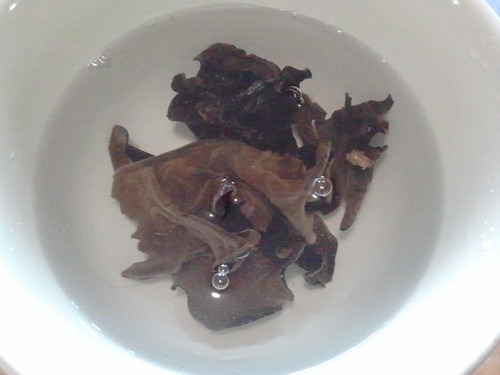
Soaking the wood ear
Rehydrate the dried wood ear mushroom by allowing it to soak in a bowl of water while you are prepping the other ingredients (shredding cabbage and cooking the eggs.) When the mushroom is soft, cut it into very fine shreds.

Heat the remaining oil in the skillet or wok and add all of the vegetables - bok choy, cabbage, bean sprouts, carrot, bamboo shoots, mushroom, and scallions. Stir fry quickly to wilt the cabbages and then, as you toss the veggies in the pan over the fire, add the soy sauce, Shaoxing wine, salt, and MSG. Continue to cook until the veggies are softened.  Add the egg and shrimp and stir over the fire for a few minutes so they pick up the flavors from the seasonings. When this stir fry is ready, transfer the mixture into a pan and put into the refrigerator to chill.

To actually make the egg rolls:

Lay an egg roll wrapper on the table in front of you with one corner pointing at you.  Dip your finger in water and wet the entire edge of the wrapper. Take a quarter-cup of the filling and spread it in a line in the center of the wrapper, leaving plenty of room at the edges for folding.
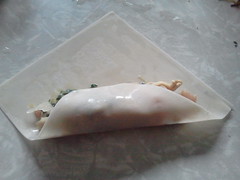
Tightly roll the bottom point of the wrapper over the filling.  Then take the side corners and fold them inward to the center, so that the egg roll kind of looks like an overstuffed envelope.  Continue to roll the wrapper up from the bottom, pressing the top corner of the wrapper to the body of the roll to seal it.

When you have a bunch of egg rolls made up and ready to cook, heat up about half an inch of oil in your skillet and fry the rolls brown on all sides by turning them frequently with a pair of tongs until you get them a nicely bubbled golden brown. Set them aside on newspapers or paper towels to drain for a minute or two, and serve hot.

A note about cooking: I like to roll these up six or so at a time, then fry the six I've made before making another six. This way, the rolls don't have time to dry out before I can fry them, and having just six on hand ready to fry means I won't overload the skillet and have too many rolls to keep an eye on. You may, if you choose, deep fry your egg rolls, or bake them (be sure to brush them with a bit of vegetable oil before they go into the oven at 400 F for 10 minutes on the first side and 8 minutes after turning them over.)

A note about wood ear mushrooms: You may omit these if you like, but if you can get some, don't leave them out - they really contribute an awesome flavor note to the finished egg rolls. You should be able to find them at any Asian market - they're one of the most common ingredients Western cooks aren't at all familiar with.


04 July, 2011

Clover Cheese-Flavored Snack Chips

Clover chips are one of the best-selling snack chips in the Philippines. They come in a wide variety of flavors, and they're kind of hard to classify.  They're kind of like a cheese puff, only flat; kind of like Munchos, only thicker and mostly made of corn; kind of like Fritos, only lighter and puffier.

I bought a bag of the "Cheesier with Vitamins" variety at Dong's last week, and found them to be crispy and fairly declicious. Despite the "cheesier" claim, I found the cheese flavor rather subtle and not at all like the in-your-face cheesiness of American snacks like Cheetos or Jax.  Luckily, Clover Chips do a fairly good job of staining my fingers orange, and therefore I found the cheese flavor perfectly acceptable thanks to the placebo effect working through my orange digits. Although I couldn't actually taste any of the Vitamins also advertised, it certainly was reassuring to know that the calories I consumed here were not empty of nutrients.  I would buy them again.

17 March, 2011

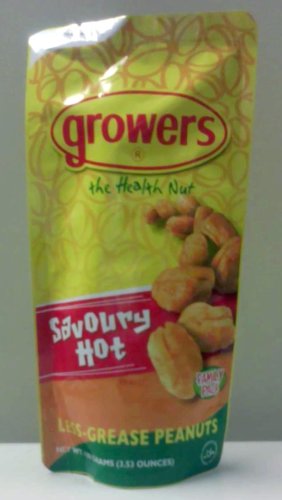
Growers Savoury Hot Nuts

Here's another Asian grocery find: Growers brand Savoury Hot Nuts. Who can resist a mouthful of hot nuts, right?  Nah, forget it - I pretty much played out the nuts-in-mouth jokes when I reviewed Everybody's Nuts in February.

Growers nuts are a Philippine import.  They're dry roasted and seasoned, like our own homegrown Planters brand, but the seasoning is decidedly different - kind of curry-like with lots of umami and a hot spiciness that isn't really very strong if you're just noshing a quick handful of nuts, but which grows cumulatively as you chomp through the whole pouch.

And chomp through the whole pouch you will, because they're addicting and inexpensive to match.  This is one of those products that I wish would become better-known so it'd be easier to find.

22 October, 2010

More Pocky

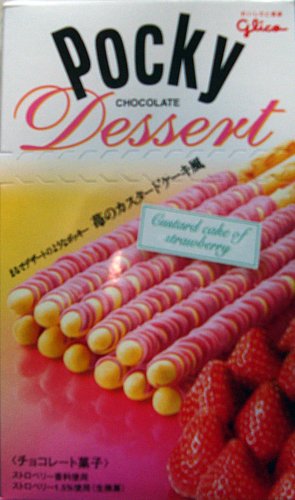
Awhile ago, I did a post on a collection of Pocky I'd eaten. Well, I'm back again with two more flavors: Strawberry Custard Cake and Chocolate Banana Cake.

The Chocolate Banana Cake have a lot more flavor than the regular chocolate banana flavored ones that I tried before. These seemed to have a more "natural" tasting banana flavor instead of the typical, noticibly artificial sort. The chocolate on these was also more pronounced, giving it an equal standing with the banana instead of letting it get overshadowed. They were good.

The Strawberry Custard Cake ones were heavenly, however. Milky and rich and full of strawberry flavored goodness, these are my new #1 favorite Pocky flavor. It was like biting into vanilla custard topped with fresh strawberries...except, you know, on a Pocky biscuit stick.

13 October, 2010

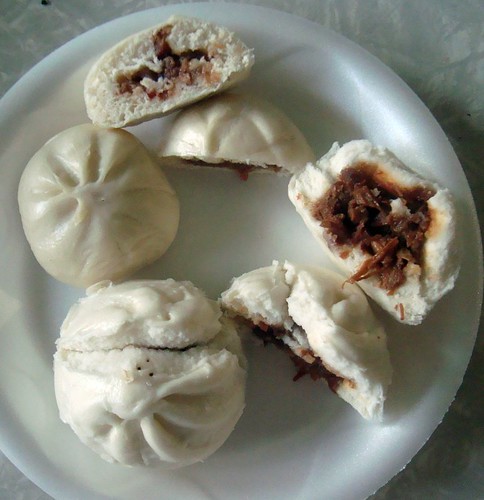
Cage Match! Roast Pork Steam Buns!

When I was little, my parents used to take me to this little Chinese restaurant in Northampton, Mass, where we used to get lunch on Saturdays. One of the things we always used to get were steamed buns with a roasted pork center. The dough was conditioned to cook via steaming, and the dough was always tender and a little on the sweet side - something that complimented the savory pork inside very well. When the restaurant closed, I was out my delicious steam buns.

But, luckily for me, the Asian supermarket in West Hartford always carries a varying selection of steam buns, roast pork included. I almost never see the same brand twice, which simultaneously rocks and sucks. So, today, I'll introduce two of the brands that I have seen more than once, Juan's and Prime Food, in a head-to-head comparison.

Juan's: These come in a nine-pack. They're smaller than Prime Food's and have a more traditional "steam bun" shape to them. The dough is a little on the tough side, but still has that slightly sweet quality I expect from them. The filling is made of small bits of pork - meaty and with little filler. These are definitely on the sweeter side, and there's some sort of sauce in there that kind of clots together in a jellylike mass. Even still, these are good. I've always enjoyed them.

Prime Food: These are bigger than Juan's, so for about the same price, you get a four pack instead of a nine pack. The dough is more tender, but they have an odd tendancy to crack at the top because of the way they're assembled. And because these're bigger, they have more filling in them. While these are more savory and roast-porky than Juan's, these also have bits of filler - cartelidge and spongy bits of fat - that the other doesn't, mixed in with the meat.

Bottom line: While I like Prime Food's steam buns, I don't really like getting a mouthful of cartelidge bits. While they've gotten better about it over the years, they still have more filler than Juan's does. And even though I prefer the savory steam buns over the sweet Juan's brand buns, I'll have to firmly side with Juan's steam buns in this cage match.

12 October, 2010

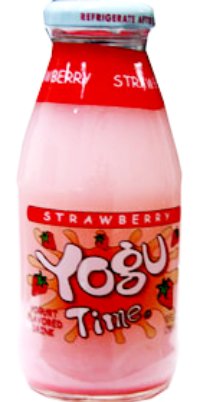
Yogu Yogurt flavored drink

When I was a kid, Dave used to buy me these drinks every now and then that were flavored like fruit and yogurt. He used to buy me the ones that were flavored like honeydew melon, because melon is one of my favorite flavors for anything ever. Then the store he used to get them from closed and we couldn't find them anymore.
So, while perusing the Korean market the other day, I stumbled across Yogu yogurt flavored drinks and bust out into a grin. "Remember these?" I asked, showing them to Dave. For nostalgia reasons, I had to pick one up. They didn't have my beloved honeydew, though, so I had to settle for strawberry.

They're not as good as I remember them being, but few things in life are. I, for some reason, always found artificial strawberry flavor to be kind of nice, so the artificial flavor really didn't bother me. It was a lot sweeter than I remembered it being, though, and a look at the ingredients (which were in English - something I don't remember from when I was a kid. I remember them being in either Korean or Chinese.) told me that it has high fructose corn syurp, sugar, and sweetened condensed milk in it. Other than that, though, it did have a nice kind of tangy yogurt-y background flavor to it.

I probably won't buy this again, but it was nice to see something that I loved as a kid again and even better to get to taste it now that I've grown up a bit.

25 June, 2010

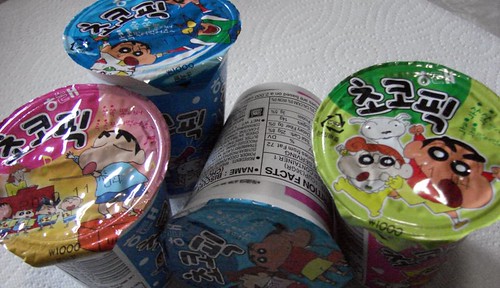
Crayon Shin-Chan snacks

I love Asian snacks. They usually come in a wider variety of flavors and shapes than American snacks. They're also sometimes not as sweet, which is a huge plus, and most of them don't use HFCS like American snacks do. And, an added bonus is that they have the opportunity to license some of my favorite anime shows, unlike American snacks.

Take these Korean-produced Crayon Shin-chan snacks, for example. I'd been a fan of Shin-chan since its American licensing by FUNimation, despite that I usually hate dubs. But because of the differences for licensing in America and in other areas of the world, I'd never be able to see these snacks in, say, Stop and Shop or other big chain stores. I'll have to settle for the catch-as-catch-can imports of Asian markets here.

The snacks themselves come in rings that taste a lot like Cinnamon Toast Crunch cereal, and are coated with a honey-cinnamon glaze. Black sesame seeds are dotted on the each piece, probably mixed in with the glaze itself, and gives a kind of nutty, smoky flavor to them when eaten.

But those aren't the only snacks with Shin on the label:


He's also on a slightly less-interesting snack involving cookie sticks that can be dipped in chocolate frosting. What makes these fun, though (more fun than their Japanese Yan-Yan counterparts) is that they come with sprinkles. Yep, you heard that right. Sprinkles.

I'm sure that there's more out there that Shin's been featured on. I just haven't found them yet. But, even if there hasn't been anything, I'll take my Asian imported Shin-Chan snacks over the lame Lucky Charms knockoffs and waxlike fruitsnacks that license most American properties any day.

.

09 December, 2009

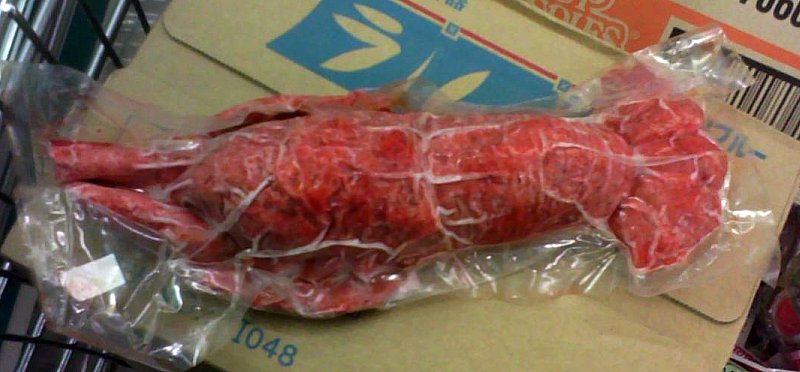
Fishy Delights 26: Surimi Lobster

A Dong Supermarket in the Shield Street Plaza in West Hartford never fails to deliver surprises to me, no matter how often I go there. Like last weekend, when I found this full-size lobster replicant made entirely of surimi (the same stuff fake crab legs and cheap-ass deli "seafood" salad is made of.)

Very cool indeed. Wish I could tell you how delicious (or, you know, not) it was, but at $13.50 it cost more than the real thing, so it went right back into the freezer after I snapped this shot.

.

29 August, 2009

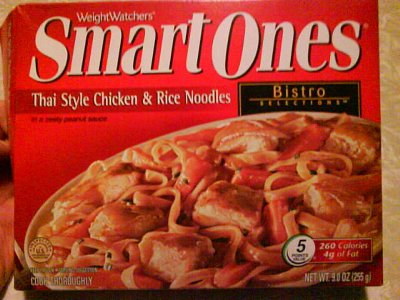
Healthy Frozen Meals: Smart Ones Thai Style Chicken and Rice Noodles

After some careful deliberation and avoiding frozen foods for a few weeks, I decided that I'm going to write these up as I'm eating them. It'll make their review much more honest and make me procrastinate less on actually writing the thing up.

And today, I'm looking at Smart Ones Thai Style Chicken and Rice Noodles. The fine print under the flavor adds: In a zesty peanut sauce.


Before I jump into this review, I want to say right now that I don't like "sour" notes in my food. The flavor of vinegar to me is a complete turn-off. That's why I don't like pickles, or sauerkraut, or hot-and-sour soup, or most sweet-and-sour Asian dishes. So keep this in mind as you read my review, okay?

This meal smelled of peanut butter and vinegar, which was an immediate warning that I probably wouldn't like it. And the monotone, brown sludge that came out of the microwave wasn't very appealing. It looked kind of slimy.

The carrots are cut up into little stick-like shapes; there's not an overabundance of them but there's definitely a good handful, and the rice noodles are all clumped together. That's one of the reasons I'm not a huge fan of reheated rice noodles. Sure, they're delicious, but the damn things stick together like no one's business. I stir the contents up according to package instructions and take a small bite.

The "zesty peanut sauce" is kind of strange. Peanutty, kind of sweet, and with an odd kind of tomato flavor, like tomato soup. It has a very mild cayenne-pepper spiciness. And a definite vinegary sourness.

Remember what I said about me not liking sour. For me, the combination of the vinegar and the tomato made this meal taste like those vomit-flavored jelly beans that come in Bertie Bott's Every Flavor Bean. Objectively, this flavor combination probably works for a lot of people, but I just hate hate hate vinegar flavoring. Getting through this one bite of noodle is hard enough, and without Dave here to egg me on, I can't stomach much more of this. I can't even tell you what the carrots or the chicken is like, because I can't get past the one bite of it.

Other web reviews seem to be pretty positive, but I know I won't be buying it again.

NUTRITION BREAKDOWN:
Calories: 260
Calories From Fat: 35
Sodium: 570 mg; 24%

Dave has his say:

Smart Ones Thai Style Chicken and Rice Noodles is an interestingly-flavored example of cheapo Thai taste. The peanut/tomato/sweet-and-sour flavor of the sauce does have a vinegary tang to it, so it's really not something Lynnafred would have liked.

As for the meal itself: The rice noodles are tender and somewhat sticky, loosened with a mildly spicy peanut sauce that has shades of tomato, sweet, and sour elements. The flavor of the carrots in the dish is enhanced with the addition of concentrated carrot juice; unfortunately this had the effect of giving the sauce a kind of tomato soup taste.

The chicken was well seasoned and flavorful, and there was a fairly generous portion of large, firm chunks. The ingredients said "roasted chicken tenderloin" and I have no reason to doubt it.

Overall, the meal wasn't all that bad, and was a nice change from some of the more run-of-the-mill noodly frozen meals. Props to Heinz for a tasty faux-Thai lunch, even though the sour aspect might turn some people away.

.

23 March, 2009

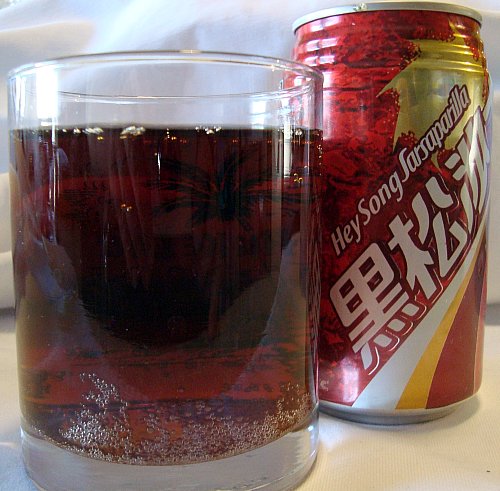
Hey Song Sarsaparilla

Sarsaparilla soda was a favorite treat when I was a kid. Back then, there were still lots of small regional bottling companies that sold their own varieties and flavors of soda, and it was easy to find.

As it turns out, though, the 1970's were actually the sunset years for most local bottlers. High sugar prices, increased transportation costs for their heavy returnable glass bottles, and the inability to afford the same massive amounts of advertising as the Big Guys forced many of them to close or shrink into obscurity while the huge super-supermarkets gave shelf space only to a handful of
national brands. Until I started poking around in the beverage section at Dong's Asian Supermarket, I hadn't seen real sarsaparilla for years.

Hey Song's Sarsaparilla is pretty decent; it's close enough to what I remember as a kid to satisfy my sarsaparilla jones, though I think there might be a little something missing from this formulation (birch oil, maybe? vanilla?) Still, the familiar herbal scent is there, and the big root-beery start fades to a touch of medicinal bitterness at the end. Very refreshing and not too sweet (though this soda is sugar-sweetened.) If you can find it, give it a try.

.

16 February, 2009

Sweet Suprises (Goodies From China, Part 2)

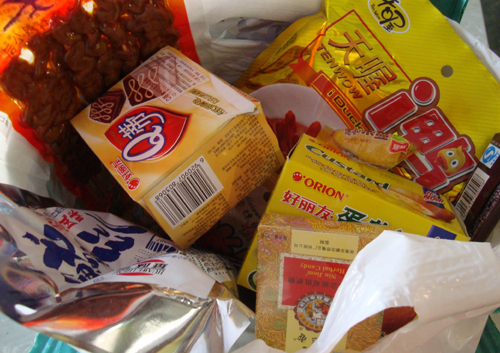
Digging further into the goodie bag that Stephanie sent from China, we find:


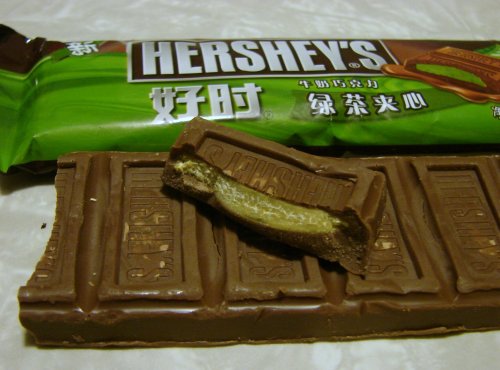
Hershey's Milk Chocolate bar with "green tea" filling: Steph's package took a little over two months to travel from Shanghai to Connecticut, and on the way it apparently encountered some temperature variations. As a result, this Hershey bar was not really in optimal condition when I opened it - you can see in the photo that there seems to be a little meltiness to the bar, and the slight greenish tinge to the chocolate is perhaps caused by the color of the filling migrating into the outer bar.

Biting into the Hershey's green tea bar is almost exactly the same as biting a standard Hershey's Milk Chocolate bar. The chocolate is an overwhelming first flavor, and it has every characteristic of Hershey's Pennsylvania-made product, right down to the slightly "cheesy" flavor unique to Hershey's. I tasted the green tea filling alone, and it hasn't got much initial flavor of its own other than "sweet." What makes this bar unique, though, is the marvelous and rich green tea aftertaste. I had just about shrugged off this candy as unremarkable when the green tea flavor came through and surprised me.


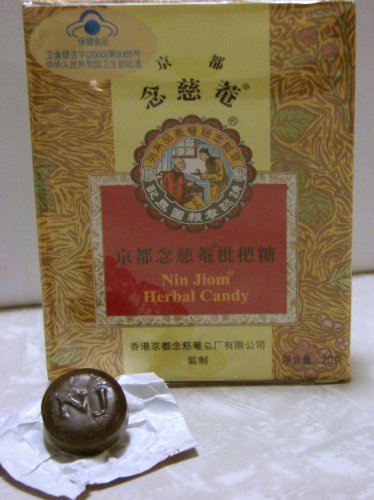
Nin Jiom Herbal Candy: The flavor of these marvelous little drops is difficult to describe. They're similar to the Riccola herbal cough drops, but perhaps a bit sweeter with more of a traditional candy-like flavor, and they're loaded with menthol.

They are also the best thing ever for soothing a sore throat. Halfway through one of these little drops and my daughter's horribly irritated throat was comfortable enough again that she could comfortably swallow.

A quick web search revealed that Nin Jiom is indeed a highly-regarded herbal remedy for sore throats, coughs, and colds in China, and that there are liquid preparations as well, most of which are sold at Chinese pharmacies in the US. The next time I'm down at Dong's Supermarket, I'll be spending some time at the medicine counter to see if they have any Nin Jiom.


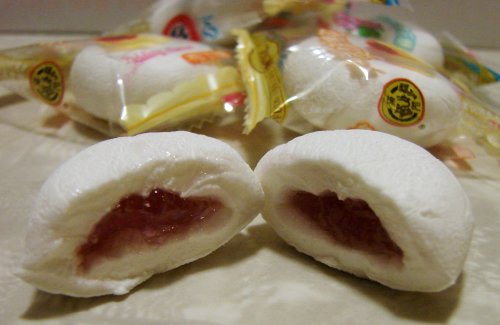
Filled Marshmallow Candies: These are small individually wrapped 1-inch round marshmallow pillows filled with various sweets. Stephanie sent a big handful which included two varieties: grape and "pudding." The grape flavor had a pale purple grape jelly inside, and the "pudding" ones had a translucent amber chewy stuff that tasted similar to vanilla custard. A little too sugary for my tastes, but popular with kids.


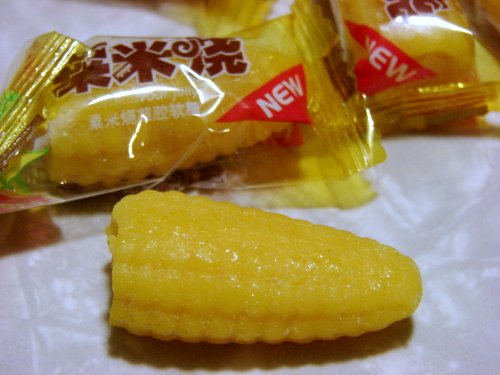
Corn Jelly: If these were being actively marketed in the US, they'd be called Gummi Corn. They are inch-long gummis made in the shape of a tiny ear of corn - and they taste exactly like biting into flavorful corn on the cob. I'm not kidding.


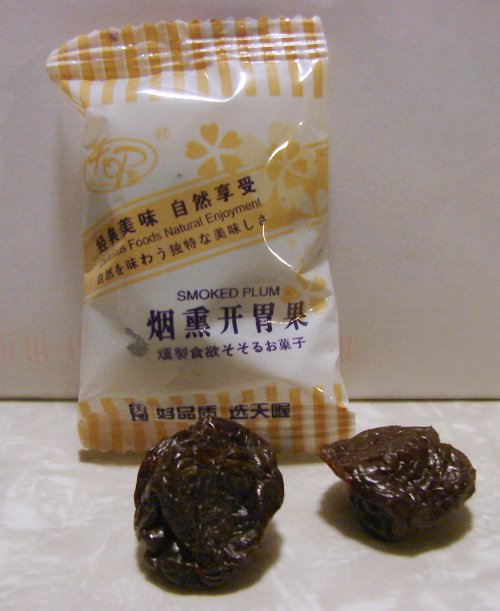
Smoked Plum: Each of these sugar-packet-sized wrappers contain two small sugarplum prunes, unpitted. I'm not sure whether they are actually dried over smoke, or smoked as a final step after they are dried, but they do indeed have a slightly resinous pine smoke flavor coupled with the taste of the ever-present five-spice mix that seems to be really common in the snacks Steph has sent.

That flavor combination sounds like it should be awful, but it works well, especially because they're also just a bit salty. The sweet dark fruitiness of the prunes, the earthy smoke flavor, and the salt/five-spice combination produce a very unique snack.

07 February, 2009

Duck Tongues and Feet (Goodies from China, Part 1)

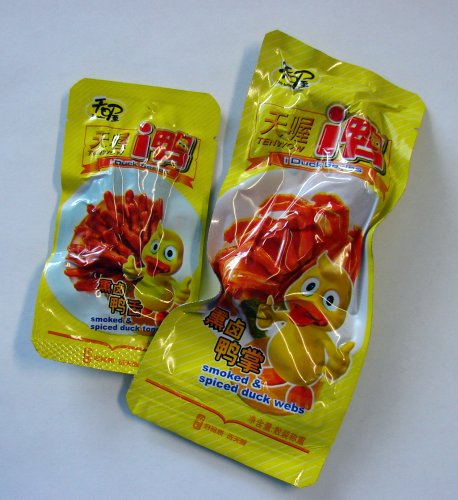
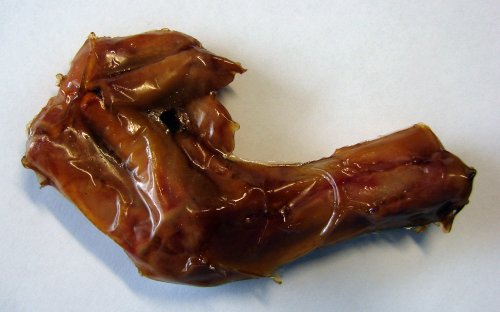
Last week, I mentioned that Stephanie had sent a big box of goodies from China. Today we're taking our first peek, and we find Smoked and Spiced Duck Tongues, and Smoked and Spiced Duck Feet! Yummy!

Now, I have to say that the packaging and graphics are truly inspired. Each duck foot, or "duck web" as they are labeled, is individually cryovac packaged in a foil pouch. The tongues are similarly packed, but there are two in each pouch. These packages keep the treats fresh and delicious for a long time. And I love the graphics, with a cartoon duckling giving the viewer a "thumbs up" superimposed over photographs of the tasty snacks. I got a kick out of the brand name, too: The iDuck Series.


Duck Tongues: The Snack That Tastes You Back

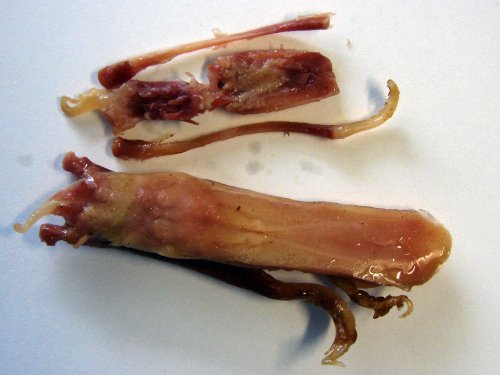
This is what a smoked spiced duck tongue looks like right out of the package. Each tongue has four small bones associated with it. There are two thin pin bones, one on each side, and two short but broad bones under the tongue itself.

I've found the easiest way to eat the tongues is to pluck out the broad bones from under the tongue and then eat the rest kind of like a chicken wing - pop the whole thing into your mouth and then slide the two pin bones out between your teeth, removing the meat from them as your go.

How do they taste? Well, Americans tend to think "hot" when they see the word "spicy" but "spicy" on a Chinese-packaged product often means "five-spice seasoned" instead, and that is exactly the case here. The smoke flavor is very subtle and the flavor of the tongue is mild. Overall, it's very similar to American vienna sausages, but richer and with a more interesting texture (provided by the little curlicues of cartilage no doubt.)


At Left, Top: The bones from inside a duck tongue

At Left, Bottom: The tongue as removed from the packaging; the pin bones are folded under the tongue (aboard a duck, those bones extend from the base of the tongue.)


I wish that I had duck feet...


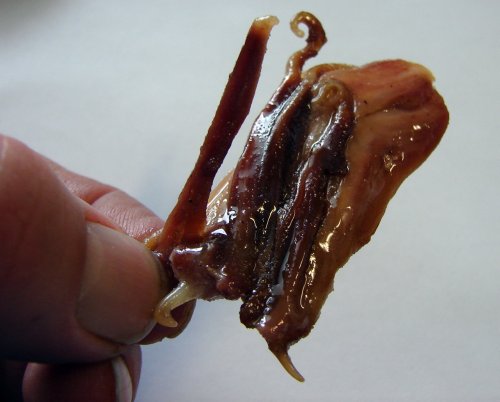
Duck feet, although bonier, are easier to eat. The bones are bigger and there's more meat. right out of the package it looks like a tiny withered fist, perhaps ready to flip us off:

As with the tongues, "spicy" refers to the five-spice seasoning. The meat and gristle, all of which should be eaten, are tender but not "fall off the bone" tender, and the foot is enshrouded with flavored aspic, made from the juices of the foot as it cooks and is sealed in the pouch.

Duck feet aren't very meaty - most of what's there is soft-cooked tendon and skin. But the texture is interesting, and the smoke and spice give an interesting flavor: different from the tongue, almost like a rich chicken stock.

I don't think there's a "proper" way to eat them. You can nibble the meat off the bones (make sure you eat the gristly bits between the bones) or break off the bone segments and clean them off by pulling them between your front teeth. Some people eat the toes whole, toenails, little bones, and all, but I'm not really comfortable with that - and the nails are really sharp! I got one jabbed into my gums between two molars and it hurt like hell.

Anyway, my favorite way of eating them is to pull out all the little bones and toenails first - they slip right out and leave the web all wobbly and boneless - and then pop it in my mouth like a tiny drumstick, with the ankle bone as a handle. Delicious.

With any luck, I'll be able to find these in my local Asian supermarket.

Link:

Ten Wow Food Co. of Shanghai website (in Chinese - no English page available at this writing.)


I wish that I had duck feet
And I can tell you why:
You can splash around in duck feet
You don't have to keep them dry.

-- Theo. LeSeig
(Dr. Seuss)

01 February, 2009

Goodies from China!

Wow! Look what came in the mail on Friday! A big box of mysterious and esoteric goodies from China, courtesy of Stephanie! There are all sorts of strange and delicious delights here...let's see...some duck tongues, and duck feet. And here's something called "Spicy Chicken Feet String." Cool candies, and Fishsnacks, and little cakes. ...There are many interesting flavors and blog posts in the days to come.

.

22 January, 2009

Mama Jok Cup

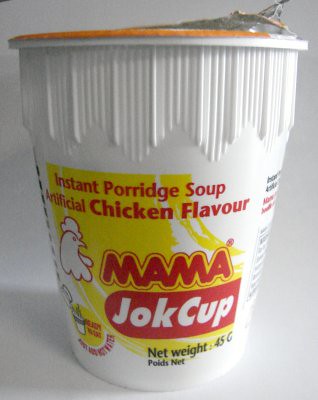
Yes, of course, what self-respecting food blogger with a taste for the unusual and a puerile sense of humor can possibly resist the allure of Mama brand Jok Cup, an instant rice porridge/soup concoction from Thailand? Not me, I can tell you, even though I know that Thais pronounce the word as "joke," not "jock."

I had no idea what to expect when I put this in my cart at the Asian supermarket, but thought it would make a decent fast lunch at my desk. Alas, it was indeed fast, but also about as contrary to my taste and preferences as I could possibly have chosen.

I hate almost all cooked cereals. Oatmeal, cream of wheat/farina, cream of rice - I loathe every milled particle of those vomitous vile masses. And Jok Cup is simply a very thin and runny form of cream of rice. ::gag::

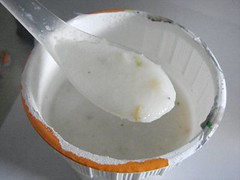
It's as simple to make as cup noodles: all one needs to do is open the lid, pour in boiling water, and allow the cup to stand for a few minutes while the soup rehydrates. Mama makes it as convenient to prepare and eat as possible - when the the foil lid is peeled back, one finds a small plastic Asian-style spoon inside.

The ingredients are wholesome enough for an instant cup - rice flour, chicken flavoring, bits of leek and ginger root, pepper, and garlic - and I admit that the flavor wasn't so bad. But the texture. Ugh. Baby food. Nasty runny stuff, it triggers my gag reflex every time. I tried to eat it, I really did, but I just couldn't do it. This shit is not for me - I'm sticking with Mama's noodle varieties.
.

04 August, 2008

Szechuan Tokyo, West Hartford CT

Two years ago, I went to Szechuan Tokyo for dinner with friends and fucking hated it. A small jazz band was scheduled to perform that day and we made the mistake of thinking it would be an enjoyable experience. The goddamned band had their amps cranked up as far as they'd go and we were deafened by the volume. It was so loud it was impossible to talk to one another; the music even thundered oppressively in the rest rooms. We ate our food and left, and I swore I'd never go back there again.

Last week, though, I found myself in West Hartford again with a different bunch of friends and after discussing our lunch options, we decided to give Szechuan Tokyo another try - on the condition that there'd be no live music.

It turned out to be as pleasant as we'd hoped.

Szechuan Tokyo squats on the corner of New Britain Avenue and South Main Street in the Elmwood section of West Hartford. The funky little white building is a bit run-down but comfortable on the inside, kind of homey and casual and festooned with bits of red-paper-and-gold-foil cheap Asian gift shop decorations. It was a hot afternoon, and our waiter appeared immediately with glasses of icewater and menus; throughout lunch, he was always prompt and available and maintained an excellent level of service. Our party of five decided to order a number of predominately Szechuan appetizers and share them around; that turned out to be a fine idea.

Here, then, in no particular order, is what we had:

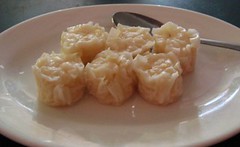
Shumai dumplings are a particular favorite of my daughter. Szechuan Tokyo's version were competently prepared if somewhat unexceptional; we agreed that they were probably pre-made and frozen, though we really couldn't tell if they were made on the premises during off-hours or brought in from a commissary.


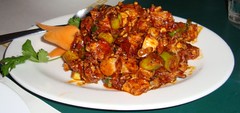
Ma la rabbit was authentically Szechuan, salty and hot. Plenty of Szechuan peppercorns gave the bony little bunny cubes fire to spare, and there were notes of garlic, scallions, sesame oil, and ginger - though perhaps not enough garlic or sesame oil for some in our party. Honestly, it was a little hard for me to tell because the Szechuan peppercorns kind of seared my tastebuds.


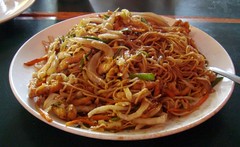
My daughter Lynn was quite pleased with her yakisoba with chicken, though it was more Chinese in style than Japanese. I particularly enjoyed the smoky flavor that permeated the dish and which is lent by extremely high-temperature cooking in an old, well-seasoned wok, though it has been pointed out to me that this comes from not scouring the wok often enough. If losing that elusively wonderful seared smoked flavor is the price for scrubbing the wok clean, however, I hope the kitchen continues to neglect the steel wool for a good long time.


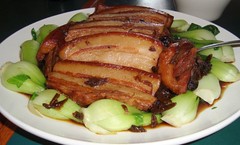
Unquestionably, the star of the meal was Stewed Pork Belly with Pickled Vegetable. About half a pound of lovely slow-cooked pork belly, sliced and arranged on a bed of quite delicious but rather unidentifiable preserved vegetable (we think it was not the standard cabbage, but may have been kale.) The dish was trimmed with a ring of tender steamed baby bok choi halves. Absolutely wonderful.

My wife Maryanne ordered scallion pancakes (no photo, sorry.) They were flaky and crisp outside, chewy inside and studded with loads of scallions, but they were exceptionally oily - could have used a little more draining time before being served - and she and Lynn decided that although these were good, my homemade scallion pancakes were better.

Of course, any time a number of things are ordered there are bound to be a few disappointments, and this time was no exception. Ants Climbing Trees, for example, was completely different than the puffed rice and ground pork we were expecting; what arrived was rice noodles simmered in what my friend Michael described as "a murky soy and hot pepper broth" with bits of scallions and meat burbling about. ("The dish should have been called Ants Drowning in the Amazon Rainforest After a Flash Flood," he said.)

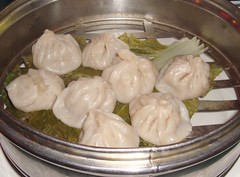
Soup dumplings were another letdown. We were told when we ordered them that they took an additional 20 minutes to prepare; as the rest of our meal arrived, the waiter apologetically told us that the dumplings would be out "soon" and another twenty minutes or more went by before they finally arrived. Unfortunately, they weren't really worth the wait. Instead of the slurpy burst of hot broth we expected when we bit into them, we got a chunk of moist and flavorful, but not soup-dumplingy, ground pork. The dough was too thick and bready and had perhaps absorbed the broth before we could get to them.

For the most part, however, our experience was overwhelmingly positive; the food was quite authentic and delicious and we didn't have to scream at one another over an annoyingly loud band. I'd certainly go again.

But never - never - on a live music night.

Click here for Szechuan Tokyo's website.

Michael Loo
contributed to this article.


21 July, 2008

A. Dong Supermarket, West Hartford CT

I've written before about A. Dong Supermarket, the large Asian market in West Hartford CT. My wife and I were back there yesterday and stopped to buy a roasted duck to take out for supper.

The photo at right shows the display case where the roasted goodies are kept hot pending customer's orders. In the background, whole red-roasted chickens hang, followed by strips of "baby BBQ pork" (bright red ovals of sweet barbecued pork cut from the shoulder.) Hanging on hooks in the center of the photo are a number of roasted five-spice ducks, with the head and neck still on. To the right, whole roasted pigs hang from steel hooks as a deli employee sections them with a razor-sharp Chinese chef's knife. In the foreground, three or four roasted pig's heads gaze at the ceiling next to several "long feet" (roasted pig's feet which include the leg all the way up to and including the hock.)

Since we arrived at Dong's early in the afternoon, this deli/lunch counter was busy. Some girls in front of me in line ordered a couple of ducks, and the woman behind the counter took two down from the case and brought them to a massive chopping block. Within a minute or two, she had the two ducks expertly cut into inch-wide strips, packed and arranged in an eye-pleasing manner in lunch-sized aluminum pans - half a duck per pan.

I ordered our duck, and the woman picked one down. "Don't throw away the head, OK?" I asked her.

She looked at me strangely. "You want duck head? You sure?"

"Yes, thanks."

"Okay. You like tail, too?" she asked. When I said yes, I wanted the tail too she gave me a big smile. "I give you extra tail, we have some from other duck."

When the cutting and packing were done, she handed me two lunch-sized aluminum pans artfully packed with inch-wide strips of duck...and a plastic bag with four duck tails and the head from the duck I ordered.


By the time we got home, the duck skin had lost its crispiness. I fired up the charcoal grill and very carefully gave the duck a few minutes over the hot coals, warming the meat back up and making the duck skin crispy and delightful. "Very carefully" is not an exaggeration, because duck is fatty and if not watched closely can turn an outdoor grill into an inferno. It turned out delicious.


07 April, 2008

Lunch at A. Dong Supermarket, West Hartford CT

A. Dong Supermarket is the largest and most well-stocked Asian Supermarket in Connecticut. A full-service supermarket, the departments include aisles devoted to housewares, various ramen noodles, Japnese candies and snacks, and more - and there's even a gift shop to one side up front.

The front of the produce/meat section includes a hot and cold lunch counter, where you can get roasted pork, duck, or chicken, various noodle dishes, soup, bahns, and so on - ready to eat, or to take home to heat and eat. It's noisy and crowded at lunchtime, with people jostling to place their orders and deli workers with razor-sharp Chinese butcher knives chopping pork and duck into thin strips and packing them into take-out trays.

We stopped in on a recent Sunday to do some regular shopping and picked up a light lunch on the way out, picking up bahn bao and bi cuon to chase off the mid-afternoon munchies.

Bahn bao is a Vietnamese steamed dumpling about the size of a baseball. The dough is slightly sticky, but firm and light, neutral in flavor. It's gathered up around the filling (a few slices of Chinese sausage, half a hardboiled egg, and some ground pork seasoned with ginger and scallion, like the center of a wonton) and the bahn is then steamed. Dong's bahn bao are absolutely delicious.

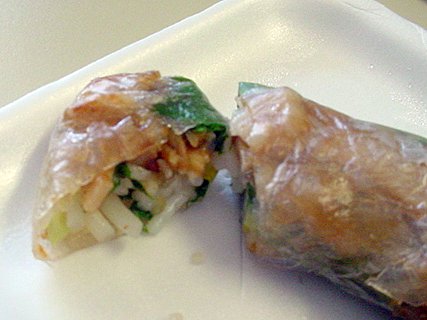
We also bought a tray with a few bi cuon, a Vietnamese pork roll made with rice paper wrapping up a filling of finely julienned pork and pork skin, bean sprouts, noodles, cucumber slices, mint leaves, and ground brown rice. These were served with a few small hot bird's-eye chiles and a small cup of fish sauce for dipping, and they were as delicious as the bahn.

A. Dong Supermarket
160 Shield Street
West Hartford, CT 06110

They are the anchor of the Shield Street Shopping Plaza and the store is set back from the road - be careful you don't miss it as you go by!

.

21 March, 2008

Making Wontons

Ever since she was a toddler, my daughter has loved wonton soup. She never fails to order it when we eat at a Chinese restaurant. But there is no reason not to have it anytime. Wontons are time-consuming to make (all that stuffing and folding!) but fairly easy.

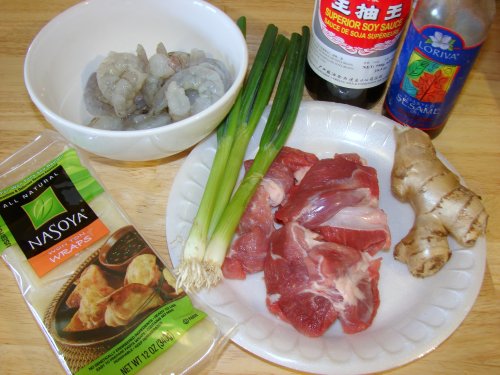
The ingredients are shown to the left. For a batch of 50 wontons, you'll need:

1/2 pound of pork (not too lean)
1/2 pound shrimp (peeled, deveined)
1/4 cup finely minced scallions
2 tbsp finely minced ginger
1 tbsp soy sauce
1 tbsp oyster sauce
A dash of sesame oil
1 tsp ground black pepper
1 package of 50 wonton wrappers

Pulse the pork and the shrimp separately in the food processor until each are finely minced, then combine them along with the scallions, ginger, soy sauce, oyster sauce, sesame oil, and black pepper until well-mixed. Cover the bowl and refrigerate for 2 hours to allow the flavors to combine.

Fill wonton skins with the mixture and either simmer them in broth or soup to cook them, or freeze them for later use.

You may want to have an extra package of wonton wrappers on hand. Depending on how big the wrappers are and how much filling you put into each one, you may have some of the pork/shrimp mixture left over after just one package.


How to Fill and Fold Wontons

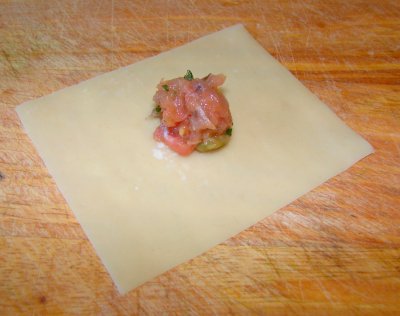
Place a single wonton wrapper down on a clean, dry surface. Put about half a teaspoon of filling in the center.


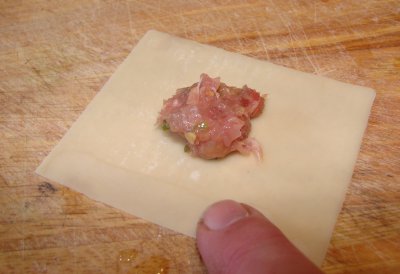
Moisten your finger with water and wet the edge borders of the wonton wrapper, all the way around.


Fold the wonton wrapper corner-to-corner over the filling, and press down along the edges to seal them.


Now moisten the opposite corners with water and fold them towards each other. Press the tips together to seal them.

Repeat until you run out of filling or wonton wrappers. (No one ever seems to run out of both at the same time.)


Simple Wonton Soup

9 cups of pork broth or chicken broth (pork is best)
1/4 cup finely julienned pork loin (about 3 ounces)
25 wontons
3 scallions, sliced into fine rings
1/4 pound snow peas (or 1/4 cup of frozen sweet peas)
A large handful of baby spinach leaves

Bring broth to a simmer and add julienned pork and wontons; simmer, stirring occasionally, for two or three minutes. Add remaining ingredients and continue to simmer for a few minutes until snow peas are tender.

Makes a filling lunch for four.


20 January, 2008

How To Make Scallion Pancakes

Scallion pancakes are a delicious appetizer and dim sum treat found in many Chinese restaurants. A kind of fried bread, they are crispy and flaky on the outside, tender and a bit chewy on the inside, with shreds of finely diced scallions between the savory layers of pancake. And surprisingly enough, they aren't that hard to make.

You'll need:

3 1/2 cups of flour
1 heaping teaspoon of salt
2 tablespoons of vegetable oil
1 1/4 cups of boiling water
Sesame oil
1 bunch of scallions (3 to 5 scallions)
Oil for frying

This is easiest with a stand mixer. If you don't have one, you can do the initial mixing and kneading by hand.

Put flour into the bowl of your mixer and add salt. Using the dough hook, turn the mixer on low speed and allow the salt to stir into the flour. Then drizzle in 2 tablespoons of vegetable oil. Allow the mixer to incorporate the oil into the flour while you bring 1 1/4 cups of water to a boil.


Turn the mixer to medium speed and add the boiling water slowly. As the water is combined with the flour, turn the mixer speed up and let the dough hook do the work. You may have to scrape down the sides of the mixing bowl a couple of times to get the water worked into the flour evenly.


When the dough holds together well, turn it out from the bowl and knead it a few times by hand on a lightly floured surface until you have a smooth, elastic dough. It will be very firm, appear silky, and not be sticky at all. Lightly oil a bowl with a little bit of sesame oil. Put the dough into the bowl and turn it a few times to coat the dough's surface and keep it from drying out. Cover with a damp towel and allow it to rest for at least twenty minutes. If you're going to do this step ahead, it's okay to let the dough rest longer - up to a couple of hours if you need to. Letting the dough rest allows the gluten in the flour to relax after the kneading, and there's no hurry.


While the dough is resting, trim the roots and nasty bits off a bunch of scallions and then chop them very finely into rings as thinly as you can manage. You'll need anywhere from three to five scallions, depending on how big they are. When they're all chopped, set them aside in a bowl.


After the dough has rested, roll it into a rough cylinder and divide that into eight equal segments. On a lightly floured surface, flatten each cylinder slightly with the palm of your hand and then roll it out to about an eighth of an inch thick. Sprinkle the pancake with flour lightly if you need to prevent sticking.


Rub a light coating of sesame oil all over the top surface of the pancake using your fingers. You don't need much; just a light glaze - enough to make the pancake shiny with oil. Then sprinkle it lightly all over with the finely chopped scallions. Don't use too many - just a tablespoon or so will do. If you put too many on, the pancakes won't cook well and the scallions will break through the flour and make a mess.


Carefully roll the pancake into a tight rope like a miniature jelly roll, making a scallion-filled dough stick. Then take that stick and form it into a coil, keeping the seams on the inside. Pinch the trailing end closed and tuck it under the coil to keep the scallions on the inside.


Gently press the top of the coil with the palm of your hand to flatten it a bit. It will look something like the picture on the left.


Dust the coil with a bit of flour on both sides to prevent sticking, and roll it out into a thin pancake. Try to get the thickness between 1/8 and 1/4 of an inch. You'll see the scallion bits through the thin layers of pancake, and some of the scallions on the edge might break through a bit. Don't worry about them, that's OK. You should end up with about a 7- or 8-inch pancake when you're all done. After each pancake is rolled out, rub the top and bottom surfaces with a bit of sesame oil and stack them up between sheets of waxed paper. You can store the stack in a plastic bag in the refrigerator until you're ready to cook them, and they can be made up to three days ahead of when you need them. If you wrap each pancake individually in waxed paper, you can even freeze them for later use.

To cook: Put less than half an inch of cooking oil in a skillet and heat it to about 350 F. Using tongs, carefully place a pancake into the oil and fry it until it is browned. As it fries, you may notice the center of the pancake lifting above the oil on the steam it generates. Use your tongs to slightly lift the edges and let the steam escape so the center browns, too. Turn the pancake over and brown the other side, too. As the pancakes cook, you'll see the trapped air bubbles in the pancakes expand and brown. The pancakes will be flaky, crisp, and all in layers. Drain on absorbent paper and serve hot, with a dipping sauce if you like. I make a simple dipping sauce of 1/4 cup soy sauce, a teaspoon of oyster sauce, 2 tablespoons of rice vinegar, a teaspoon of honey, some of the chopped scallions left over from making the pancakes, and some crushed red pepper.