Showing posts with label vintage sunday. Show all posts

21 October, 2014

Vintage Cookie Recipes

Some time ago I posted about a set of old Christmas cookie cutters that made me nostalgic for my childhood. Last week I got a comment from a reader:

"Do you happen to have the cookie and glaze recipe that I believe was on the lid of the box, on the inside? If so, would you be kind enough to share?"

I had forgotten all about the recipes included with the cutters, so I dug them out of their off-season sleeping place and checked it out. There are actually four recipes printed on the underside of the lid - three cookies and one for frosting.

Sugar Cookies

½ cup shortening
1 cup sugar
2 well-beaten eggs
2 tablespoons cream
1 tablespoon vanilla or almond extract
3½ cups cake flour
2 teaspoons baking powder

Cream together shortening and sugar. Add eggs, cream, and flavoring extract and beat well.  Sift flour and baking powder together. Add dry ingredients to creamed mixture. Shape into mound, wrap in waxed paper and chill thoroughly. Roll on board lightly "floured" with confectioners sugar until dough is about ¼ inch thick. Dip cutter in confectioners sugar each time before cutting cookie, the place cookie on lightly greased baking sheet. Bake in moderate oven (375 F) for about 8 minutes, or until delicately browned.

------

Ginger Snap Cookies

½ cup molasses
¼ cup sugar
3 tablespoons shortening
1 tablespoon milk
2 cups flour
½ teaspoon baking soda
½ teaspoon salt
½ teaspoon ground cloves
½ teaspoon ground cinnamon
½ teaspoon ground ginger\

Heat molasses to boiling point; add sugar, shortening, and milk and mix well. 

Sift flour, soda, salt, and spices together; add sifted dry ingredients to the molasses mixture. Shape into mound, wrap in waxed paper and chill thoroughly. Roll on board lightly "floured" with confectioners sugar until dough is about ¼ inch thick. Dip cutter in confectioners sugar each time before cutting cookie, the place cookie on lightly greased baking sheet. Bake in moderate oven (375 F) for about 8 minutes.

------

Brown Sugar Cookies

2 cups brown sugar
2/3 cup shortening
2 well-beaten eggs
½ teaspoon vanilla
3 cups flour
1 teaspoon baking powder

Cream sugar and shortening together until light and fluffy. Add eggs and vanilla and beat well.

Sift flour and baking powder together. Add sifted dry ingredients to the creamed sugar and shortening. Shape into mound, wrap in waxed paper and chill thoroughly. Roll on board lightly "floured" with confectioners sugar until dough is about ¼ inch thick. Dip cutter in confectioners sugar each time before cutting cookie, the place cookie on lightly greased baking sheet. Bake in moderate oven (375 F) for about 8 minutes, or until delicately browned.

------

Frosting and Decorating

1 egg white
1 cup confectioner's sugar
Few grains of salt

Add sugar gradually to the unbeaten egg white. Beat until smooth and of a consistency to pour slightly. Divide frosting into two or three small bowls and color to pastel shades with vegetable coloring; flavor as desired.


17 July, 2011

Sau-Sea Shrimp Cocktails & Tiny shrimp

Do you remember Sau-Sea shrimp cocktail?  When I was a kid, this was one of my favorite treats;  my mother would buy them for semi-special occasions.

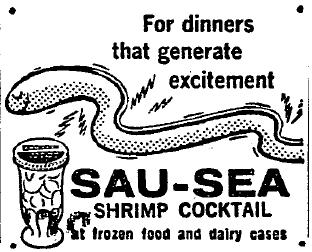
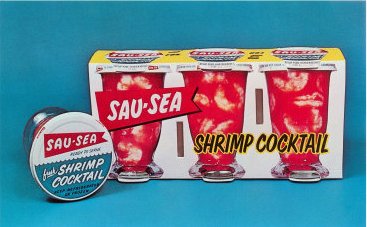
Sau-Sea cocktails consisted of tiny little shrimp, swimming in a bland, almost ketchupy, cocktail sauce and packed in small fluted juice glass. Each glass was sealed with a litho'd tin lid, as shown in the photo, and the glasses were reusable.  Go to a church rummage sale and you'll find a testament to Sau-Sea's onetime popularity - you'll almost always find a dozen or more of those heavy little glasses for sale (often for about a dime each.)  Up until the mid-eighties, when she finally sold off her own hoard in a tag sale, I bet you could tell how many times our family had eaten Sau-Sea shrimp cocktails by the number of old Sau-Sea tumblers lurking in my mother's kitchen.


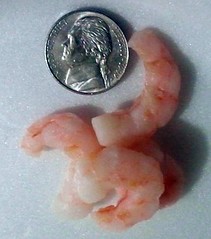
When Sau-Sea first started business in the late 1940's, shrimp was a luxury food that most people almost never ate outside of a restaurant.  These days, of course, you can get really good fresh or freshly-frozen shrimp at just about any supermarket, and they're big enough to actually see with the naked eye.  Even so, sometimes I get nostalgic for Sau-Sea Shrimp Cocktail. It doesn't seem to be as ubiquitous as it once was, so I often try to make my own version.

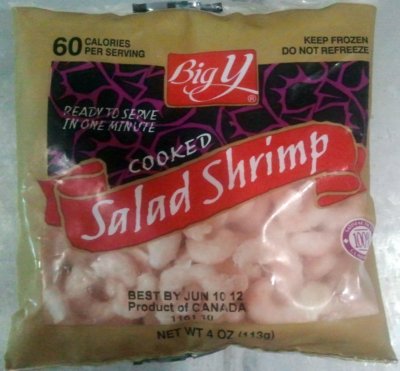
Big Y sells small bags of what they call "salad shrimp." Like most of what Big Y sells, they're hideously overpriced - except for a few times a year when the store jacks the price up a bit and then pretends to do everyone a favor by selling it as a "Buy One, Get Two Free!" special. That's when I'll buy three bags and make my own bastardized Sau-Sea imitations.

Thanks for selling me that
bag of krill, Big Y.
I make up some cocktail sauce - not the boring Sau-Sea cocktail sauce of my sprogdom, but my own kickass version - and pack the salad shrimp into juice glasses. It's never the same.  Those salad shrimp are completely nasty. They're not tender and meaty like shrimp should be, they're soggy and wet and feel like shrimp-shaped cut-outs from a kitchen sponge when you chew them. And even though they're about as tiny as they can be and not qualify as Sea Monkeys, size doesn't really have anything to do with their crappiness - that's purely the fault of whatever cutrate company Big Y deals with.  And, of course, it's my own damn fault for buying them again. You'd think I'd have learned my lesson by now, but  no - there I am,  back at the frozen food counter, buying shitty little fingernail-clipping-sized shrimp from Pig Y. Whatever else you may think of Sau-Sea, back in the day the shrimp might have been small as hell, but they were always pretty decent and they have my respect in that regard.  Also, those glasses. Until I was like 14 years old and started chugging it right from the carton, I never had orange juice at home unless it was served in one of those repurposed Sau-Sea glasses.


I hardly ever find Sau-Sea shrimp cocktails in the store anymore.  When I do, I rarely buy them. They're more expensive than when I was a kid, when the Waldbaum's Food Mart in town sold them for something like $1.25 for three little jars, and those little tiny shrimp just don't seem to be such a good deal as they used to.  My perceptions of "shrimp cocktail" have changed since I was 7, I guess.  And the Sau-Sea company has changed, too.  In 1993 they  decided to become a marketing company rather than a manufacturer.  They stopped processing their own shrimp in Yonkers NY, released the 70 employees who had processed 10 tons of shrimp per day, and handed over production to a company in Virginia.

Sau-Sea newspaper advertisement, c. 1960

31 October, 2010

Vintage Sunday: Bonomo Turkish Taffy IS BACK

Of all the candies that were available when I was a kid. I remember Bonomo Turkish Taffy most fondly.  I don't know why - maybe because of their intense and ubiquitous advertising which ran well into the 1970's, or because Turkish Taffy was a standard feature of so many childhood Christmas stockings and Easter baskets, or maybe simply because it became unavailable for so long when it was discontinued years ago.  Whatever the reason, memories of Bonomo caused me to keep an eye open for it at every specialty candy store I visited for many years, without success.  Eventually I found out that the company had at one point been bought out by Tootsie and production had ceased in the late 1980's.  I had no idea that Bonomo had been resurrected as an independent company until a casual browse through my local Five Below store.  

THEY HAD BONOMO ON T3H SHELF!!  I was there with my big sister Fran and my wife Maryanne, digging Five Below's cool and fun pop cultural swag when I spotted it, and all three of us pretty much had the same reaction : OMG BONOMO TURKISH TAFFY GET SOME!!!!!1!  I picked up a pack of chocolate and a pack of vanilla and would have gotten the banana and strawberry flavors too, if they had any.

I'm happy to report that it's just like it was back in the day.  It still "tastes like ice cream," as the old ads used to say.  (Tastes like really cheap ice cream, but the ads never did specify the grade of ice cream, so I give them a pass.)  And it's still got that "brittle-chewy" makeup, so slapping the package sharply onto a tabletop still breaks the taffy into pieces which then soften in your mouth to a chewy-but-not-very-sticky consistency.

So, why was Turkish Taffy gone so long from the collective sweet tooth?  The original company, founded in 1897 by Turkish immigrant Albert Bonomo, was a candy manufacturer on Coney Island making saltwater taffy for sale to tourists.  In 1945, the founder's son Victor came up with "Turkish Taffy," made from a batter of corn syrup and egg whites that was boiled and then baked.  Turkish Taffy quickly became the company's star product. 

In 1980, the Tootsie Co. bought Bonomo, and within a few years discontinued Turkish Taffy, saying that "tastes had changed" and demand had fallen off.  

Today, Classic Caramel LLC, a wholly owned subsidiary of candymaker Warrell Corporation, is making and distributing Bonomo Turkish Taffy using the original recipes, manufacturing process, and flavors.  Track some down - there's nothing like it.
.

10 October, 2010

Vintage Sunday: Old Moxie Ads

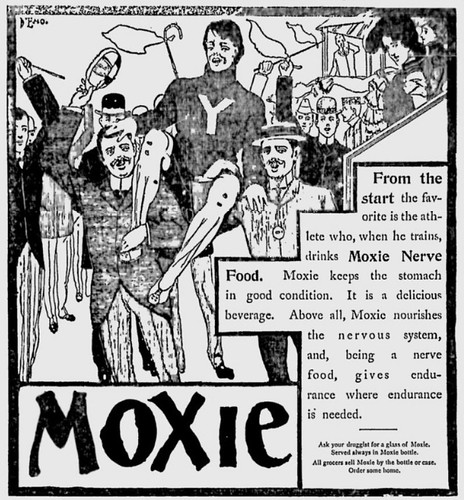
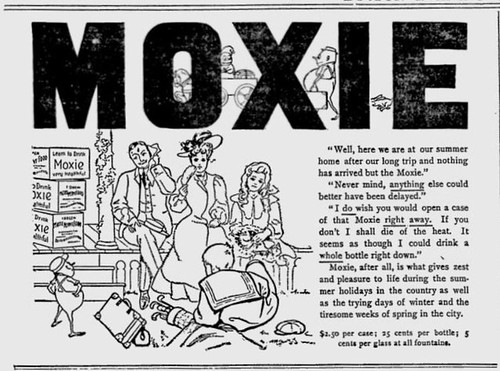
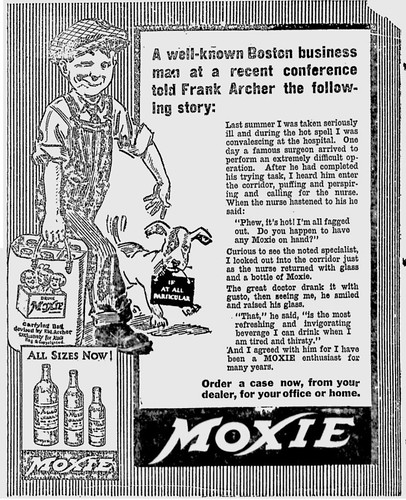
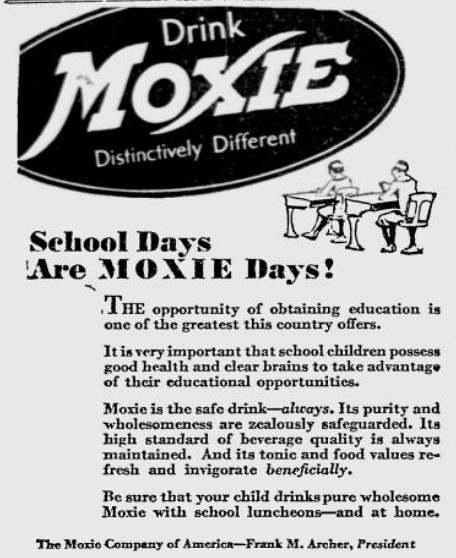
I'm sitting here, drinking a Moxie, and thought I'd share with you some vintage Moxie newspaper ads which have appeared over the years.  These are all from New England papers, though at the time these ads were run Moxie was the most popular soft drink in the US (yes, even more popular than Coca-Cola.)

1900
1905
1905
1926
1929
1930

03 October, 2010

Vintage Sunday: "Antique" Milled Corn at the Berlin Fair

On Saturday, the family and I went south to the Berlin Fair, an agricultural fair which has been sponsored by the Berlin Lions Club since the late 1940's and which is the successor to the Connecticut State Fair.  That area of my little state - the region around Middletown, Meriden, and New Britian - still has a number of working farms and "backyard agriculture" and so there are plenty of old-fashioned exhibits like oxen pulls, poultry, cattle, food and craft competitions, and tractor pulls mixed in with the craftspeople, local businesses, and hucksters that are standard finds at fairs.

We tend to stay clear of the overly commercial "exhibits" and seek out the small, local, and unusual stuff.  One such interesting display was put on by the Tobacco Valley Flywheelers, a group of antique engine enthousiasts who collect, restore, and maintain old gas and steam engines and machinery.  

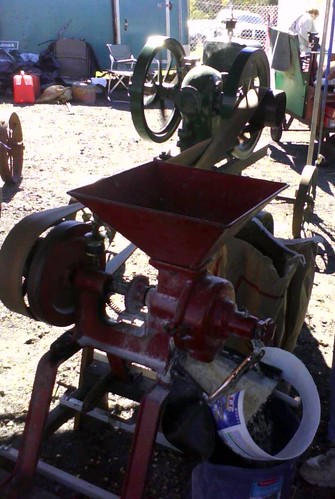
Among the number of one-lungers that were chugging away under their tent was a c.1910 McCormick-Deering engine driving a David Bradley corn mill.  It was completely cool to watch sacks of corn being dumped in to the mill's hopper as medium-grind cormeal poured out the chute into a bucket.  From there, volunteers were scooping the freshly-milled cornmeal into small paper bags and selling them for a dollar a bag.  I bought two of them and used the cornmeal later to make delicious corn bread.


The small gas engines on display at the fair, and the cast-iron-and-steel machinery driven by them, represents an interesting period in New England farming history.  At the time, much of the "bull work" on a farm - plowing, cultivating, hauling hay, harvesting, etc. - was done manually or with the help of animal teams like oxen or horses.  Most farmers would bring grain to a centrally-located mill from processing, but small kits like this became more common as economical gas engines took their place on farms.

The David Bradley corn mill (foreground) grinding cornmeal.  It's
connected to the McCormick Deering engine in the background by
a three-inch-wide leather drive belt.

These engines, with their heavy flywheels, low RPM, and moderate horsepower, were used for a huge number of jobs on New England farms.  They ran water pumps, grain mills, sawmills, machine shops, smithies, and more.  Virtually anything you could run with a belt drive or crankshaft could be run by a hit-or-miss engine and they became a common sight in rural areas.  Today, there are still thousands of them out there - some in the hands of collectors, who restore and maintain them - but many are still lying forgotten in barns, sheds, and shops waiting to be resurrected.


26 September, 2010

Vintage Sunday: A Baking Contest & Antique Recipes

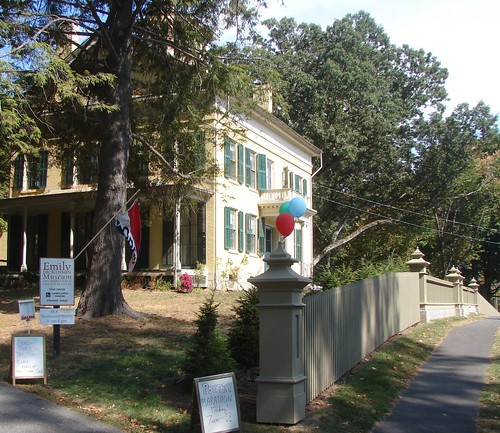
The Emily Dickinson House
A few weeks ago, I wrote about the Emily Dickinson Museum's baking contest. in which participants were challenged to recreate their choice of four baked goods Ms. Dickinson is known to have prepared, using the recipes (if any) she was known to have used.

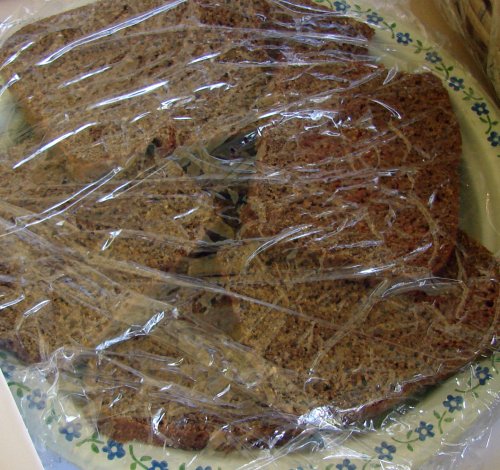
There were fourteen entrants in all (not bad for the first contest of its kind by a relatively small local museum.)  Three of the entries - including mine - were for "Rye and Indian Bread," a bread once common in New England which was made from rye flour and corn meal (aka Indian meal.) 

Ms. Dickinson won a Second Place prize for her Rye & Indian Bread at the Amherst Cattle Show in 1856.  Unfortunately. the actual recipe she used has not survived.  We were instructed to research antique recipes and come up with one that would be as authentic as possible.

As it turned out, each of us entereing the competition took a completely different approach to the problem and all of the results, while bearing little resemblance to each other, were reasonable and authentic solutions.  Each of the breads are shown below along with tasting notes.  Sorry for the dubious picture quality, but I was only able to take photos of the wrapped breads before the judging.

First Place went to a yeast-raised loaf which used a combination of cornmeal, rye flour, and whole-wheat flour (to incorporate enough gluten to allow for rising.)  The bread was dense and somewhat moist, with a pronounced rye flavor and a very tender crust.  The density of the bread made it very filling.

Second Place was claimed by a steamed bread very much akin to Boston Brown Bread.  Having been steamed in a pudding mold, it was cylindrical in shape.  The baker cut it into wedges for serving, but it really should have been served sliced into generous round slices.

Very moist and dense in texture, this bread was rich with the flavor of molasses.  Typical of steamed breads and puddings, it was very heavy and filling.  It would have been the perfect accompaniment for delicious homemade baked beans.  Unfortunately, it was an unseasonably hot day in Amherst - 90-plus F - and that dramatically reduced my enjoyment of this one.

Third Place, and therefore The Loser, was taken by my own interpretation, a pan-baked quickbread which relied on acidic ingredients (buttermilk and molasses) along with baking powder and baking soda to provide leavening power.  Not as heavy as the previous two entries, it was also not nearly as moist, coming out quite reminiscent of a modern cornbread (though with an interesting rye flavor tinged with molassesy sweetness.)

After the judging was over and the winners announced, the portions of the bread which hadn't been eaten by the judges were offered to attendees at the museum for general nomming.   The first and third place breads vanished the quickest (reflecting, as I noted earlier, the heat and oppressiveness of the day.)

Unfortunately, I wasn't given the opportunity to get a copy of the recipes my rivals used, but I can provide you with my own recipe if you'd like to try baking a batch of Rye & Indian Bread for yourself.

Third Place Rye & Indian Bread
9 servings

1 cup yellow corn meal
1 cup rye flour
¼ cup brown sugar (NOT packed)
½ teaspoon salt
4 teaspoons baking powder
1 teaspoon baking soda
1 cup buttermilk
1 egg
¼ cup vegetable oil
¼ cup molasses

Preheat oven to 425 F and grease an 8 x 8 x 2 baking dish.

In a large bowl, combine corn meal, rye flour, brown sugar, salt, baking powder, and baking soda. Stir well with a whisk until all the dry ingredients are uniformly blended.

In a small bowl, beat buttermilk, egg, oil, and molasses with a fork until thoroughly mixed. Pour liquid mixture all at once into dry ingredients and stir in just until the batter is thoroughly moistened.

Turn the batter out into the prepared baking dish and bake at 425 F for 20 minutes, or until a toothpick inserted in the center comes out clean.
.

19 September, 2010

Vintage Sunday: The Swirl Mixer


New dog Iris is a bundle of energy who spends most of her day racing around the back yard romping and wrestling with Zim.  By the time nine p.m. rolls around, she's pretty much spent for the day.  She curls up on a blanket on my recliner and goes out like a light, sleeping so soundly that I can easily pose a piece of kitchenware on the side of her head and take my time getting a ridiculous picture.

The kitchenware in question is called a "swirl mixer," which was first introduced in the 1930's  by Rochow Swirl Mixer in Rochester NY.  The graduated aluminum cup is stamped with volume markers from 1/4 cup to a full cup, and the curved lid with the interesting spiral shape stamped into the lid fits the cup tightly.  The idea was to pour mixable liquids into the cup, cap it tightly with the lid, and give it a few shakes.  The spiral shape at the top supposedly encouraged the liquid to swirl and mix more thoroughly.

I'm sure they have a million uses, but I can tell you what they are excellent for:  Scrambling eggs.  Crack a couple of eggs into a Swirl Mixture, add a bit of milk or water as you wish, and give it a couple of good, hard shakes and you have perfectly blended eggs for scrambling.

As long as I can remember, there have been Swirl Mixers in my kitchen.  My grandmother had one.  My mother's got two of them: a one-cup size like the one shown above and a two-cup size.  When I was a kid, they were everywhere; I'd see them all the time at rummage and tag sales, selling for a dime or a quarter.  Although I don't see them quite as often as I used to, there are still millions of them out there. 

And what, you might ask, ever became of the Rochow Swirl Mixer company?

They're still in business, selling and distributing kitchen equipment in Rochester NY.  They don't maintain a website and they seem to concentrate mostly on imports. Up until a few years ago, you could buy a brand new Swirl Mixer from the Vermont Country Store, but the item seems to be discontinued now.

But no matter.  Keep your eyes open at the next church rummage sale if you're going to look for one.  Betcha you find one or more on the kitchenware table.
.

12 September, 2010

Vintage Sunday: Postcard Finds

I was at a Tailgate Sale yesterday.  A Tailgate Sale is when an organization - in this case a childcare center - organizes a sort of flea market.  Anyone can rent a space for small fee and sell stuff (supposedly out of the back of a station wagon or small pickup, hence the term "tailgate sale.")

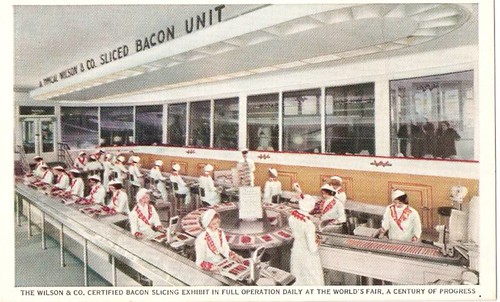
Anyway, one of the vendors had a box of postcards and I poked through them, picking out two pretty cool bacon-related cards:

This card shows women working in the packaging room at Swift & Company, packaging and wrapping Swift Premium Bacon.  It dates from the mid-1930's.  The back of the card reads: 'In a room cooled by washed air, and without being touched by hand, Swift & Company's Premium Bacon is sliced and packaged at the rate of more than 200 packages a minute.'  Maybe the women packaging the bacon are wearing gloves or something, because that one in the foreground on the right sure looks like she touching the bacon with her hand.
This scene shows the operation of a "typical Wilson & Co. Sliced Bacon Unit."  This one was set up for public viewing at the Century of Progress Exposition (also known as the Chicago World's Fair) in 1933.  This one shows a few more details of the operation than the Swift photo above:  The bacon slices are coming down a conveyor on the right, packaged and placed on the roundabout near the center; next they're weighed at one of four weighing stations before being handed off to be wrapped.
I got a kick out of finding two old cards with pretty much the same subject on them.  They're not very rare, though.  I found several of them for sale on eBay
.

05 September, 2010

Vintage Sunday: Americans Have Always Loved To Poop

We seem inundated lately in products which claim to promote "digestive health."  Most of them seem to be dairy products of one kind or another, sold pre-contaminated with live bacteria and advertised as magic potions to cure "sluggishness."

But even though these "probiotic" and "digestive health" products are new, marketers have been trying to make us feel guilty and obsessive about bowel movements for decades.  The current "digestive health" movement (heh heh, movement) is actually fairly low-key and mild compared to how practically insane America was about crapping in the 1920's and 30's.  At that time, many physicians believed that the colon was an unneccessary and even unhealthy organ.  Thousands of patients went under the knife and had their colons removed for the treatment of conditions we now know are entirely unrated to that poor maligned organ.

That was also the era in which ridiculous notions about pooping and digestion came about.  Things like "At any given time you have x pounds of putrifying meat in your colon" and "Chewing gum stays in your intestines for seven years."

And so it was during this time period that Kellogg's produced an annual series of cookbook/dietary booklets promoting "A New Way of Living" on The Sunny Side of Life.  The picture at right is the cover of the 1934 edition, but they were all pretty much the same every year, just updated with fresh illustrations.  They contained advice about incorporating lots of Kellogg's All Bran cereal into one's diet, as a breakfast cereal and as an ingredient in foods served at every meal, and touted the many health benefits of regularly scheduled crapping.

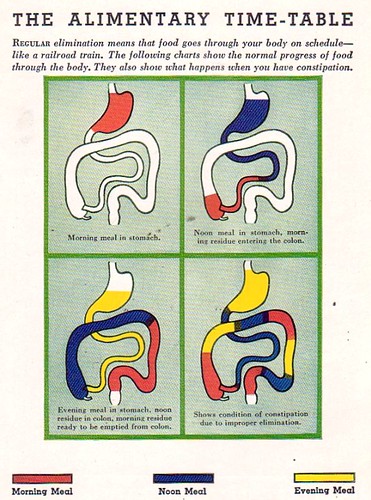
Each booklet also included very official-looking but completely idiotic diagrams and charts purporting to explain how food travels through the intestinal tract.


This chart, for example, is Kellogg's representation of how food should ideally travel through your body - right "on schedule like a railroad train."  Each color represents a meal.  You're REGULAR when all your meals politely line up at the colon, waiting their turn to be "emptied."

But look at the bottom right frame in that chart.  O NOES!!!1! MY MEALS R ALL MIXT UP & NOW MY BOWELS WON'T MOVE!!!!!!1! LOL

Don't you dare argue, damn it, this is SCIENCE, in bold italicized caps which everyone knows is shorthand for "truth."

Kellogg's gave away hundreds of thousands of these booklets over the years via mail-in requests and giveaways at state fairs and groceries spurring millions of dollars in sales for their bran products.

And just in case science and scare tactics didn't convince you to eat bran and organize your turds like boxcars in gut, they also commissioned newspaper comic strip artists to create advertising comics starring popular characters such as  this one with Alphonse and Gaston, two unctuously polite Frenchmen.  Note how the constipated Gaston refuses to set foot into the water, a situation also used by Activia ads 70 years later (remember the woman poolside who wouldn't go swimming because "I'm a little...irregular," she explains as she rubs her stomach.)

Yes, lady.  You are a little irregular, like your mother and grandmother before you.  Lucky for you there have always been marketers out there to remind you of your defecatory responsibilities and to provide you with the products you need to perform them.

22 August, 2010

Vintage Sunday: A Baking Contest!

The Emily Dickinson Museum in Amherst MA is holding an awesome baking  contest for the next month - a contest which just so happens to fit right in with our usual Vintage Sunday feature.

The basic idea of the baking contest is simple:  Choose one of four period baked goods that Emily Dickinson is known to have made - Gingerbread, Black Cake, Coconut Cake, or Rye and Indian Bread - and, using Ms. Dickinson's own recipes (provided as part of the rules) develop a modern recipe suitable for today's kitchen.

There's a catch, of course.  Cookbooks in Emily Dickinson's day assumed that the reader knew her way around the kitchen and were familiar with the proper techniques and methods needed to produce edible food.  Therefore, recipes were usually little more than lists of ingredients.  Take, for example, Dickinson's own recipe for gingerbread:

1 Quart Flour
1/2 Cup Butter
1/2 Cup Cream
1 Table Spoon Ginger
1 Tea Spoon Soda
1 [Teas Spoon] Salt
Make up with molasses.

Using only these ingredients (measurements may be varied) you would need not only to make delicious gingerbread, but to document your process in order to submit - along with samples of the gingerbread to be tasted by judges - a modern recipe with quantities, ingredients, and full instructions including oven temperature, size of pan, and baking time.

Entrants must preregister by submitting an Intention-to-Enter Form by September 21 and deliver the completed recipe as well as a sample of the baked good itself on Saturday September 25th at the museum between 11:00 am and 1:30 pm.

This sounds like a lot of fun.  Full recipe rules and more information may be found HERE.  Good luck!

Special thanks to reader Zoe for passing along news of this contest to me.
.

15 August, 2010

Vintage Sunday: E. Swasey & Co, Pottery

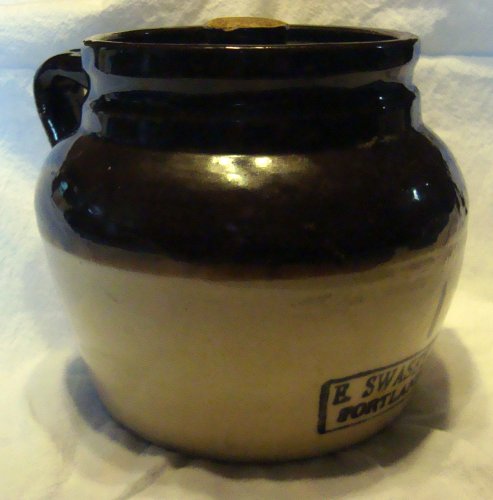
Pictured at right is a cute little 1-quart beanpot I picked up at a thrift store not too long ago.  It was made sometime in the late 1800's by E. Swasey & Company of Portland ME, a company which at one time was one of New England's most prolific pottery works and today is all but forgotten.

Eban Swasey was a potter who apprenticed in Exeter NH in the mid-1800s.  In 1875 he and his partner, Rufus Lamson, moved to Portland ME and established the Portland Earthen Ware Manufactory, producing redware.  Swasey and Lamson eventually went their separate ways, and in 1890 Swasey established E. Swasey & Co. at 273 Commercial Street in Portland.

In 1897, Swasey's youngest son Perley joined the company, which became a sizeable enterprise by the turn of the century.  Eban  died in 1906, but the business carried on until finally sputtering out of business in the Depression.  The factory buildings are still there on Commercial Street - refurbished and with the "E. Swasey" logos freshly restored on the end of the mill, they serve today as an office park.


During their four decades of operation, Swasey pottery was common and used all over New England.  They made beanpots, crocks, jugs and bottles, jars, creamers, and more.  Their most common pattern was the typical color combination shown in the photo - brown top, cream-colored bottom, with a light brown stripe between them and the characteristic "E. SWASEY & CO - PORTLAND ME" mark on one side - but they also produced contract work and more decorative pieces as well.

Not too long ago, Swasey pottery was easy to collect.  It wasn't considered "old enough" to attract the attention of antiquers, and it was pretty commonly found in rummage and yard sales really inexpensively.  Then, sometime in the early 2000s it was "discovered" and has since become hard to find and kind of costly for old crockery.  Personally, I don't collect any one particular manufacturer, but the little Swasey piece that inspired my essay here made a great addition to my collection of beanpots.
.

08 August, 2010

Vintage Sunday: Call for Entries!

Do you have an antique or vintage kitchen item that's been in your family forever and you  want to show it off?  Do you have something old in your kitchen that maybe you got from your Mom or grandmother and you just don't know what it is and you'd like to find out more about it?  Do you have a favorite food or product that just doesn't seem to be around any more and you wonder whatever happened to it?

If you do, I'd like to hear about it, and perhaps blog about it on Vintage Sunday.  Click the "Contact Me" tab just under the blog banner to get in touch.  Thanks!

.


18 July, 2010

Vintage Sunday: Snow's Clam Crisps

A few days ago I received a note through my Contact Me page from a woman I'll identify only by her first name, Cynthia.  Unfortunately, Cynthia didn't leave an email address for a reply - but on the other hand, she presented me with a fascinating puzzle which in turn has led to this Vintage Sunday post.  Here's her message:

I had a lady call about a canned product she bought back in the 50's made by Snow's - "Clam Crisps" is what she called them and she said they were similar to the fried onions that come in a can and were about the size of a Frito. She actually called Fred Snow, who is now about 92, and he had two cans of the product - and he wouldn't sell them to her! She swears they are the best thing ever. Have you heard of this product?
Would love to know any information you might find.
I enjoy challenges like this.  I'm a patient and tenacious researcher, I know where to look for many different types of esoteric information, and I'm very creative in constructing the types of queries which tease out data where others sometimes come up dry.  And that includes non-digital research when necessary:  there's a lot of info on the internet, but it's very often the case that there are few - or no - digital records of things which existed only briefly in the days before digital media.  Such is the case with Snow's Clam Chips.  Not even Bumble Bee Foods, the current owner of the Snow's label, could help me - After several changes of ownership and a big move which carried the brand out of Maine and down to New Jersey, there aren't many original corporate records left.

Nevertheless, I was able to find out a bit about Snow's Clam Crisps.

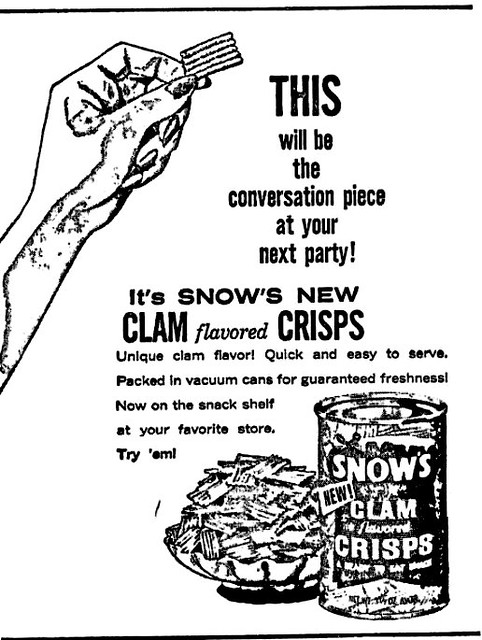
Although they may have been sold in the late 1950's in Maine and eastern Massachusetts,  the earliest print references I could find for them date them to no earlier than 1964, when they first appeared widely in newspaper ads all throughout New England.  Snow's Clam Crisps were kicked off in this ad campaign, which hit New England newspapers in late summer 1964:


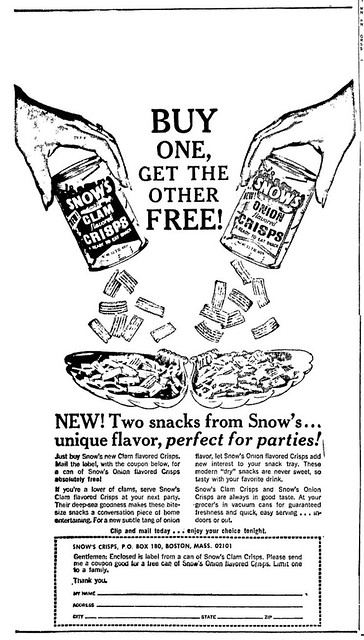
They were a thin and crispy cracker shaped something like Sun Chips are today, seasoned and clam-flavored.  Instead of traditional boxes or snack bags, Snow's marketed them in sealed metal cans.  Although I've found message board postings here and there in which the writers mention how delicious the chips were and how much they miss them, Clam Crisps were almost certainly a niche product that didn't appeal to everyone.  By 1965, Snow's was offering special mail-in coupons allowing folks to send a label in to receive a return of their purchase price (Try them FREE!) or to receive another can free:

Clam Crisps just never really caught on.  The last advertisements for them showed up in newspapers in late summer 1966, and after that the product just sort of faded away.


Although fondly remembered by many people. Crisps were removed from production and Snow's concentrated their attention on their more traditional products - Chowders, soups, and canned seafood.

11 July, 2010

Vintage Sunday: Eight O'Clock Coffee

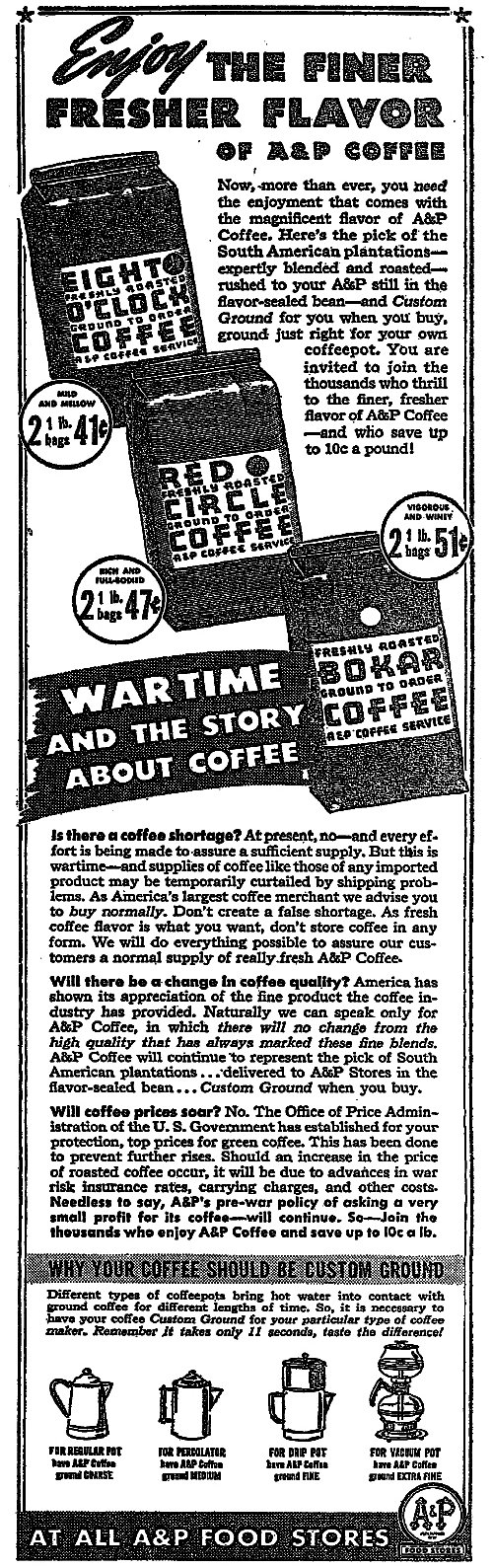
The third largest-selling brand of coffee in the US, Eight-O-Clock Coffee started out as A&P Food Store's house brand of light-roasted "breakfast" coffee in 1919, and was sold in A&P stores alongside their other original roasted blends "Red Circle" and "Bokar."  

Over the years, the "Eight O'Clock" brand came to encompass the rest of the A&P coffee lineup as a brand name as well as a type of roast.  In the early 1980's, A&P began licensing the coffee to be sold in other supermarkets - including their competitors.  Eight O'Clock has been owned by India's Tata Group since 2005.

I find it interesting that in recent years, almost every supermarket has added a custom grinder to their coffee aisle.  When I was a kid, A&P was the only store where you could get coffee ground to order - and every checkout aisle had a coffee grinder built in right by the cashier's station so the coffee could be freshly ground just before you left the store.  I wonder what happened to all those huge red grinders?  They were big, heavy, bullet-proof, and built to last a hundred years by the Hobart Company.  I'd love to have one in my kitchen, wouldn't you?

04 July, 2010

Vintage Sunday: Happy 4th of July!


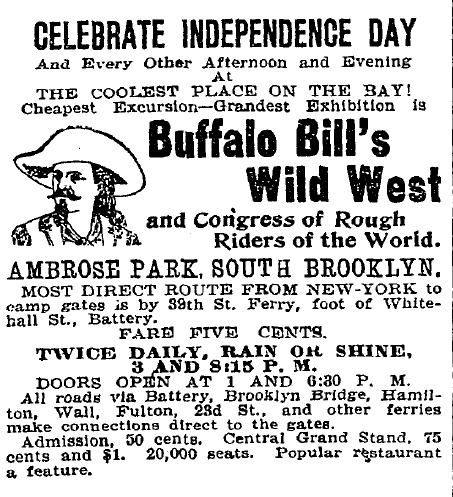
Unfortunately, we can't celebrate July 4th by going to see Buffalo Bill's Wild West and Congress of Rough Riders of the World, like New Yorkers could in 1894.  But there are plenty of fireworks displays and other activities available to us.  

.

27 June, 2010

Vintage Sunday: Antique and Vintage Cookbooks

Local cookbooks, published as fundraisers for churches, charities, and civic organizations, have a long and storied history.  I usually refer to them as "Ladies Aid Society cookbooks" because they were so often issued by the "Women's Auxiliary" or "Ladies Aid"  divisions of churches and lodges, back in the days when a woman's place was in the home and men were expected to do much of the directorial duties of the organization. Filled with the favorite recipes of their contributors, they are like culinary snapshots of the times in which they were published, and a study of them can be not only entertaining but quite revealing of trends in society as a whole.

For example, look at a series of Ladies Aid cookbooks from the 1920's to the 1980's, paying special attention to desserts.  You'll find that early cookbooks tended to contain a great number of different cake recipes and a few cookie (mostly bar cookie) recipes.  As time went on and women found themselves with outside interests, cake mixes from the supermarket became more prevalent because the preparation was easier and faster - and the results more consistent - than cakes baked from scratch.  Cake recipes in cookbooks have steadily dwindled since the 1950's.  Meanwhile, recipes for cookies - fast and relatively easy to make, delicious and totally more-ish to eat - have increased.  Betty Crocker saw it coming with The Betty Crocker Cooky Book, first published in the late 1950's and still so popular that the 1963 edition has recently been reissued after having been out of print for over 45 years!
Another trend you can easily pick up is the steady move toward more and better instructions.  19th and early 20th century American cookbooks assume that the reader has some measure of culinary skill already. Check out this recipe for "Loaf Cake Without Eggs" from the pictured L. W. Cook Book, printed in 1908 by Loyal Workers Society of the Advent Christian Church of Springfield MA:

One cup sugar; 2 tablespoons butter or other shortening; 1 cup sour or buttermilk; 1 scant teaspoon soda; 2 cups flour; 1 teaspoon cinnamon; 1/2 teaspoon cloves.  A little nutmeg and salt; 1 cup raisins.

That's it.  A housewife of the time would have no problem with this recipe at all; like her mother and grandmother before her, she learned her culinary skill first hand -  working side-by-side with her mother, her sisters, and perhaps her aunts -  from childhood.  She would know without being told that the butter and sugar would have to be creamed together before being mixed with the buttermilk; the dry ingredients sifted together in a bowl and then stirred together with the wet ingredients; the raisins folded in last.  She'd know how hot the oven would have to be, what size baking pan she would need, and how long the cake would need to bake. 
Antique and vintage local cookbooks are one of the main reasons why I haunt estate sales.  When an entire house is opened for an estate sale, the first place I head is the kitchen, to poke through drawers and the backs of kitchen bookshelves.  I can usually find a treasure or two, forsaken by the family or put aside long ago by the person whose estate is being liquidated. 

20 June, 2010

Vintage Sunday: Old Candies

Do you remember variety stores?  There used to be one up the street from me when I was a kid: Bob's Variety.  There's a tattoo parlor in the building now, but back in the day Bob's Variety was a destination store for neighborhood kids.  I guess that today a variety store would be pretty mundane to my jaded adult eyes, but back then Bob's was the retail equivalent of paradise.  Every Saturday I'd head there with my allowance to check out the latest comic books, get a chocolate malt at the fountain in back, and shop the seemingly limitless selection of candy.  I look at the building when I drive by today and shake my head at my memories - the building is so small, how could it possibly have been such a Valhalla of wonder and delight?

Some of the candies that were my favorites back then are still available today - both online and from brick-and-mortar stores.  Join me on a trip down memory lane:

Atomic Fire Ball by Ferrara Pan - Awesomely hot cinnamon-flavored jawbreakers.  I think this was the "gateway food" that first introduced me to spicy flavors.   Most of the time, when you first pop an Atomic Fire Ball into your mouth, you're met with punishing, eye-watering cinnamon candy heat (note that I said most of the time - I seem to recall that the candies varied some from piece to piece and we'd sometimes get a milder one that didn't hurt so much initially.)  That first layer would fade, and there would be a period where the flavor would be sweet and mildly flavored...and then, a little more than halfway through, there would be another burst of fire!  By the time that second wave had passed, the Fire Ball would me small, and we'd try to crush it with our molars.  Sometimes we succeeded.  Sometimes we felt like we were going to break a tooth.    These were absolutely my hands-down favorite, and they're still found just about everywhere - as well as being available online.
 
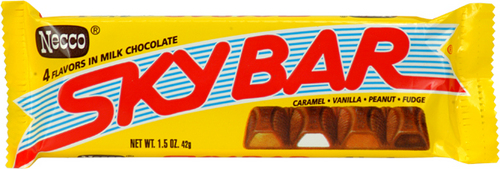
Sky Bar by NECCO - The label has changed a couple of times since I was a kid - the picture I have here is the current packaging - but the contents haven't changed a bit.  Decent-quality chocolate (somewhat better than Hershey's usual quality in fact) wrapped around four different fillings: caramel, vanilla, peanut, and chocolate fudge.  For a long time, you couldn't find these if you traveled too far from New England.  They have wider distribution these days, but can still be tough to locate if you're From Away.

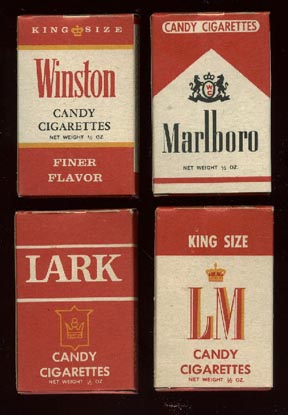
Candy Cigarettes - As you can see from the illustration here, candy cigarettes were sold in packaging remarkably similar to the real thing.  Cynics will believe - perhaps with some justification - that this was done deliberately to build brand loyalty  before kids were old enough to smoke.  However, we have to remember that back then, smoking wasn't the social leprosy that bluenoses have turned it into today.  Realistically-packaged candy smokes were intended to allow children to imitate Mom and Dad with more verité. I used to love candy cigarettes, but kinda lost interest in them when I started actually smoking (I've quit since then.)

I tried some candy cigarettes recently, just to see if they still tasted the same way they did when I was a kid.  I think they do, but the packages don't look anything like the real thing, and they don't call them "candy cigarettes" any more, they're called "candy stix."

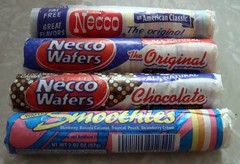
NECCO Wafers - I did a post about these awhile ago, but I'll mention them again for the sake of Vintage Sunday.  NECCO recently changed both the packaging and the flavoring in their wafers.  I liked the old flavors better, but the new flavors are "all natural" and I guess that makes parents feel somehow better about letting their kids eat rolls of compressed processed sugar.

Wax Lips, currently made by Concord Confections (a division of the Tootsie Roll Company) - I don't know of any kids who don't love fooling around with a pair of wax lips.  They're made of sweetened, flavored chewable wax.  When we were kids, we would wear them around for a while and when the novelty wore off we'd bite off hunks and chew them like gum.  I notice that most kids just throw them away when they get bored.  The same company also made Wax Moustaches, which were big black handlebar moustaches along the same lines as the Lips.

I've really only touched on a handful of the candies I loved as a kid and can still find even today.  I could write about them all day and still not manage to capture all of my old faves.  What are some of the canides from yesteryear you loved?

Links:

Ferrara Pan Candy Co. - Take their virtual tour and see how Atomic Fire Balls are made.  Tres cool.

NECCO - Information and online store.


13 June, 2010

Vintage Sunday: Switchel and Honegar

In the year of my 22nd summer, I suddenly became unemployed.  To keep some money coming in, I signed on with a temporary labor agency to tide me over until I could find another full-time job.  One of the jobs that was assigned was painting aircraft hangars at a local Air Force Reserve base.

It was hot work: summer in my part of New England can be pretty brutal, with temperatures and relative humidity levels both in the 90s.  I was on a rope scaffolding (similar to those used by window washers) in full sun.  I was miserably unprepared for the heat and by the time I was done for the day, I had broad white salt lines sweated into my T-shirt and I was weak from the heat. 

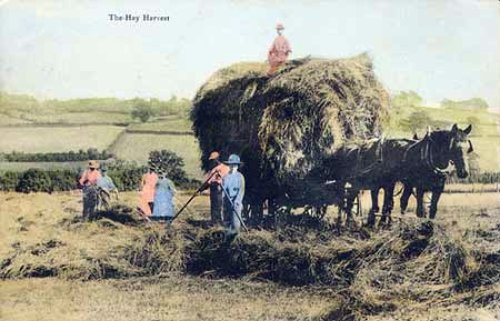
My grandmother had invited me for dinner that night, and when I told her about how hot and sapping it was on the scaffolds, she told me about "switchel," a drink her grandmother had prepared for her grandfather to drink in the fields during haying season.  She made up a gallon of it in a plastic milk jug, mixing half a cup or so of apple cider vinegar with about a cup of honey and water sufficient to fill the jug.  She finished it off by adding a couple of spoonfuls of grated ginger ("to settle your stomach when you get gorky in the sun," she said.)


The next day, I brought a "sweat towel" and the bottle of switchel with me to work.  The day was no less brutal for the heat and the humidity, but I was a lot more comfortable, being able to take a drink of the switchel every now and then when the sun became just too much for me to take.  The job lasted a week, and I had a gallon of switchel with me every day.  By the end of the day, some of the other guys working with me were bringing some of their own.  There just wasn't anything else like it.

Dr. Jarvis mixing a batch of honegar.
No discussion about switchel would be complete without mentioning Dr. Deforest Jarvis of Vermont, who in 1959 received some publicity for a switchel variant he called "honegar."  Dr. Jarvis mixed equal amounts of good apple cider vinegar with native Vermont honey.  He considered honegar to be a folk remedy for aches and pains and thought it was especially useful in treating arthritis pain.  Although honegar has a more or less permanent place in folk medicine today (just Google honegar to see how many people hold it in high regard) it has shown up on at least a couple of internet-published "worst inventions" lists - lists written, no doubt, by people who have probably never tasted either switchel or honegar.

Dr. Jarvis, an early-20th century country doctor, was inspired by the rugged health of so many of his patients: hard-working Vermont farmers who often used switchel to stay hydrated while working in the fields.  And despite the scribblings of various Internet wiseasses, Dr. Jarvis may have been onto something: not only did he live to be 85 years old, but modern medical research has begun to investigate some of his claims about apple cider vinegar.  Although I'm not tempted to take a straight spoonful of honegar, it does make a pretty decent base for a tall cool drink of switchel.

Trivia:  Dr. Jarvis died in Vermont in 1966.  After his death, the Shelburne Museum in Shelburne VT carefully dismantled his doctor's office and rebuilt it at the museum, where it is still on exhibit as an example of a Vermont country doctor's office.
.

06 June, 2010

Vintage Sunday: Meat for War

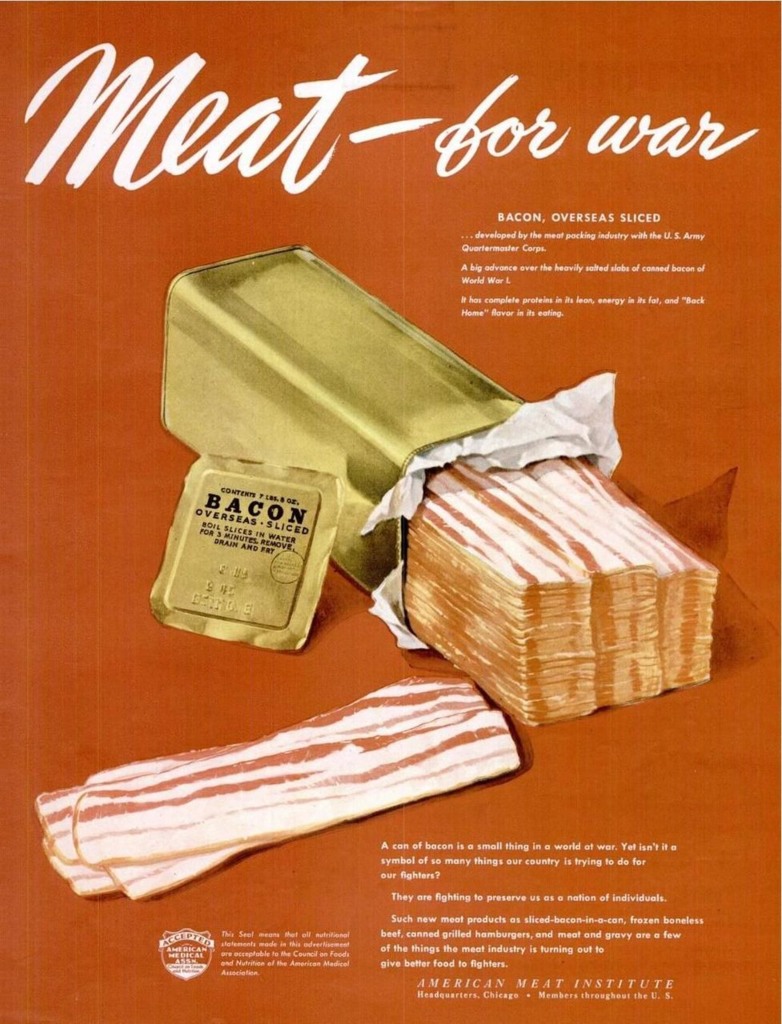
Click the picture to load the full-size scan.
I found this awesome WW2-era advertisement from the American Meat Institute on the web and thought it was worth sharing.  Enjoy.

.

30 May, 2010

Vintage Sunday: Hormel Chili Con Carne

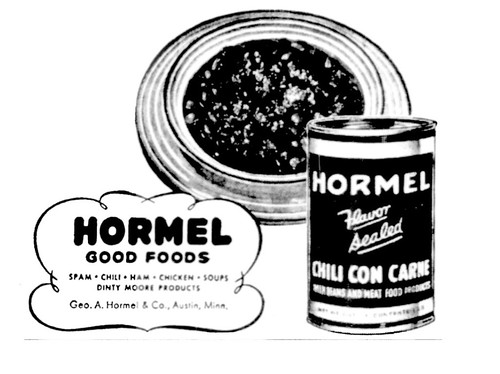
From a 1940 newspaper advertisement
I was poking around the internet t'other day and discovered that 2010 is the 75th anniversary of Hormel Chili Con Carne.  I love the original label, shown above in that vintage ad:  "Chili Con Carne With Beans and Meat Food Products."

Back in the day, Hormel's Chili Con Carne was highly esteemed; writer Richard Gehman in his 1966 book The Haphazard Gourmet refers to it as "excellent" and after giving his own personal recipe for chili, mentions that the homemade is "nowhere near the equal" of Hormel's.

Personally, I don't care for it very much, but hey, I'm not about to trash-talk a senior citizen on its birthday.  Happy 75th to Hormel Chili Con Carne!

Later edit - 31 May 2010 - It's come to my attention that Hormel has been sponsoring blog posts about the 75th anniversary of the introduction of their chili and their Dinty Moore line of prepared foods.  Please note that this is not a sponsored post.
.