10 September, 2008

The British One Hundred

Michele at Life, Lightly Salted brought a very interesting "One Hundred" list to my attention this morning: The British One Hundred, originally posted by Helen on her blog Food Stories. With it's narrow focus on British specialties, I found it to be an interesting study - and I was surprised at how many of the foods here I'd not only already tried, but that I actually have old family recipes for (mom's side of the family being from the UK.)

So, first the rules:
  1. Copy this list into your blog or journal, including these instructions.
  2. Bold all the items you’ve eaten.
  3. Cross out any items that you would never consider eating.
  4. Link back to Food Stories, if you would be so kind.
And on to the list (with commentary in some cases):

  1. Grey squirrel - Not only have I eaten grey squirrel, I have personally killed the ones I ate.
  2. Steak and kidney pie - I'm not all that fond of kidney, but I admit the pie was pretty good.
  3. Bubble and squeak
  4. Spotted dick - I've only had this canned (by Heinz, of course!) and I bought it because of the giggly name (which is, of course, sophmorically naughty in the US)
  5. Hot cross buns
  6. Laver bread
  7. Toad in the hole
  8. Shepherds pie - Only when made at home. For some reason, Americans can't fathom the difference between "shepherds pie" (made with lamb) and "cottage pie" (made with beef) and call them all "shepherds pie."
  9. Cottage pie - see above.
  10. Scotch egg
  11. Parkin
  12. Welsh rarebit
  13. Jellied eels I can scarcely imagine anything more wretchingly nasty than jellied eels. :: huarrf f::
  14. Stilton
  15. Marmite - I like Marmite, but I like Vegemite much better.
  16. Ploughman’s lunch
  17. Cucumber sandwiches - (yawn)
  18. Coronation chicken - Helen says, "now THIS is another reason why we have a bad rep," but this is just a rather dull variation on chicken salad.
  19. Gloucester old spot - If I had a larger yard, I'd try raising one or two, though.
  20. Cornish pasty
  21. Samphire
  22. Mince pies
  23. Winkles
  24. Salad cream - but I prefer mayonnaise.
  25. Malt loaf
  26. Haggis
  27. Beans on toast
  28. Cornish clotted cream tea
  29. Pickled egg
  30. Pork scratchings
  31. Pork pie
  32. Black pudding
  33. Patum Peperium or Gentleman’s relish - This list is the first I've ever heard of Gentleman's Relish, and now that I've looked it up and read about it, I MUST FIND SOME because it sounds to me awesomely delicious.
  34. Earl grey tea
  35. Elvers- Gaaaaah! Seriously, do eels really need two places on this list?? :: hurrrrk ::
  36. HP Sauce
  37. Potted shrimps
  38. Stinking bishop - I'll eat it if ever I find some.
  39. Elderflower cordial
  40. Pea and ham soup
  41. Aberdeen Angus Beef
  42. Lemon posset - Not yet, but I found a recipe for this and I plan to try it soon.
  43. Guinness - To all of you out there who are ravenous fans of Guinness: If ever we meet, I will happily buy you a pint to keep from having to drink it myself, but on the next round you agree to buy me a lager.
  44. Cumberland sausage
  45. Native oysters - Native to me, LOL. If I'm ever in the UK, I'll eat the native oysters there too.
  46. A ‘full English’ - just once. A New England "farmhouse breakfast" is very similar, though, and that's my family's favorite way to start a Saturday (and our only meal until supper that night!)
  47. Cockles
  48. Faggots - Anyone have a recipe for these? It's another thing I've never had that sounds delicious.
  49. Eccles cake
  50. Potted Cromer crab
  51. Trifle - My mother and my aunt discovered trifle in the mid-1980's and it instantly became their favorite dessert for the next fifteen years. I am so sick of trifle.
  52. Stargazy pie
  53. English mustard - No spice cupboard is complete without English mustard.
  54. Christmas pudding - Every Christmas, without fail, as long as I can remember. Thanks, mom!
  55. Cullen skink
  56. Liver and bacon with onions - One of my favorite meals when my wife and daughter are away; no one else in my family will eat liver and so when they are gone, I make this for supper and share it with my very appreciative dog.
  57. Wood pigeon
  58. Branston pickle
  59. Oxtail soup - another family favorite.
  60. Piccalilli
  61. Sorrel
  62. Chicken tikka masala
  63. Deep fried Mars Bar (eewww.)
  64. Fish, chips and mushy peas
  65. Pie and mash with liquor
  66. Roast beef and Yorkshire pudding (with gravy) - This was my grandmother's favorite Sunday dinner, and I don't fault her a bit for it.
  67. Pickled onions
  68. Cock-a-leekie soup
  69. Rabbit and Hare
  70. Bread sauce
  71. Cauliflower cheese - One of my daughter's favorite vegetable sides.
  72. Crumpets
  73. Rice pudding
  74. Bread and butter pudding
  75. Bakewell tart
  76. Kendall mint cake
  77. Summer pudding
  78. Lancashire hot pot
  79. Beef Wellington - Highly overrated.
  80. Eton mess - No, but Strawberry Shortcake is very similar.
  81. Neeps and tatties
  82. Pimms
  83. Scampi - Not the way in which Helen intends. Also, whenever I hear the word "scampi" I think of this.
  84. Mint sauce
  85. English strawberries and cream - I'm counting native strawberries and cream as equivalent.
  86. Isle of Wight garlic
  87. Mutton
  88. Deep fried whitebait with tartare sauce
  89. Angels on horseback
  90. Omelette Arnold Bennett
  91. Devilled kidneys
  92. Partridge and pheasant
  93. Stew and dumplings
  94. Arbroath smokies - I smoke my own trout, salmon, bluefish, etc. so I'm counting this; we're part of a universal brotherhood.
  95. Oyster loaves (but I wonder if we're referring to the same thing)
  96. Sloe gin
  97. Damson jam
  98. Soda bread
  99. Quince jelly
  100. Afternoon tea at the Ritz
So that's it - sixty-eight out of one hundred; I'll no doubt whittle down on a few more of them now that Helen and Michele have me interested. Alas, some of them - Afternoon tea at the Ritz, for example - may never be checked off the list.


09 September, 2008

Canning Stewed Tomatoes

Every year, Maryanne and I put in a garden. This year, we've had a lot of cloudy, rainy weather and the plants have been suffering for it. None of our pepper plants produced anything, for example, and our eggplants were overrun by some kind of grub that burrowed into the fruit and ruined most of them.

Our tomatoes struggled this year, too. We've had a great many tomatoes rot on the vines before being anywhere close to ripe, and now the plants are dying off almost a month early with greenies still clinging to them (conditions that are duplicated even on the commercial farms here in the Valley.)

Even with the less-than-ideal conditions, though, we're still loaded with a huge crop of tomatoes, because we always set enough plants to supply us with enough fruit to eat, can, and give away to our families. And as usual, almost all of the tomatoes have come ripe at the same time. When that happens, it's time to break out the jars and the canning kettles and get to work.

Throughout the fall and winter, our favorite meals are stews and soups that are often improved by a bit of tomato in the gravy or broth. We could simply buy cans of processed tomatoes, but homemade is much better and after all, we have a surplus right now that can be put up for later. Over the years, we've decided that stewed tomatoes fit our needs best of all.

Stewed Tomatoes

1 gallon tomatoes - peeled, cored, and chopped
1 cup chopped onion
1 cup chopped celery (including leaves if desired)
1 tablespoon salt
1/4 cup sugar

Place all ingredients in a heavy, non-reactive stockpot and bring to a simmer. Simmer 10 minutes, stirring occasionally.

Pack hot jars with prepared tomato mixture, leaving ½-inch headspace. Remove air bubbles from jars by slipping a knife along the inside of the jar. Wipe jar rims with a damp cloth or paper towel before capping. Process in a pressure canner: 15 minutes for pints, 20 minutes for quarts, at 10 pounds pressure.

Notes:
  1. You can vary the flavor of these tomatoes by adding herbs - for example, putting a few fresh basil leaves at the bottom of a jar before filling them gives the finished product a delicious flavor.
  2. Add a cup of chopped red or green peppers to the batch for more variety.
  3. To make spicy stewed tomatoes, drop a couple hot peppers into the bottom of each jar before filling.
  4. You may leave out the sugar if you like, but the small amount in this recipe enhances the natural flavor of the tomatoes and is not noticeable as a "sweet" flavor in the overall batch.


08 September, 2008

How to Peel Tomatoes

Tomatoes are delicious, but I really hate tomato peels. In soups and stews, chopped tomatoes shed their little bits of skin, which roll up tight and make irritating twigs. They get in the way of smooth sauces, and they separate annoyingly in canned tomatoes.

That's why I take the skins off of tomatoes before I cook with them and before I can them. It only takes a few minutes, and it's really easy:


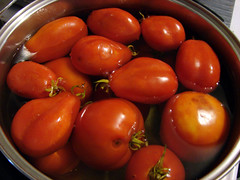
Fill a saucepan or Dutch oven halfway with water, and bring the water to a full rolling boil. When the water is boiling, dump in some tomatoes. Stir them genly for a few seconds - you only need to have them in the water for about 15 seconds or so. Then, use a large slotted spoon to remove them from the hot water and put them in a colander.


Run cold water over the tomatoes for a moment to stop residual heat from cooking the tomatoes.


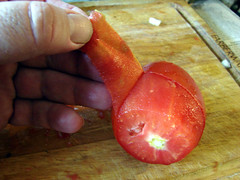
The skins will easily peel off the tomatoes.


This method will work for removing the skin of almost any soft fruit (peaches, plums, nectarines, kiwi, peppers, tomatoes, and more.) Compost the skins or feed them to your chickens.

Tomorrow: Canning Stewed Tomatoes

.

07 September, 2008

Minute Maid Soft Frozen Lemonade

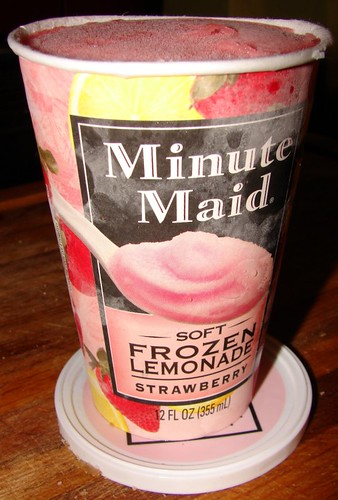
Have you ever had something that was really delicious and that you really liked at first, but there was so much of it that it got kind of disgusting by the end? That pretty much sums up Minute Maid Soft Frozen Lemonade in the 12-ounce cup shown here.

It was hot, and I was in the dollar store buying Italian Ices. The Dollar Tree near me sells 4-packs of Luigi's Italian Ice for a dollar (25 cents per cup) which is a much better deal than the local supermarkets ' price of $3.00 for a 6-pack (50 cents per cup.) Right next to the Italian ice, there were a bunch of these Minute Maid Soft Frozen Lemonade treats, in strawberry and straight lemon. I'd never had them before, so I bought a few.

The first spoonful was delicious. Good, tart, strawberry-accented lemonade flavor that tasted like real lemons. And sweet.

The second spoonful was delicious. But sweet. Really sweet.

I was about four ounces in when the cloying, overpowereing, tooth-cracking sweetness just got to me. Euurgh. I didn't want another bite. What I really wanted was a good sour dill pickle to reset my tastebuds. I put the cap back on the cup and put it back in the freezer and left a note for my wife and daughter to give it a try and let me know what they thought.

My wife shuddered at her first taste and never went back to it. My daughter, however, found it enjoyable in small doses; she finished off the cup over a period of two or three nights, eating some for dessert each night and returning the unfinished portion to the freezer each time. We pretty much agreed that the actual product was good in small doses, but a 12-ounce portion was just too much.

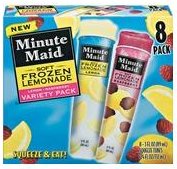
Apparently, someone at Minute Maid must have been thinking the same thing. When I went to Minute Maid's website to check the Nutrition Facts, I found that the splash page for the Soft Frozen Lemonade announces that it's "experienced a makeover" and is now available in eight-packs of 3-ounce squeeze tubes - with no mention of the larger cups at all. The three-ounce size is definitely a more manageable snack.

HFCS ALERT: These things are loaded with high fructose corn syrup.

Link: Minute Maid's website.

06 September, 2008

Greek Yogurt CAGE MATCH!

My daughter Lynn has loved Greek-style yogurt for awhile now, ever since she discovered the Fage brand in a local natural-foods supermarket. Back then, it was the only Greek yogurt on the shelves, and Fage's US branch was an import business as they built brand identity among American consumers.

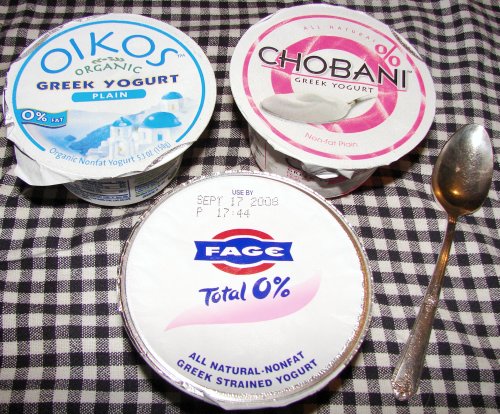
Fage has had enormous success here, and now makes yogurt for the US market in a shiny new facility in upstate New York - and along with their success has come competition. Lynn, along with my wife Maryanne, has tried other Greek yogurts - always coming back to Fage as her favorite. There are three widely-available Greek yogurts in our local supermarkets, so we decided to give them a head-to-head comparison test.

Note: This was not a "blind taste test" to determine which Greek yogurt is "best." This was a tasting to compare and contrast flavors and textures between the three, to explain why we like the ones we do, and to give you an idea of what to expect when you shop for a Greek yogurt.

To give a fair comparison, we needed identical types of yogurt. We chose plain non-fat (0% fat) yogurt for the tasting because that was the only style common to all three brands on the shelf at the supermarket.


Fage
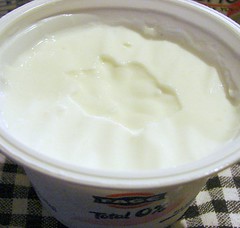
Total 0% - Thick, smooth, and rich-tasting despite being a fat-free yogurt, Fage's texture is almost pudding-like. It's very milky-tasting with a strong yogurt taste. Characteristically sharp but not overly acidic, Fage's Greek yogurt is an excellent choice for snacks with jam or fruit stirred in, and it's thick enough to use as a substitute for sour cream in dips or dressings. This was our favorite of the three.

Link:
Fage's American website.


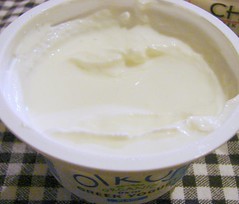
Oikos Organic Greek Yogurt - Thinner than Fage, with a consistency much closer to regular yogurt. Mild-tasting with subtle sour milk notes, Oikos is a good choice if you enjoy more standard commercial yogurts but want something with a little more body. Blends well with flavored syrups and jams.

Careful attention to the Oikos label will reveal that it is made by Stonyfield Farm, a big name in the yogurt business. When I visited Oikos' website, I found that the yogurt is made "in partnership" with Euphrates Inc., a business specializing in feta cheese and Greek yogurt production which also makes Chobani Greek yogurt, the other brand in this test (more about Euphrates and Chobani in a moment.)

Links:
Oikos Organic Greek Yogurt website.
Stonyfield Farm website.


Chobani Greek Yogurt - Very thick but with a coarser texture than the Fage, this brand also had the sharpest taste of the three. Aggressive yogurt flavor with a pronounced vinegary sourness; Chobani practically begs to be mixed with something to cut it's overpowering acidity. Though it was my daughter's least favorite brand, my wife likes Chobani with a couple spoonfuls of fruit jam or honey stirred in.

Chobani's story is interesting - it's made by Agro-Farma Inc. in New York state. Although the name sounds like it belongs to a huge factory-farming conglomerate, it's actually a small company closely tied to Euphrates Inc., a large New York State maker of feta cheese which established itself as an important supplier of high-quality feta to the food-service industry before turning it's eye on the consumer market. Euphrates got it's start in 1998 when a third-generation European cheesemaker decided that it would be more advantageous to start operations in the US than to try to import his family's product into the country. In 2005, Euphrates purchased a former yogurt-processing plant from Kraft and began production of Greek yogurt there. Today, they produce Chobani Greek yogurt, and as related above, also make Oikos Organic Yogurt in partnership with Stonyfield Farms.

Links:
Chobani Greek Yogurt's website (this is also Agro-Farma's website.)
Euphrates Inc. website
Euphrates focuses on top-notch Feta - an article from the 17 March 2006 issue of Retail Watch, a digest for cheese marketers.


Special thanks go to snackgirl, author of Second Rate Snacks, one of my new favorite blogs. I don't ordinarily do head-to-head comparisons of foods, but her format inspired me. Yogurt comparison was one of the suggestions in a comment on her blog and it seemed like a natural for my wife and daughter to help with because they each eat a dose of yogurt every single day. I hope that snackgirl takes the time to do a comparison also - I'd love to compare her impressions with ours. Now click on the link up there to her blog. You'll enjoy it (link will open in a new tab or window depending on your browser.)

05 September, 2008

Wendy's Baconator

I was a big fan of Wendy's Spicy Baconator: pepper Jack cheese, chipotle sauce, pickled jalapeño slices - a nice hot kick, but not really a big burn unless you were a total pepper wuss. The standard Baconator - a double bacon cheeseburger with six strips of bacon - isn't even in the same league.

Unfortunately, the spicy version's been discontinued, which has led to some confusion among my friends who read my original blog entry about it. Some of them have gone to Wendy's, gotten the regular version, and then said to me, "What's with you and the Baconator? It's just a bacon cheeseburger."

This is what's with me and the Baconator: Nothing. I wrote about the Spicy Baconator, and the two are not the same. They're not even comparable. But in the interest of seeing just what the deal is with the Baconator, I stopped into the local Wendy's and got one. They sure look good in that picture there, don't they? (That picture is from a Wendy's press release.)

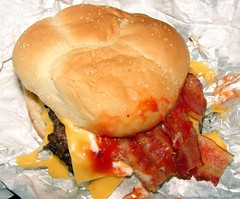
He's what I actually got. Yeah, I know it's an old joke about how fast food never looks as good as the picture on the menu, but still. This thing looks like it was put together by throwing the pieces across the room.

The burgers were fairly typical Wendy's square patties, done just on the pink side of medium well, with the standard fast-food orange cheese slices. There were six slices of bacon, but if I wanted to really nit-pick, the slices are half the size of the ones you fry at home, so you're not fooling anyone, Wendy.

I took the burger apart and re-stacked it to make it a little less disgusting to eat. It was amazingly average - nothing about the Baconator stands out as any better than any competing product. In fact, if it were a head-to-head against a sandwich like the Burger King bacon double cheeseburger, I'd go with the BK version. Yes, there's less bacon on it, but the patties are flame broiled, and that's worth many points over a griddle-fried burger any day of the week.


04 September, 2008

Tender Delicious Dumplings

I love dumplings. Tender little pillowy clouds of dough floating on simmering gravy...what's not to like?

There seems to be two kinds of dumplings in American cooking - rolled dumplings, and drop dumplings. My mom always made the drop kind, so I do, too. Some people think that drop dumplings are heavier and denser than rolled dumplings, but if they can be light and fluffy if you don't mix the batter too much and if you give it time to rest before you drop the batter into the gravy. Here's the recipe I've been using for 30 years:

Fluffy Dumplings

1 cup all-purpose flour
1 tablespoon baking powder
1 teaspoon salt
½ cup milk
2 tablespoons light salad oil

Stir dry ingredients together well with a fork or a whisk. Combine milk and oil, and pour all at once into the flour mixture. Stir briskly with a fork until the mixture is evenly moistened, but don't overmix it. The batter should be sticky, slightly wet, and almost as thick as dough.

Set the dumpling mix aside for ten minutes. Then, scoop out spoon-sized lumps and drop them atop simmering stew. Cover the pot and allow to slowly simmer for 15 minutes. Don't lift the lid and peek at all or the dumplings won't rise! (I cover my pot with a glass lid so I won't be tempted to peek. Lifting the lid really does ruin the dumplings.) makes 8 to 10 dumplings, depending on the size of your scoops.

Some tips:
  1. If the batter is too thick, sprinkle in a little more milk or some water to make it very soft and sticky.
  2. Letting the dumpling mix sit for ten minutes is the secret to extra-fluffy dumplings. During that ten minutes, the baking powder starts to work and makes the dumpling mix start to rise. When you scoop out the batter to drop into the stew, you'll see all the air holes where the baking powder has been working. In the heat of the stew, the baking powder goes into overdrive and really makes the dumplings rise into fluffy, floury puffs.
  3. My recipe is based on the one given in the 1967 edition of the Better Homes and Gardens Cookbook (the Chicken and Dumplings recipe is where you'll find it.) The original is horribly bland. This version is still kind of bland, too. If you're not watching your sodium intake, you can add about half a teaspoon of your favorite seasoning salt in addition to the teaspoon of salt included to make them taste better. When I make these for chicken, I like to add half a teaspoon or so of Bell's Seasoning (my favorite brand of poultry seasoning.)
  4. Don't peek when they're cooking! It's the steam and the simmer from the stew that makes them turn out so wonderful. That's why I use a glass cover on the pot - so I don't even get tempted to look.


03 September, 2008

Exploring the Dollar Store

Good deals and bad deals at Dollar Tree this week:


Junior Bear Honey Flavored Syrup. This is corn syrup, high fructose corn syrup, and a touch of honey for flavor and color. Note the clever packaging - a bear-shaped plastic bottle with a yellow cap, closely resembling the way some genuine honeys are sold in supermarkets. The honey pot picture on the label reinforces the similarities for the unwary shopper.

Bad deal.


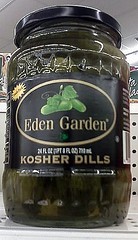
Eden Garden Kosher Dills. Good flavor, nice and crunchy, high-quality pickles made with smallish cucumbers (kind of like "baby dills.") 24 ounces for $1.00 means these are half the price of supermarket Vlasic pickles. Check the label, though - Eden Garden dills are packed in India and imported to the US. (India is one of the largest exporters of pickled cucumbers and many American companies outsource their pickle production to them.)


Good deal.


Utz Snacks
- Just as fresh as the ones in the supermarket, with a huge variety of chip flavors and snack foods, Dollar Tree devotes an entire aisle just to Utz. Tags printed on the bags are all in the $1.59 to $1.79 range, so you always save at least 35% over standard supermarket or convenience store pricing. They only carry the 5-ounce size though, so that's the downside.


Good Deal.


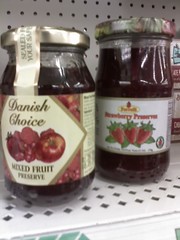
Jams and Jellies - They look like generics, with their unfamiliar and sometimes no-nonsense labels, but take a close look at the ingredients and you'll be pleasantly surprised. Fruit, sugar, pectin, perhaps some citric acid (lemon juice) and that's it. No fillers, no cheap apple juice, and - most importantly for me - no high-fructose corn syrup.

The Danish Choice Mixed Fruit Preserves are a blend of a variety of summer berries and apples and is one of the best-tasting preserves I've ever had. The Furelli Strawberry Preserves are all strawberries with sugar and a touch of pectin, just like you'd make at home. Both of them are every bit the equal of any gourmet-shop jam you'd spend $4.00 or more to buy, except these are just one dollar each.

Very good deal.


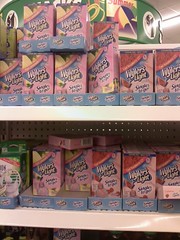
Wyler's Light Singles To Go (8 count) - Both these and Hawaiian Punch singles were in the section; these are very convenient as well as delicious. In the supermarket you'd pay $2 to $3 for each 8-count box.

Good Deal.


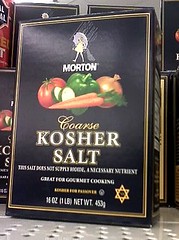
Morton Coarse Kosher Salt, 1 pound
- In the supermarket, you can get a three-pound box of Morton Kosher salt or a four-pound box of Diamond Kosher salt for a little over $2.00 making this item a poor purchase. Similarly, a single-pound bag of sugar at Dollar Tree is almost twice as expensive as buying a generic five-pound bag of sugar at the supermarket.

Bad Deal.

02 September, 2008

The Pork King

Someday I will find my way to the throne room of the Pork King, and I will stride boldly through the court and place my sword at his feet, and swear fealty to him. And we will celebrate by roasting sausages and feasting upon bacon.

And truly, it will be as though I had entered smoky, delicious Valhalla.

.

01 September, 2008

Labor Day and Lobsters!

Today is Labor Day in the US, a Monday holiday which is traditionally thought of by Americans as the holiday marking the "end" of Summer. Tourism drops off, the kids go back to school after the long summer recess, and many of us start doing chores that prepare for the coming winter.

And here in Southern New England, it's time for lobsters, because a home-cooked lobster dinner is just as traditional a Labor Day Weekend meal here as grilling steaks. And this year, with lobster prices as low as they've been in five years or so, bugs are flying out of supermarket and fishmonger tanks and into kitchens all over the area. (Yesterday, one of my local supermarkets sold out of lobsters - 1500 pounds of them - in four hours.)

Here at Chez Dave, we enjoyed our stereotypical "lobsterbake" of bugs, steamers, potatoes, and fresh corn on the cob yesterday. Although some people think that preparing lobster at home is difficult and time-consuming, if you have a very large pot - like a common blue-enamel canning kettle - a one-pot lobster dinner is simple to prepare and won't leave you with a sink full of pots and pans.

  1. Set the kettle on the stove; it gets heavy when it's full, and this way it will be all set to go when you fill it up.
  2. Put a rack in the bottom of the pan. Something like you'd cool cookies on, and as large as you have that still fits in the kettle. Round is ideal, but whatever fits.
  3. Line the rack with seaweed if you have any. If you don't have any, just skip this step. (If you live on the shore in New England, you've probably had experience gathering seaweed along the water to put in the pot with your lobsters. If you're not close to the beach, you can sometimes get some seaweed from your lobster dealer, because lobsters are often packed with seaweed for shipping. Keeps them from getting homesick or something.)
  4. The bottom layer of food should be small potatoes. New potatoes are okay, but you might want something just a little bigger so they don't get overcooked. I've found that small round Eastern spuds about 3 to 4 inches in diameter work best.
  5. The next layer is corn. Leave the corn in the husk, just trim off the hanging cornsilk and the brown tips of the leaves, and break off any excess stalk on the ends, then place the corn on top of the potatoes.
  6. Pour in water sufficient to cover the potatoes and come up a bit on the corn. You need four or five inches of water in there.
  7. Next, arrange the lobsters on top of the corn. Your lobsters should be alive and wriggling, but if you've just got them from the store they'll be feisty as hell. Fold their tails under and try to get their claws arranged under their faces if you can, and just keep putting them in layers until you're done. A canning kettle can usually hold three or four average chicken lobsters (those are 1¼-pounders) per layer.
  8. Scrub the clams under cool running water to remove any grit, and when they're all clean, dump them on top of the lobsters.
  9. Cover the kettle and turn the heat on high. Watch it for boiling. When it starts boiling hard, start timing. As soon as the clams open (about ten minutes,) they're done and you can remove them with a wide, slotted spoon, but optionally you can leave them in until everything's ready - about twenty minutes.
  10. Arrange the lobsters in a circle on a deep platter and pile the clams in the center. Serve the corn and potatoes right out of the kettle or put them on serving dishes as well. Serve with melted butter and put a roll of paper towels on the table so everyone has plenty of rugged, absorbent napkins!